

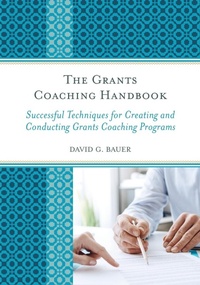
The Grants Coaching Handbook
Successful Techniques for Creating and Conducting Grants Coaching Programs
Published on 16. March 2017
Book
Paperback/Softback
150 pages
978-1-4758-3565-6 (ISBN)
Description
If you want to help your grant seekers achieve up to 50% success rates and move your grants program to new heights in an ever competitive market do not teach them grant/proposal development. Do not mentor them. Coach them to success.
Whether you are a research administrator, a current grants consultant, or a professional wanting to build a grants consulting business, grants coaching is the key.
This book will teach you how to couple proactive grant strategies with a consistent and reinforced plan that will guide your coachees through the proposal development process. It will provide you with everything you need to develop, implement, and evaluate a grants coaching program. Once you become involved in grants coaching you will never again rely solely on grants seminars to increase grants success because you will be amazed by the results achieved by your individualized grants coaching program.
Whether you are a research administrator, a current grants consultant, or a professional wanting to build a grants consulting business, grants coaching is the key.
This book will teach you how to couple proactive grant strategies with a consistent and reinforced plan that will guide your coachees through the proposal development process. It will provide you with everything you need to develop, implement, and evaluate a grants coaching program. Once you become involved in grants coaching you will never again rely solely on grants seminars to increase grants success because you will be amazed by the results achieved by your individualized grants coaching program.
Reviews / Votes
The CRADLE (Creative Research Activities Development and Enrichment) program offers our faculty a comprehensive professional development opportunity. Four of the graduates of this program have received NSF CAREER awards in 4 consecutive years. In the previous 20 years we only received two. By far the most popular aspect of the CRADLE program is the one-on-one meetings. The faculty appreciate the accountability as well as the guidance from David Bauer." -- S. Bruce King, associate provost for research, Wake Forest University This book is long overdue. I have watched David Bauer develop the grant coaching approach over the last 20 years and have witnessed wits effectiveness personally. Several of my publications have documented the gains faculty received as a result of their participation in a grant coaching program. My only regret is that I did not have an opportunity to experience grant coaching early in my own academic career. -- James E. McLean, PhD, executive director and research professor emeritus, Center for Community-Based Partnerships, The University of AlabamaMore details
Language
English
Place of publication
United States
Publishing group
Bloomsbury Publishing Plc
Target group
Professional and scholarly
Illustrations
56 b/w illustrations
Dimensions
Height: 254 mm
Width: 178 mm
Thickness: 8 mm
Weight
297 gr
ISBN-13
978-1-4758-3565-6 (9781475835656)
Copyright in bibliographic data and cover images is held by Nielsen Book Services Limited or by the publishers or by their respective licensors: all rights reserved.
Schweitzer Classification
Other editions
Additional editions
David G. Bauer
The Grants Coaching Handbook
Successful Techniques for Creating and Conducting Grants Coaching Programs
E-Book
03/2017
1st Edition
Rowman & Littlefield Publishers
€33.49
Available for download
Person
David G. Bauer,one of the most highly sought after speakers on grant seeking, is president of David G. Bauer Associates, Inc. a consulting firm created in 1981 to provide educationally based grant seeking and fund raising seminars and materials. Bauer, a grants expert and lively lecturer, has taught more than 35,000 individuals effective grant seeking and fund raising techniques and has facilitated successful grants coaching programs at several universities including the University of Alabama, Wake Forest University, University of North Carolina Greensboro, Marquette University, State University of New York at Cortland, and Western Michigan State University.
Content
List of Exhibits
Preface
Introduction
Part 1: The Grants Coaching Program
Chapter 1: Goals, Objectives, and Benefits
Chapter 2: Proactive Grant Seeking: The Foundation for an Effective Grants Coaching Program
Chapter 3: Target Population
Chapter 4: Program Outlines, Participant Incentives, Requirements/Benchmarks
Chapter 5: Educational Components
Chapter 6: Estimating the Costs Associated with Your Unique Grants Coaching Program
Part II: The Grants Coach
Chapter 7: Grants Coaching Basics
Chapter 8: The Role of the Grants Coach
Chapter 9: Helping Coachees Develop their Career Grants/Research Plans
Chapter 10: Getting Coachees to Focus on the Problem and Measure the Gap
Chapter 11: Assisting Coachees in Developing Advocacy Plans, Consortia, and Teams
Chapter 12: Encouraging Coachees to Develop and Maintain Research/Grant Profiles
Chapter 13: Showing Coachees How to Analyze Federal Grantors to Find the Best Match for their Research/Projects
Chapter 14: Assisting Coachees in Contacting Federal Program Officers
Chapter 15: Guiding Coachees through the Federal Proposal Development Process
Chapter 16: The Coach's Role in Improving Federal Proposals
Chapter 17: The Coach's Role in the Proposal Submission and Follow-Up Processes
Chapter 18: Guiding Coachees through the Private Proposal Development Process
Chapter 19: Integrating the Institution's/Organization's Grants Administration Staff into Your Grants Coaching Program
Chapter 20: Evaluating and Improving Your Grants Coaching Program
Index
About the Author
Preface
Introduction
Part 1: The Grants Coaching Program
Chapter 1: Goals, Objectives, and Benefits
Chapter 2: Proactive Grant Seeking: The Foundation for an Effective Grants Coaching Program
Chapter 3: Target Population
Chapter 4: Program Outlines, Participant Incentives, Requirements/Benchmarks
Chapter 5: Educational Components
Chapter 6: Estimating the Costs Associated with Your Unique Grants Coaching Program
Part II: The Grants Coach
Chapter 7: Grants Coaching Basics
Chapter 8: The Role of the Grants Coach
Chapter 9: Helping Coachees Develop their Career Grants/Research Plans
Chapter 10: Getting Coachees to Focus on the Problem and Measure the Gap
Chapter 11: Assisting Coachees in Developing Advocacy Plans, Consortia, and Teams
Chapter 12: Encouraging Coachees to Develop and Maintain Research/Grant Profiles
Chapter 13: Showing Coachees How to Analyze Federal Grantors to Find the Best Match for their Research/Projects
Chapter 14: Assisting Coachees in Contacting Federal Program Officers
Chapter 15: Guiding Coachees through the Federal Proposal Development Process
Chapter 16: The Coach's Role in Improving Federal Proposals
Chapter 17: The Coach's Role in the Proposal Submission and Follow-Up Processes
Chapter 18: Guiding Coachees through the Private Proposal Development Process
Chapter 19: Integrating the Institution's/Organization's Grants Administration Staff into Your Grants Coaching Program
Chapter 20: Evaluating and Improving Your Grants Coaching Program
Index
About the Author