

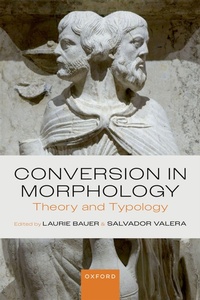
Conversion in Morphology
Theory and Typology
Will be published approx. on 31. March 2026
Book
Hardback
336 pages
978-0-19-894397-6 (ISBN)
Description
This book provides a detailed account of morphological conversion-also known by various other names, including zero-derivation- a process whereby a word is turned into a distinct but semantically and/or grammatically related word without any change of form. Following an introductory chapter that offers an overview of morphological conversion and the main questions of interest, the volume is divided into two parts. In the first, contributors consider a range of issues relating to conversion, such as word classes, inflection, figurative language, and directionality. The chapters in the second part explore specific typological aspects of the process of conversion in a wide range of language families, including Austronesian, Dravidian, Indo-European, and Tupian. The volume offers new perspectives on conversion, moving beyond traditional Anglocentric approaches that have dominated the field to date.
More details
Language
English
Place of publication
Oxford
United Kingdom
Target group
Professional and scholarly
Product notice
sewn/stitched
Cloth over boards
With dust jacket
Dimensions
Height: 236 mm
Width: 164 mm
Thickness: 31 mm
Weight
698 gr
ISBN-13
978-0-19-894397-6 (9780198943976)
Copyright in bibliographic data and cover images is held by Nielsen Book Services Limited or by the publishers or by their respective licensors: all rights reserved.
Schweitzer Classification
Persons
Laurie Bauer FRSNZ is Emeritus Professor at Victoria University of Wellington. He has published extensively on morphology, particularly on word formation, and in a number of related areas, such as the description of varieties of English, phonetics, phonology, and the recent history of the English. He is the co-author, with Rochelle Lieber and Ingo Plag, of The Oxford Reference Guide to English Morphology (OUP, 2013), which won the Leonard Bloomfield Award in 2015.
Salvador Valera is Associate Professor at the University of Granada. His research focuses primarily on morphology, especially on conversion and related areas of lexical semantics, and also on syntax. His work has been published in leading journals, and in edited volumes published by Oxford University Press, Cambridge University Press, de Gruyter, John Benjamins, and Routledge.
Salvador Valera is Associate Professor at the University of Granada. His research focuses primarily on morphology, especially on conversion and related areas of lexical semantics, and also on syntax. His work has been published in leading journals, and in edited volumes published by Oxford University Press, Cambridge University Press, de Gruyter, John Benjamins, and Routledge.
Content
1: Laurie Bauer and Salvador Valera: Conversion: The core issues
Part I. Theoretical issues
2: Antonio Fabregas: The analysis of conversion: Historiography
3: John Mansfield: Word classes
4: Anna M. Thornton: Conversion and inflection
5: Alexandra Soares Rodrigues: Conversion and other word-formation processes
6: Gianina Iordachioaia: The position of conversion in word-formation
7: Bozena Cetnarowska: Conversion and coercion
8: Heike Baeskow: The semantics of conversion
9: Reka Benczes and Lilla Petronella Szabo: Conversion and figurative language
10: Gergana Popova: Directionality
Part II. Description and typology
11: Akiko Nagano: Japonic: Japanese
12: Livio Gaeta: Indo-European: Germanic and Romance
13: Magda Sevcikova and Jurgis Pakerys: Indo-European: Slavic and Baltic
14: Daniel Kaufman, Nathan Adamson, Victoria Chen, Bradley McDonnell, and Olivia Waring: Austronesian: Tagalog and Indonesian
15: Wolf Dietrich: Tupian: Guarani
16: Olga Lovick: Dene: Upper Tanana
17: Giorgio Francesco Arcodia: Sino-Tibetan: Chinese (Mandarin/Cantonese)
18: Laszlo Palagyi: Uralic: Hungarian
19: Ora (Rodrigue) Schwarzwald: Semitic: Hebrew
20: Pingali Sailaja: Dravidian: Telugu
21: Xabier Artiagoitia: Basque
Laurie Bauer: Conclusion and retrospective
Part I. Theoretical issues
2: Antonio Fabregas: The analysis of conversion: Historiography
3: John Mansfield: Word classes
4: Anna M. Thornton: Conversion and inflection
5: Alexandra Soares Rodrigues: Conversion and other word-formation processes
6: Gianina Iordachioaia: The position of conversion in word-formation
7: Bozena Cetnarowska: Conversion and coercion
8: Heike Baeskow: The semantics of conversion
9: Reka Benczes and Lilla Petronella Szabo: Conversion and figurative language
10: Gergana Popova: Directionality
Part II. Description and typology
11: Akiko Nagano: Japonic: Japanese
12: Livio Gaeta: Indo-European: Germanic and Romance
13: Magda Sevcikova and Jurgis Pakerys: Indo-European: Slavic and Baltic
14: Daniel Kaufman, Nathan Adamson, Victoria Chen, Bradley McDonnell, and Olivia Waring: Austronesian: Tagalog and Indonesian
15: Wolf Dietrich: Tupian: Guarani
16: Olga Lovick: Dene: Upper Tanana
17: Giorgio Francesco Arcodia: Sino-Tibetan: Chinese (Mandarin/Cantonese)
18: Laszlo Palagyi: Uralic: Hungarian
19: Ora (Rodrigue) Schwarzwald: Semitic: Hebrew
20: Pingali Sailaja: Dravidian: Telugu
21: Xabier Artiagoitia: Basque
Laurie Bauer: Conclusion and retrospective