

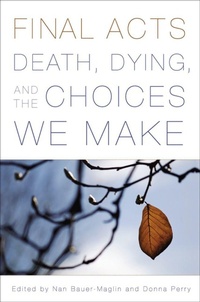
Final Acts
Death, Dying, and the Choices We Make
Will be published approx. on 7. December 2009
Book
Paperback/Softback
344 pages
978-0-8135-4628-5 (ISBN)
Description
Today most people die gradually, from incremental illnesses, rather than from the heart attacks or fast-moving diseases that killed earlier generations. Given this new reality, the essays in Final Acts explore how we can make informed and caring end-of-life choices for ourselves and for those we loveuand what can happen without such planning.Contributors include patients, caretakers, physicians, journalists, lawyers, social workers, educators, hospital administrators, academics, psychologists, and a poet, and among them are ethicists, religious believers, and nonbelievers. Some write moving, personal accounts of "good" or 'bad" deaths; others examine the ethical, social, and political implications of slow dying. Essays consider death from natural causes, suicide, and aid-in-dying (assisted suicide).
Writing in a style free of technical jargon, the contributors discuss documents that should be prepared (health proxy, do-not-resuscitate order, living will, power of attorney); decision-making (over medical interventions, life support, hospice and palliative care, aid-in-dying, treatment location, speaking for those who can no longer express their will); and the roles played by religion, custom, family, friends, caretakers, money, the medical establishment, and the government.
For those who yearn for some measure of control over death, the essayists in Final Acts, from very different backgrounds and with different personal and professional experiences around death and dying, offer insight and hope.
Writing in a style free of technical jargon, the contributors discuss documents that should be prepared (health proxy, do-not-resuscitate order, living will, power of attorney); decision-making (over medical interventions, life support, hospice and palliative care, aid-in-dying, treatment location, speaking for those who can no longer express their will); and the roles played by religion, custom, family, friends, caretakers, money, the medical establishment, and the government.
For those who yearn for some measure of control over death, the essayists in Final Acts, from very different backgrounds and with different personal and professional experiences around death and dying, offer insight and hope.
Reviews / Votes
"Final Acts provides the reader with persuasive and enlightening views on the controversial complex issues that are illustrated in the personal stories. It is a collection of moving stories and compelling essays."(The Gerontologist) "If there's one profound lesson to be learned from Final Acts, it is that most of us are woefully uninformed and unprepared to make wise end-of-life choices. A good place to begin is by reading this book." - Eleanor Foa Dienstag (Transition Network Newsletter) "The essays in Final Acts offer all manner of paths, exploring a new relationship with death. Wise and gentle guides, Bauer-Maglin and Perry reveal meaning and purpose in the journey." - Barbara Coombs Lee (President, Compassion & Choices) "An insightful, complex, and pragmatic 'how-to' guide for dying in the Western world. Final Acts a is strong, well-composed, and balanced tool kit to help us all not only change our system to better maintain the integrity of the dying, but to enter into the end of life with confidence and control." (Global Action on Aging) "Final Acts provides the reader with persuasive and enlightening views on the controversial complex issues that are illustrated in the personal stories. It is a collection of moving stories and compelling essays."
(The Gerontologist) "If there's one profound lesson to be learned from Final Acts, it is that most of us are woefully uninformed and unprepared to make wise end-of-life choices. A good place to begin is by reading this book." - Eleanor Foa Dienstag (Transition Network Newsletter) "The essays in Final Acts offer all manner of paths, exploring a new relationship with death. Wise and gentle guides, Bauer-Maglin and Perry reveal meaning and purpose in the journey." - Barbara Coombs Lee (President, Compassion & Choices) "An insightful, complex, and pragmatic 'how-to' guide for dying in the Western world. Final Acts a is strong, well-composed, and balanced tool kit to help us all not only change our system to better maintain the integrity of the dying, but to enter into the end of life with confidence and control." (Global Action on Aging)
More details
Edition
None edition
Language
English
Place of publication
New Brunswick NJ
United States
Target group
College/higher education
Professional and scholarly
Product notice
Paperback (trade)
Unsewn / adhesive bound
Dimensions
Height: 234 mm
Width: 161 mm
Thickness: 19 mm
Weight
481 gr
ISBN-13
978-0-8135-4628-5 (9780813546285)
Copyright in bibliographic data and cover images is held by Nielsen Book Services Limited or by the publishers or by their respective licensors: all rights reserved.
Schweitzer Classification
Other editions
Additional editions
E-Book
12/2009
1st Edition
Rutgers University Press
€41.99
Available for download
Persons
Nan Bauer-Maglin was formerly a professor of English, Borough of Manhattan Community College, CUNY, and academic director of the CUNY Baccalaureate Program. She is the coeditor of "Bad Girls/Good Girls": Women, Sex, and Power in the Nineties (with Donna Perry), Women Confronting Retirement: A Nontraditional Guide, and Cut Loose: (Mostly) Older Women on the End of Their (Mostly) Long-Term Relationships (Rutgers University Press).
Donna Perry, a professor of English, teaches literature, writing, and women's studies courses at William Paterson University. She is the editor of Backtalk: Women Writers Speak Out and coeditor (with Nan Bauer-Maglin) of "Bad Girls/Good Girls": Women, Sex, and Power in the Nineties (Rutgers University Press).
Donna Perry, a professor of English, teaches literature, writing, and women's studies courses at William Paterson University. She is the editor of Backtalk: Women Writers Speak Out and coeditor (with Nan Bauer-Maglin) of "Bad Girls/Good Girls": Women, Sex, and Power in the Nineties (Rutgers University Press).
Content
Part I: Death and the Family
Ruthann Robson, Notes on My Dying
June Bingham, Live Better or Longer?
Nancy Barnes, "Life which is ours to know just once"
Susan Perlstein, Caregiving Beulah
Sara M. Evans, E-mails to Family and Friends
Carol K. Oyster, Whose Death Is It, Anyway?
Jean Levitan, The Family Tree
Mimi Schwartz, Elegy for an Optimist
Alan Pope, Buddhist Reflections on Life and Death
Mary Jumbelicm, Death as My Colleague
Part II: Perspectives on Death and Dying
Stephen P. Kiernan, The Transformation of Death in America
Kathryn Temple, Unintended Consequences
Natalie R. Hannon, The Ethics Committee
Candace Cummins Gauthier, Ethical Principles for End-of Life Decision Making
Cherylynn MacGregor, Life or Death
Kathryn L. Tucker, Empowering Patients at the End of Life
Philip Nitschke and Fiona Stewart, Dying Down Under
Margaret Cruikshank, Ageism As It Affects Late-Life Choices
Ira Byock,Physician-Assisted Suicide
Marge Piercy, End of days
Ruthann Robson, Notes on My Dying
June Bingham, Live Better or Longer?
Nancy Barnes, "Life which is ours to know just once"
Susan Perlstein, Caregiving Beulah
Sara M. Evans, E-mails to Family and Friends
Carol K. Oyster, Whose Death Is It, Anyway?
Jean Levitan, The Family Tree
Mimi Schwartz, Elegy for an Optimist
Alan Pope, Buddhist Reflections on Life and Death
Mary Jumbelicm, Death as My Colleague
Part II: Perspectives on Death and Dying
Stephen P. Kiernan, The Transformation of Death in America
Kathryn Temple, Unintended Consequences
Natalie R. Hannon, The Ethics Committee
Candace Cummins Gauthier, Ethical Principles for End-of Life Decision Making
Cherylynn MacGregor, Life or Death
Kathryn L. Tucker, Empowering Patients at the End of Life
Philip Nitschke and Fiona Stewart, Dying Down Under
Margaret Cruikshank, Ageism As It Affects Late-Life Choices
Ira Byock,Physician-Assisted Suicide
Marge Piercy, End of days