

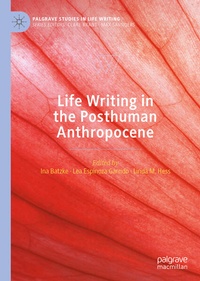
Life Writing in the Posthuman Anthropocene
Description
Reviews / Votes
"Life Writing in the Posthuman Anthropocene is one of the most recent additions to this 'transversal field of knowledge' . . This collection of essays grapples with the challenge of repositioning life writing-a genre traditionally grounded in a human perspective and ostensibly anthropocentric by nature-within the context of the Anthropocene, the current geological age in which human activity has altered and damaged the environment, climate, and ecology of the planet on a scale previously unimaginable." (Louis van den Hengel, Biography, Vol. 46 (2), 2023)
"Life Writing in the Posthuman Anthropocene is a down-to-earth (quite literally) posthumanist account that substitutes speculative futurism for a much-needed socioecological sensitivity. Students of the aging process would be inspired by the ways in which their object is put into perspective . . The book would also benefit anyone interested in the intersection between environmental and biographical studies . ." (João Pedro Martinez Pinheiro, Anthropology & Aging, Vol. 44 (1), 2023)
More details
Other editions
Additional editions
Persons
Ina Batzke is a researcher and lecturer in American Studies at the University of Augsburg, Germany. She has published a monograph on life narratives of undocumented migrants and co-edited a special issue on Storied Citizenship. Her current research project concerns the productivity of nature writing as a genre for the Anthropocene.
Lea Espinoza Garrido is a researcher and lecturer in American Literary and Cultural Studies at the University of Wuppertal, Germany. She has published on racialized and gendered representations in contemporary American and European popular culture and has co-edited a special issue on Migrant States of Exception.
Linda M. Hess is a senior lecturer and postdoctoral researcher at the Chair of American Studies at the University of Augsburg, Germany. She is the author of Queer Aging in North American Fiction (2019). Her current research focuses on ideas of grievability, preservation, and loss in ecocriticism.