

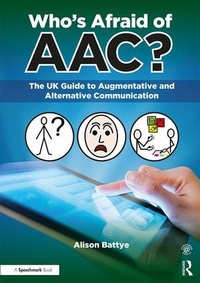
Who's Afraid of AAC?
The UK Guide to Augmentative and Alternative Communication
1st Edition
Published on 17. August 2017
Book
Paperback/Softback
302 pages
978-1-911186-17-5 (ISBN)
Description
Who's Afraid of AAC? is a clear and concise guide to Augmentative and Alternative Communication (AAC) in the UK and will be an essential resource for all Speech and Language Therapists, educators, parents and carers supporting children with non-verbal communication.
This book sets out to demystify AAC by demonstrating that you already have the skills necessary to use AAC successfully. Key features include:
an overview of the different types of AAC
analysis of the best available approaches
tools to give you the context you need to make specific recommendations and choices
thorough sections on different settings including Home, Early Years, Primary, Secondary and Special Schools so that guidance is relevant to individual needs
numerous practical examples, templates and activities to help you implement AAC in all settings
summaries of recent research and hot topics including eye-gaze technology, using AAC in exams, and internet safety so that you have the most up-to-date guidance at your fingertips.
Created by a Speech and Language Therapist who specialises in AAC training for therapists, educators, and individuals with communication needs, as well as parents and carers, this is the only book of its kind written for a UK audience.
This book sets out to demystify AAC by demonstrating that you already have the skills necessary to use AAC successfully. Key features include:
an overview of the different types of AAC
analysis of the best available approaches
tools to give you the context you need to make specific recommendations and choices
thorough sections on different settings including Home, Early Years, Primary, Secondary and Special Schools so that guidance is relevant to individual needs
numerous practical examples, templates and activities to help you implement AAC in all settings
summaries of recent research and hot topics including eye-gaze technology, using AAC in exams, and internet safety so that you have the most up-to-date guidance at your fingertips.
Created by a Speech and Language Therapist who specialises in AAC training for therapists, educators, and individuals with communication needs, as well as parents and carers, this is the only book of its kind written for a UK audience.
Reviews / Votes
"This is a colourful and accessible book aimed at SLTs, educators, parents and carers. (...) The book's written content is supported with images and pictures, making it a useful resource for a wide audience." - Katherine Broomfield, SLT/HEE NIHR Clinical Research Fellow, Gloucestershire Care Services NHS Trust/Sheffield Hallam UniversityMore details
Language
English
Place of publication
London
United Kingdom
Publishing group
Taylor & Francis Ltd
Target group
College/higher education
Professional and scholarly
General, Professional, and Professional Practice & Development
Illustrations
132 farbige Abbildungen, 108 Farbfotos bzw. farbige Rasterbilder, 24 farbige Zeichnungen, 29 s/w Tabellen
29 Tables, black and white; 24 Line drawings, color; 108 Halftones, color; 132 Illustrations, color
Dimensions
Height: 297 mm
Width: 210 mm
Weight
900 gr
ISBN-13
978-1-911186-17-5 (9781911186175)
Copyright in bibliographic data and cover images is held by Nielsen Book Services Limited or by the publishers or by their respective licensors: all rights reserved.
Schweitzer Classification
Other editions
Additional editions
E-Book
08/2017
Routledge
€59.49
Available for download
E-Book
08/2017
1st Edition
Routledge
€59.49
Available for download
Person
Alison Battye is a practising Speech and Language Therapist who specialises in working with children with Complex Needs and Autism Spectrum Disorder. She has worked across mainstream and special school settings from Foundation Stage to Further Education, supporting practitioners in implementing AAC with children and young people.
Content
1: What is Communication? 2: Typical Language Development 3: The Diversity of the AAC Population 4: Atypical Language Development and Acquired Disorders 5: No-tech, Low-tech and Light-tech AAC 6: High-tech AAC 7: Alternative Access and Mounting 8: Why Are We Afraid of AAC? 9: Aided Language Stimulation 10: AAC Assessment 11: Starting out at Home and in the Early Years Setting 12: A New Adventure in Primary School 13: Widening Horizons at Secondary School 14: Take off into the World of University, Work and Independent Living 15: Changing Circumstances 16: Target-setting and EHCPs 17: AAC Competencies Overview