

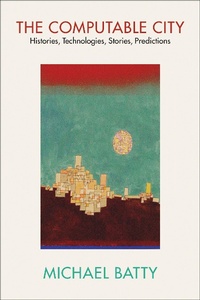
The Computable City
Histories, Technologies, Stories, Predictions
Published on 26. March 2024
Book
Paperback/Softback
536 pages
978-0-262-54757-4 (ISBN)
Description
How computers simulate cities and how they are also being embedded in cities, changing our behavior and the way in which cities evolve.
At every stage in the history of computers and communications, it is safe to say we have been unable to predict what happens next. When computers first appeared nearly seventy-five years ago, primitive computer models were used to help understand and plan cities, but as computers became faster, smaller, more powerful, and ever more ubiquitous, cities themselves began to embrace them. As a result, the smart city emerged. In The Computable City, Michael Batty investigates the circularity of this peculiar evolution: how computers and communications changed the very nature of our city models, which, in turn, are used to simulate systems composed of those same computers.
Batty first charts the origins of computers and examines how our computational urban models have developed and how they have been enriched by computer graphics. He then explores the sequence of digital revolutions and how they are converging, focusing on continual changes in new technologies, as well as the twenty-first-century surge in social media, platform economies, and the planning of the smart city. He concludes by revisiting the digital transformation as it continues to confound us, with the understanding that the city, now a high-frequency twenty-four-hour version of itself, changes our understanding of what is possible.
At every stage in the history of computers and communications, it is safe to say we have been unable to predict what happens next. When computers first appeared nearly seventy-five years ago, primitive computer models were used to help understand and plan cities, but as computers became faster, smaller, more powerful, and ever more ubiquitous, cities themselves began to embrace them. As a result, the smart city emerged. In The Computable City, Michael Batty investigates the circularity of this peculiar evolution: how computers and communications changed the very nature of our city models, which, in turn, are used to simulate systems composed of those same computers.
Batty first charts the origins of computers and examines how our computational urban models have developed and how they have been enriched by computer graphics. He then explores the sequence of digital revolutions and how they are converging, focusing on continual changes in new technologies, as well as the twenty-first-century surge in social media, platform economies, and the planning of the smart city. He concludes by revisiting the digital transformation as it continues to confound us, with the understanding that the city, now a high-frequency twenty-four-hour version of itself, changes our understanding of what is possible.
More details
Language
English
Place of publication
Cambridge (Massachusetts)
United States
Publishing group
MIT Press Ltd
Illustrations
48 BLACK AND WHITE ILLUS.
Dimensions
Height: 229 mm
Width: 151 mm
Thickness: 34 mm
Weight
860 gr
ISBN-13
978-0-262-54757-4 (9780262547574)
Copyright in bibliographic data and cover images is held by Nielsen Book Services Limited or by the publishers or by their respective licensors: all rights reserved.
Schweitzer Classification
Other editions
Additional editions
E-Book
03/2024
MIT Press
€43.99
Available for download
Person
Michael Batty
Content
Preface
Preamble
1 The Unpredictable Technology
Part I: Computers and Information
2 The Information Mile
3 Turing’s Legacy
4 The PC Revolution
5 Networks: The Final Piece in the Jigsaw
Part II: Cities and Urbanization
6: The Standard Model
7 The Death of Distance
8 Building Cyberspace
9 High and Low Frequency Cities
Part III: Models and Computation
10 Simulations, Models and Predictions
11 Drawing, Mapping, and Painting the City
12 Big Data and Urban Analytics
13 Digital Cities and Virtual Realities
Part IV: Planning and Organization
14 The Technological Convergence
15 The 21st Century Technology Surge
16 Organizing the Smart City
17 The Unpredictable City
Notes
References
Sources and Permissions
Name Index
Subject Index
Preamble
1 The Unpredictable Technology
Part I: Computers and Information
2 The Information Mile
3 Turing’s Legacy
4 The PC Revolution
5 Networks: The Final Piece in the Jigsaw
Part II: Cities and Urbanization
6: The Standard Model
7 The Death of Distance
8 Building Cyberspace
9 High and Low Frequency Cities
Part III: Models and Computation
10 Simulations, Models and Predictions
11 Drawing, Mapping, and Painting the City
12 Big Data and Urban Analytics
13 Digital Cities and Virtual Realities
Part IV: Planning and Organization
14 The Technological Convergence
15 The 21st Century Technology Surge
16 Organizing the Smart City
17 The Unpredictable City
Notes
References
Sources and Permissions
Name Index
Subject Index