

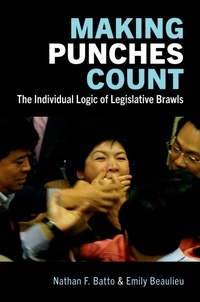
Making Punches Count
The Individual Logic of Legislative Brawls
Published on 29. August 2024
Book
Paperback/Softback
224 pages
978-0-19-774443-7 (ISBN)
Description
In Making Punches Count, the first comprehensive account of legislative floor violence and its consequences, Nathan Batto and Emily Beaulieu focus on recent episodes from a wide variety of countries, including Turkey, South Korea, Taiwan, Ukraine, Mexico, Uganda, and others. What do cultures of legislative brawling tell us about the health of democracy in a given country? Are the brawls mere fits of passion, or is there a deeper logic at work? Bacchus and Batto argue that legislative brawls are, in fact, calculated acts that serve the interests of the legislators who engage in them. Beginning from the incentives driving lawmakers in different party systems and drawing on both signaling theory and theories of contentious politics, they develop a powerful explanation of why individual legislators choose to brawl. As they show, brawls are more common in younger democracies, particularly ones with high levels of corruption, but sometimes there are contextual factors that make violence an attractive strategy even to legislators in long-established democracies.
Ultimately, brawls should be seen as calculated acts of political violence initiated by legislators to advance their careers. Legislators can strategically use brawling to send costly signals to the actors--both opponents and allies--who will have the most influence over their political fortunes. A genuinely novel account of why conflict can reach such extreme levels in democracies, the book also sheds light on the structural mechanisms that drive politicians to violence in settings where we least expect it.
Ultimately, brawls should be seen as calculated acts of political violence initiated by legislators to advance their careers. Legislators can strategically use brawling to send costly signals to the actors--both opponents and allies--who will have the most influence over their political fortunes. A genuinely novel account of why conflict can reach such extreme levels in democracies, the book also sheds light on the structural mechanisms that drive politicians to violence in settings where we least expect it.
More details
Language
English
Place of publication
New York
United States
Target group
Professional and scholarly
Product notice
Paperback (trade)
Unsewn / adhesive bound
Dimensions
Height: 239 mm
Width: 160 mm
Thickness: 20 mm
Weight
318 gr
ISBN-13
978-0-19-774443-7 (9780197744437)
Copyright in bibliographic data and cover images is held by Nielsen Book Services Limited or by the publishers or by their respective licensors: all rights reserved.
Schweitzer Classification
Other editions
Additional editions
Book
05/2024
Oxford University Press Inc
€79.23
Shipment within 15-20 days
E-Book
05/2024
OUP eBook
€21.99
Available for download
E-Book
05/2024
OUP eBook
€21.99
Available for download
Persons
Nathan F. Batto is Associate Research Fellow at the Institute of Political Science, Academia Sinica, and he holds a joint appointment at the Election Study Center, National Chengchi University. He previously taught at the University of the Pacific. He has published widely on electoral and legislative politics in Taiwan.
Emily Beaulieu is Professor of Political Science at the University of Kentucky. She received her PhD from the University of California, San Diego and has published books and articles on democracy and contentious politics.
Emily Beaulieu is Professor of Political Science at the University of Kentucky. She received her PhD from the University of California, San Diego and has published books and articles on democracy and contentious politics.
Content
Acknowledgments
Chapter 1: Introduction
Chapter 2: Brawls in Taiwan, Ukraine, and Around the World
Chapter 3: An Individual Theory of Parliamentary Brawls
Chapter 4: Who Brawls
Appendix 4.1: Legislative Behavior Coding for video coverage
of Taiwan's legislative Yuan
Chapter 5: Media and Signal Transmission
Appendix 5.1: Media coverage of Brawling in Taiwan-
Data Collection and analysis
Appendix 5.2: Media coverage of Brawling in Ukraine-
Data Collection and analysis
Chapter 6: The Audience for Brawls
Chapter 7: Brawling and Re-election
Chapter 8: Conclusions
Chapter 1: Introduction
Chapter 2: Brawls in Taiwan, Ukraine, and Around the World
Chapter 3: An Individual Theory of Parliamentary Brawls
Chapter 4: Who Brawls
Appendix 4.1: Legislative Behavior Coding for video coverage
of Taiwan's legislative Yuan
Chapter 5: Media and Signal Transmission
Appendix 5.1: Media coverage of Brawling in Taiwan-
Data Collection and analysis
Appendix 5.2: Media coverage of Brawling in Ukraine-
Data Collection and analysis
Chapter 6: The Audience for Brawls
Chapter 7: Brawling and Re-election
Chapter 8: Conclusions