

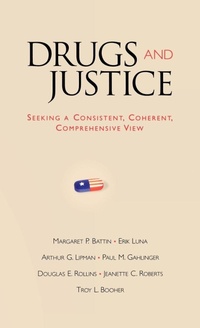
Drugs and Justice
Seeking a Consistent, Coherent, Comprehensive View
Published on 25. September 2008
Book
Hardback
312 pages
978-0-19-532100-5 (ISBN)
Description
This compact and innovative book tackles one of the central issues in drug policy: the lack of a coherent conceptual structure for thinking about drugs. Drugs generally fall into one of seven categories: prescription, over the counter, alternative medicine, common-use drugs like alcohol, tobacco and caffeine; religious-use, sports enhancement; and of course illegal street drugs like cocaine and marijuana. Our thinking and policies varies wildly from one to the other, with inconsistencies that derive more from cultural and social values than from medical or scientific facts. Penalties exist for steroid use, while herbal remedies or cold medication are legal. Native Americans may legally use peyote, but others may not. Penalties may vary for using different forms of the same drug, such as crack vs. powder cocaine. Herbal remedies are unregulated by the FDA; but medical marijuana is illegal in most states.
Battin and her contributors lay a foundation for a wiser drug policy by promoting consistency and coherency in the discussion of drug issues and by encouraging a unique dialogue across disciplines. The contributors are an interdisciplinary group of scholars mostly based at the University of Utah, and include a pharmacologist, a psychiatrist, a toxicologist, a trial court judge, a law professor, an attorney, a diatary specialist, a physician, a health expert on substance abuse, and Battin herself who is a philosopher. They consider questions like the historical development of current policy and the rationales for it; scientific views on how drugs actually cause harm; how to define the key notions of harm and addiction; and ways in which drug policy can be made more consistent. They conclude with an examination of the implications of a consistent policy for various disciplines and society generally.
The book is written accessibly with little need for expert knowledge, and will appeal to a diverse audience of philosophers, bioethicists, clinicians, policy makers, law enforcement, legal scholars and practitioners, social workers, and general readers, as well as to students in areas like pharmacy, medicine, law, nursing, sociology, social work, psychology, and bioethics.
Battin and her contributors lay a foundation for a wiser drug policy by promoting consistency and coherency in the discussion of drug issues and by encouraging a unique dialogue across disciplines. The contributors are an interdisciplinary group of scholars mostly based at the University of Utah, and include a pharmacologist, a psychiatrist, a toxicologist, a trial court judge, a law professor, an attorney, a diatary specialist, a physician, a health expert on substance abuse, and Battin herself who is a philosopher. They consider questions like the historical development of current policy and the rationales for it; scientific views on how drugs actually cause harm; how to define the key notions of harm and addiction; and ways in which drug policy can be made more consistent. They conclude with an examination of the implications of a consistent policy for various disciplines and society generally.
The book is written accessibly with little need for expert knowledge, and will appeal to a diverse audience of philosophers, bioethicists, clinicians, policy makers, law enforcement, legal scholars and practitioners, social workers, and general readers, as well as to students in areas like pharmacy, medicine, law, nursing, sociology, social work, psychology, and bioethics.
Reviews / Votes
The monograph is cohesive, well written, and unbiased; the extensive references and bibliography should be most valuable. Highly recommended. * R.S. Kowalczyk, CHOICE * This chewy, provocative, interdisciplinary collaboration by a group of academic experts at the University of Utah appears formidable at first glance, but turns out to be remarkably rewarding. In what they bill as a search for justice when it comes to drugs, the authors delve deep into the fundamental theoretical questions at the center of the debates over drugs - What is addiction? What is harm? - as well as the history of how we got to where we are and how we can get to a better place. Their search for justice in drug policy takes them to some very interesting places and takes the reader on a fascinating ride. * Drug War Chronicle * This chewy, provocative, interdisciplinary collaboration by a group of academic experts at the University of Utah appears formidable at first glance, but turns out to be remarkably rewarding. In what they bill as a search for justice when it comes to drugs, the authors delve deep into the fundamental theoretical questions at the center of the debates over drugs? - What is addiction? What is harm?- as well as the history of how we got to where we are and how we can get to a better place. Their search for justice in drug policy takes them to some very interesting places and takes the reader on a fascinating ride. * Drug War Chronicle *More details
Language
English
Place of publication
New York
United States
Target group
Professional and scholarly
Dimensions
Height: 222 mm
Width: 145 mm
Thickness: 22 mm
Weight
573 gr
ISBN-13
978-0-19-532100-5 (9780195321005)
Copyright in bibliographic data and cover images is held by Nielsen Book Services Limited or by the publishers or by their respective licensors: all rights reserved.
Schweitzer Classification
Other editions
Additional editions
Margaret P. Battin | Erik Luna | Arthur G. Lipman
Drugs and Justice
Seeking a Consistent, Coherent, Comprehensive View
E-Book
11/2007
1st Edition
OUP eBook
€14.49
Available for download
Margaret P. Battin | Erik Luna | Arthur G. Lipman
Drugs and Justice
Seeking a Consistent, Coherent, Comprehensive View
E-Book
11/2007
1st Edition
OUP eBook
€12.49
Available for download
Persons
Margaret P. Battin is Distinguished Professor of Philosophy and Adjunct Professor of Internal Medicine, Division of Medical Ethics, University of Utah.
Erik Luna is Professor of Law, University of Utah
Arthur G. Lipman is Director of Clinical Pharmacology, University of Utah
Paul M. Gahlinger is Adjunct Professor of Family and Preventive Medicine, University of Utah
Erik Luna is Professor of Law, University of Utah
Arthur G. Lipman is Director of Clinical Pharmacology, University of Utah
Paul M. Gahlinger is Adjunct Professor of Family and Preventive Medicine, University of Utah
Author
Distinguished Professor of Philosophy and Adjunct Professor of Internal Medicine, Division of Medical EthicsDistinguished Professor of Philosophy and Adjunct Professor of Internal Medicine, Division of Medical Ethics, University of Utah
Professor of LawProfessor of Law, University of Utah
Director of Clinical PharmacologyDirector of Clinical Pharmacology, University of Utah
Adjunct Professor of Family and Preventive MedicineAdjunct Professor of Family and Preventive Medicine, University of Utah
Professor of Pharmacology and ToxologyProfessor of Pharmacology and Toxology, University of Utah
Dean of the School of PharmacyDean of the School of Pharmacy, University of Wisconsin-Madison
LawyerLawyer, Snell & Willmer LLP
Content
FOREWORD: THE MANY FACES OF DRUGS: A PERSONAL PERSPECTIVE ; PREFACE ; BIBLIOGRAPHY