

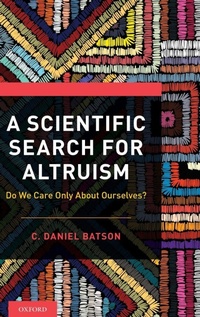
A Scientific Search for Altruism
Do We Only Care About Ourselves?
Published on 3. January 2019
Book
Hardback
312 pages
978-0-19-065137-4 (ISBN)
Description
For centuries, the egoism-altruism debate has echoed through Western thought. Egoism says that the motivation for everything we do, including our seemingly selfless acts of care for others, is to gain one or another self-benefit. Altruism, while not denying the force of self-interest, says that under certain circumstances we can care for others for their sakes, not our own. Over the past half-century, social psychologists have turned to laboratory experiments on humans to provide a scientific resolution of this debate about our nature. The experiments have focused on the possibility that empathic concern-other-oriented emotion elicited by and congruent with the perceived welfare of someone in need-produces altruistic motivation to remove that need.
With carefully constructed experimental designs, these scientists have tested the nature of the motivation produced by empathic concern, determining whether it is egoistic or altruistic and, thereby, providing an answer to a fundamental question about what makes us tick.
Framed as a detective story, this book traces the scientific search for altruism through numerous studies and attempts to examine various motivational suspects, reaching the improbable conclusion that empathy-induced altruism is indeed part of our nature. The book then considers the implications of this conclusion both for our understanding of who we are as humans (the bad news as well as the good) and for how we might create a more humane society.
With carefully constructed experimental designs, these scientists have tested the nature of the motivation produced by empathic concern, determining whether it is egoistic or altruistic and, thereby, providing an answer to a fundamental question about what makes us tick.
Framed as a detective story, this book traces the scientific search for altruism through numerous studies and attempts to examine various motivational suspects, reaching the improbable conclusion that empathy-induced altruism is indeed part of our nature. The book then considers the implications of this conclusion both for our understanding of who we are as humans (the bad news as well as the good) and for how we might create a more humane society.
Reviews / Votes
This book is a kind of busman's tour of his own and other's research into the empathy-altruism relationship, the twists and turns that research has taken, and the conclusions the author has drawn from it. Organized almost as a kind of scientific adventure story, the book provides an extraordinarily compelling history of research on altruism, as the author is a marvelously engaging storyteller and one of the scientists uniquely qualified to tell this amazing tale of who we are. * Choice * Batson's command of the experimental research provides an exceptionally lucid entry point into the empirical psychology of altruism, and as such, this volume would be an engaging resource not only for undergraduate and graduate students, but also to anyone approaching the topic for the first time. * Metapsychology Online Reviews * Survival of the fittest is a harsh reality that pervades both evolution and the free enterprise economy. Yet for many, kindness to others, arising from empathic concern, is an important reality. But is this kindness 'real' or just an indirect way to benefit one's self? Daniel Batson clearly explains how experiments have established that true altruism is indeed real, powerful and widespread. It matters a great deal that altruism arose within the natural evolution of people and society. This means that kindness is in our nature. Perhaps this helps to explain how democracies can remain fair and good, despite occasional setbacks. Thus, Batson's clear explanation also offers hope for the future." * Lorne A. Whitehead, Professor of Physics and Astronomy and Special Advisor for Innovation, University of British Columbia *More details
Language
English
Place of publication
New York
United States
Target group
Professional and scholarly
Dimensions
Height: 240 mm
Width: 161 mm
Thickness: 21 mm
Weight
631 gr
ISBN-13
978-0-19-065137-4 (9780190651374)
Copyright in bibliographic data and cover images is held by Nielsen Book Services Limited or by the publishers or by their respective licensors: all rights reserved.
Schweitzer Classification
Other editions
Additional editions
E-Book
10/2018
OUP eBook
€20.99
Available for download
E-Book
10/2018
OUP eBook
€20.99
Available for download
Person
C. Daniel Batson is an experimental social psychologist. He received a Ph.D. in psychology from Princeton University in 1972 and taught at the University of Kansas until his retirement in 2008. For over 40 years, his research has focused on prosocial motivation, with particular emphasis on altruistic and moral motivation, and related emotions. He has published well over a hundred research articles and chapters on these topics, as well as two previous books on altruism.
Content
Chapter 1. An Unsettling Surprise Part I. Starting the Search
Chapter 2. What We're Looking For Chapter 3. How to Find It Chapter 4. The Prime Suspect Part II. More Suspects Chapter 5. Avoiding Shame and Guilt Chapter 6. Pursuing Pride Chapter 7. One Way to Feel Better Chapter 8. The Pleasure of Empathic Joy Part III. Three New Possibilities Chapter 9. A Gang Chapter 10. Self-Other Merging Chapter 11. Premature Release of the Prime Part IV. Facing the Consequences
Chapter 12. How Can It Be? Chapter 13. Some Good News Chapter 14. Some Bad Chapter15. After the Fall Acknowledgements References
Chapter 2. What We're Looking For Chapter 3. How to Find It Chapter 4. The Prime Suspect Part II. More Suspects Chapter 5. Avoiding Shame and Guilt Chapter 6. Pursuing Pride Chapter 7. One Way to Feel Better Chapter 8. The Pleasure of Empathic Joy Part III. Three New Possibilities Chapter 9. A Gang Chapter 10. Self-Other Merging Chapter 11. Premature Release of the Prime Part IV. Facing the Consequences
Chapter 12. How Can It Be? Chapter 13. Some Good News Chapter 14. Some Bad Chapter15. After the Fall Acknowledgements References