

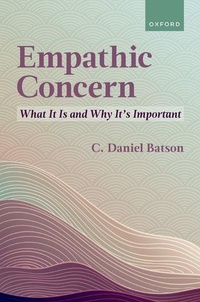
Empathic Concern
What It Is and Why It's Important
Published on 21. August 2023
Book
Hardback
280 pages
978-0-19-761092-3 (ISBN)
Description
Empathy has received much attention in recent years, being touted by some as a cure for what ails our society but considered by others to be a source of trouble. One reason for the very different assessments is that "empathy" has been used to refer to different psychological phenomena. For some scholars and researchers, empathy refers to feeling as another feels. Others think of empathy as feeling for, not feeling as, another. When the other is in need, feeling for him or her has been called "empathic concern."
This book provides an evidence-based review of developments in our understanding of empathic concern over the past five decades, clarifying what empathic concern is (and isn't), where it comes from, what its forms are, its motivational consequences, and its importance in interpersonal and intergroup relations. Rather than lauding empathic concern as a panacea or castigating it as a problem, the evidence supports a more nuanced view: Empathic concern has benefits but also liabilities, and its benefits can be realized only if we recognize and address its liabilities. The evidence-based review also points to needed next steps in research on the nature and function of empathic concern-and on its use in interventions to increase sensitive response to the needs of others near and far.
This book provides an evidence-based review of developments in our understanding of empathic concern over the past five decades, clarifying what empathic concern is (and isn't), where it comes from, what its forms are, its motivational consequences, and its importance in interpersonal and intergroup relations. Rather than lauding empathic concern as a panacea or castigating it as a problem, the evidence supports a more nuanced view: Empathic concern has benefits but also liabilities, and its benefits can be realized only if we recognize and address its liabilities. The evidence-based review also points to needed next steps in research on the nature and function of empathic concern-and on its use in interventions to increase sensitive response to the needs of others near and far.
Reviews / Votes
Clearly and engagingly written, it is best for anyone wishing to learn more about this fascinating and ultimately essential human quality. Recommended. Advanced undergraduates through faculty; professionals. * Choice *More details
Language
English
Place of publication
New York
United States
Target group
Professional and scholarly
Product notice
sewn/stitched
Cloth over boards
Dimensions
Height: 237 mm
Width: 162 mm
Thickness: 20 mm
Weight
549 gr
ISBN-13
978-0-19-761092-3 (9780197610923)
Copyright in bibliographic data and cover images is held by Nielsen Book Services Limited or by the publishers or by their respective licensors: all rights reserved.
Schweitzer Classification
Other editions
Additional editions
E-Book
07/2023
OUP eBook
€53.99
Available for download
E-Book
07/2023
OUP eBook
€53.99
Available for download
Person
C. Daniel Batson is an experimental social psychologist. He was a member of the Department of Psychology at the University of Kansas from 1972-2008 and is now Professor Emeritus there. His research has focused primarily on empathic emotion and altruistic motivation, but he has also studied moral emotion and motivation, as well as the behavioral consequences of religion. Batson is the author of numerous research articles on these topics, a half-dozen books, and has received a Career Contribution Award from the Society of Personality and Social Psychology.
Content
Introduction: The Empathy Controversy Part I: What Empathic Concern Is
1. A Definition-and a Measure 2. Distinguishing Empathic Concern from Personal Distress 3. Distinguishing It from Other Things Called Empathy 4. Necessary Conditions for Feeling Empathic Concern 5. Empathic Concern's Evolutionary Roots 6. Varieties of Empathic Concern Part II: Why Empathic Concern Is Important
7. Motivational Consequences: The Empathy-Altruism Hypothesis 8. Behavioral Consequences: Interpersonal Benefits 9. Behavioral Consequences: Interpersonal Liabilities 10. Behavioral Consequences: Intergroup Benefits 11. Behavioral Consequences: Intergroup Liabilities .
12. Realizing the Potential of Empathic Concern
1. A Definition-and a Measure 2. Distinguishing Empathic Concern from Personal Distress 3. Distinguishing It from Other Things Called Empathy 4. Necessary Conditions for Feeling Empathic Concern 5. Empathic Concern's Evolutionary Roots 6. Varieties of Empathic Concern Part II: Why Empathic Concern Is Important
7. Motivational Consequences: The Empathy-Altruism Hypothesis 8. Behavioral Consequences: Interpersonal Benefits 9. Behavioral Consequences: Interpersonal Liabilities 10. Behavioral Consequences: Intergroup Benefits 11. Behavioral Consequences: Intergroup Liabilities .
12. Realizing the Potential of Empathic Concern