

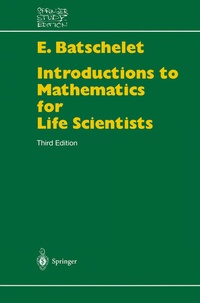
Introduction to Mathematics for Life Scientists
3rd Edition
Published on 1. October 1979
Book
Paperback/Softback
XV, 646 pages
978-3-540-09648-1 (ISBN)
Description
In this volume the author has succeeded in presenting a truly biologically-oriented introduction to the standard mathematical methods necessary for the treatment of biological problems. The previous editions have proven to be of interest to both biologists who want to become more acquainted with mathematics as well as to mathematicians teaching introductory math courses for the life science students.
More details
Series
Edition
Third Edition 1979
Language
English
Place of publication
Berlin
Germany
Publishing group
Springer Berlin
Target group
Lower undergraduate
Illustrations
XV, 646 p.
Dimensions
Height: 235 mm
Width: 155 mm
Thickness: 36 mm
Weight
996 gr
ISBN-13
978-3-540-09648-1 (9783540096481)
DOI
10.1007/978-3-642-61869-7
Schweitzer Classification
Other editions
Additional editions
Edward Batschelet
Introduction to Mathematics for Life Scientists
E-Book
12/2012
3rd Edition
Springer
€69.54
Available for download

Edward Batschelet
Introduction to Mathematics for Life Scientists
Book
10/1979
3rd Edition
Springer
€85.55
Article exhausted; check different version
Previous edition

Edward Batschelet
Introduction to Mathematics for Life Scientists
Book
08/1975
2nd Edition
Springer
€28.06
Article exhausted; check for reprint
Content
1. Real Numbers.- 1.1 Introduction.- 1.2 Classification and Measurement.- 1.3 A Problem with Percentages.- 1.4 Proper and Improper Use of Percentages.- 1.5 Algebraic Laws.- 1.6 Relative Numbers.- 1.7 Inequalities.- 1.8 Mean Values.- 1.9 Summation.- 1.10 Powers.- 1.11 Fractional Powers.- 1.12 Calculations with Approximate Numbers.- 1.13 An Application.- 1.14 Survey.- Problems for Solution.- 2. Sets and Symbolic Logic.- 2.1 "New Mathematics".- 2.2 Sets.- 2.3 Notations and Symbols.- 2.4 Variable Members.- 2.5 Complementary Set.- 2.6 The Union.- 2.7 The Intersection.- 2.8 Symbolic Logic.- 2.9 Negation and Implication.- 2.10 Boolean Algebra.- Problems for Solution.- 3. Relations and Functions.- 3.1 Introduction.- 3.2 Product Sets.- 3.3 Relations.- 3.4 Functions.- 3.5 A Special Linear Function.- 3.6 The General Linear Function.- 3.7 Linear Relations.- Problems for Solution.- 4. The Power Function and Related Functions.- 4.1 Definitions.- 4.2 Examples of Power Functions.- 4.3 Polynomials.- 4.4 Differences.- 4.5 An Application.- 4.6 Quadratic Equations.- Problems for Solution.- 5. Periodic Functions.- 5.1 Introduction and Definition.- 5.2 Angles.- 5.3 Polar Coordinates.- 5.4 Sine and Cosine.- 5.5 Conversion of Polar Coordinates.- 5.6 Right Triangles.- 5.7 Trigonometric Relations.- 5.8 Polar Graphs.- 5.9 Trigonometric Polynomials.- Problems for Solution.- 6. Exponential and Logarithmic Functions I.- 6.1 Sequences.- 6.2 The Exponential Function.- 6.3 Inverse Functions.- 6.4 The Logarithmic Functions.- 6.5 Applications.- 6.6 Scaling.- 6.7 Spirals.- Problems for Solution.- 7. Graphical Methods.- 7.1 Nonlinear Scales.- 7.2 Semilogarithmic Plot.- 7.3 Double-Logarithmic Plot.- 7.4 Triangular Charts.- 7.5 Nomography.- 7.6 Pictorial Views.- Problems for Solution.- 8. Limits.- 8.1Limits of Sequences.- 8.2 Some Special Limits.- 8.3 Series.- 8.4 Limits of Functions.- 8.5 The Fibonacci Sequence.- Problems for Solution.- 9. Differential and Integral Calculus.- 9.1 Growth Rates.- 9.2 Differentiation.- 9.3 The Antiderivative.- 9.4 Integrals.- 9.5 Integration.- 9.6 The Second Derivative.- 9.7 Extremes.- 9.8 Mean of a Continuous Function.- 9.9 Small Changes.- 9.10 Techniques of Integration.- Problems for Solution.- 10. Exponential and Logarithmic Functions II.- 10.1 Introduction.- 10.2 Integral of 1/x.- 10.3 Properties of ln x.- 10.4 The Inverse Function of ln x.- 10.5 The General Definition of a Power.- 10.6 Relationship between Natural and Common Logarithms.- 10.7 Differentiation and Integration.- 10.8 Some Limits.- 10.9 Applications.- 10.10 Approximations and Series Expansions.- 10.11 Hyperbolic Functions.- Problems for Solution.- 11. Ordinary Differential Equations.- 11.1 Introduction.- 11.2 Geometric Interpretation.- 11.3 The Differential Equation y' = ay.- 11.4 The Differential Equation y' = ay+b.- 11.5 The Differential Equation y' = ay2+ by+ c.- 11.6 The Differential Equation dy/dx = k · y/x.- 11.7 A System of Linear Differential Equations.- 11.8 A System of Nonlinear Differential Equations.- 11.9 Classification of Differential Equations.- Problems for Solution.- 12. Functions of Two or More Independent Variables.- 12.1 Introduction.- 12.2 Partial Derivatives.- 12.3 Maxima and Minima.- 12.4 Partial Differential Equations.- Problems for Solution.- 13. Probability.- 13.1 Introduction.- 13.2 Events.- 13.3 The Concept of Probability.- 13.4 The Axioms of Probability Theory.- 13.5 Conditional Probabilities.- 13.6 The Multiplication Rule.- 13.7 Counting.- 13.8 Binomial Distribution.- 13.9 Random Variables.- 13.10 The Poisson Distribution.- 13.11Continuous Distributions.- Problems for Solution.- 14. Matrices and Vectors.- 14.1 Notations.- 14.2 Matrix Algebra.- 14.3 Applications.- 14.4 Vectors in Space.- 14.5 Applications.- 14.6 Determinants.- 14.7 Inverse of a Matrix.- 14.8 Linear Dependence.- 14.9 Eigenvalues and Eigenvectors.- Problems for Solution.- 15. Complex Numbers.- 15.1 Introduction.- 15.2 The Complex Plane.- 15.3 Algebraic Operations.- 15.4 Exponential Functions of Complex Variables.- 15.5 Quadratic Equations.- 15.6 Oscillations.- Problems for Solution.- Appendix (Tables A to K).- Solutions to Odd Numbered Problems.- References.- Author and Subject Index.