

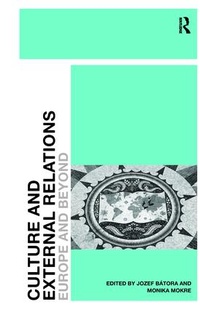
Culture and External Relations
Europe and Beyond
1st Edition
Published on 17. November 2016
Book
Paperback/Softback
216 pages
978-1-138-27959-9 (ISBN)
Description
Political entities use culture to support their soft power potential, to generate goodwill, to frame international agenda in particular ways, to erect and re-enact boundaries and/or to create societal linkages across them. While the importance of culture has been on the rise in the realm of foreign affairs, its role in this field remains one of the most under-studied aspects of state policy. In this book, a range of international experts take an unprecedented look at what role external cultural policy plays in foreign affairs. The book features historical case studies ranging from European 'civilizing' engagement with nineteenth-century China to uses of Abstract Expressionism as an instrument in the ideological struggles of the Cold War. Conceptual issues ranging from the dynamics of the 'Anglosphere' to the effects of what some term the 'culture of liberal democracy' are addressed. Current trends in the uses of culture in the EU's external relations both from the perspective of institutional developments, policies and practices in the EU and from the perspective of countries engaged by the EU's cultural policies are also discussed in greater detail. The systematic, theoretically informed and empirically supported analyses make this book an indispensable read for scholars and policy makers wishing to gain a new understanding of the role that culture plays in foreign affairs.
Reviews / Votes
'So far, students of culture in international politics have mostly focused on how culture raises boundaries and how cultural differences bring about conflicts. This volume provides a more balanced perspective. While acknowledging its boundary-raising function the authors also examine how culture builds bridges among peoples. This insight makes an important contribution to the debate.' Petr DrulA!k, Institute of International Relations, Czech Republic 'At a time when practitioners and academics alike seek answers to the question of how "culture" works, or could be put to work, in the politics of the EU, this book revisits the question itself in a more vigorous and critical manner. The outcome is an exciting contribution to a whole range of contemporary theorising: from European Studies to the "aesthetic turn" in International Relations theory.' Alexander Astrov, Central European University, Hungary 'Off the beaten path, this refreshing set of essays makes a strong case for the study of culture, as a broad concept, in European and EU international relations. The book helps to widen the horizon of students of international relations and Europe's role in it, which makes it a most welcome contribution.' Jan Melissen, Netherlands Institute of International Relations Clingendael and Antwerp University, and Co-Editor of The Hague Journal of DiplomacyMore details
Language
English
Place of publication
London
United Kingdom
Publishing group
Taylor & Francis Ltd
Target group
College/higher education
Dimensions
Height: 234 mm
Width: 156 mm
Weight
400 gr
ISBN-13
978-1-138-27959-9 (9781138279599)
Copyright in bibliographic data and cover images is held by Nielsen Book Services Limited or by the publishers or by their respective licensors: all rights reserved.
Schweitzer Classification
Other editions
Additional editions
E-Book
05/2016
Routledge
€72.49
Available for download
E-Book
05/2016
Routledge
€72.49
Available for download
Book
06/2011
1st Edition
Routledge
€222.84
Shipment within 10-20 days
Persons
Jozef BA!tora is associate professor and director at the Institute of European Studies and International Relations, Comenius University in Bratislava, Slovakia. Monika Mokre is senior research fellow at the Institute for Cultural Studies and History of Theatre, Austrian Academy of Sciences in Vienna, Austria.
Content
Introduction: What Role for Culture in External Relations?, Jozef Batora, Monika Mokre; Part I Universalism Versus Part icularism; Chapter 1 Free Trade by Force: Civilization against Culture in the Great China Debate of 1857, Erik Ringmar; Chapter 2 Our Culture and all the Others: Intercultural and International Relations, Iver B. Neumann; Chapter 3 The Logics of Culture in the Anglosphere, Srdjan Vu?eti?; Part II Boundary Building Versus Boundary Transcendence; Chapter 4 Culture and Collective Identifications, Monika Mokre; Chapter 5 Exclusion and Transversalism: Culture in the EU's External Relations, Jozef Batora; Chapter 6 'Culture' in EU-Turkey Relations, Bahar Rumelili, Didem Cakmakli; Part III Policy Aspects; Chapter 7 Abstract Expressionism as a Weapon of the Cold War, Manfred J. Holler, Barbara Klose Ullmann; Chapter 8 Between a Rock and a Hard Place: Cultural Policies of and towards Serbia, Dragi?evi? Milena Sesi?; Chapter 9 European Coordination of External Cultural Policies, Emil Brix; conclu Conclusions, Monika Mokre, Jozef Batora;