

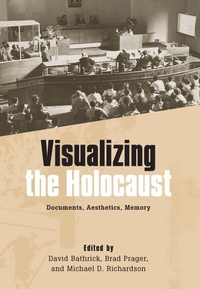
Visualizing the Holocaust
Documents, Aesthetics, Memory
Published on 1. June 2008
Book
Hardback
346 pages
978-1-57113-383-0 (ISBN)
Description
Visual representations are an essential but highly contested means of understanding and remembering the Holocaust. Photographs taken in the camps in early 1945 provided proof of and visceral access to the atrocities. Later visualrepresentations such as films, paintings, and art installations attempted to represent this extreme trauma. While photographs from the camps and later aesthetic reconstructions differ in origin, they share goals and have raised similar concerns: the former are questioned not as to veracity but due to their potential inadequacy in portraying the magnitude of events; the latter are criticized on the grounds that the mediation they entail is unacceptable. Some have even questioned any attempt to represent the Holocaust as inappropriate and dangerous to historical understanding. This book explores the taboos that structure the production and reception of Holocaust images and the possibilities that result from the transgression of those taboos. Essays consider the uses of various visual media, aesthetic styles, and genres in representations of the Holocaust; the uses of perpetrator photography; the role of trauma in memory; aesthetic problems of mimesis and memory in the work of Lanzmann, Celan, and others; and questions about mass-cultural representations of the Holocaust.
David Bathrick is Emeritus Professor of German at Cornell University, Brad Prager is Associate Professor of German at the University of Missouri, and Michael D. Richardson is Associate Professor of German at Ithaca College.
David Bathrick is Emeritus Professor of German at Cornell University, Brad Prager is Associate Professor of German at the University of Missouri, and Michael D. Richardson is Associate Professor of German at Ithaca College.
Reviews / Votes
Should be of great interest to the archival community because the essays focus on the scholarly debates surrounding visual archival records that document the Holocaust as well as some of the related controversies . . . . [I]t is reassuring and invigorating to witness many of the scholars extolling the value and potential of [such] records. * ARCHIVARIA * Adds another substantial document to analyses of visual representations of the Holocaust. * BIOGRAPHY * Has the feel of an intense seminar. . . . What emerges from these essays is a fresh look at the canon of Holocaust representation, and therefore a new appreciation for what is seen, and how memory shapes our attempt to salvage something from the ashes. -- Michael Berenbaum * JOURNAL FOR GENOCIDE STUDIES * Innovative approaches to one of the most difficult issues in German film and visual culture. * H-NET REVIEWS * An important contribution . . . . These essays transcend the anxieties surrounding Holocaust representation that began with Adorno's aesthetic interdiction and are attuned to the fruitful possibilities of analyzing the production and reception of Holocaust imagery. * SHOFAR * A welcome, well-wrought contribution to the scholarship about how we deal with traumatic events, ethically, poetically, visually, and aurally. * GERMAN QUARTERLY * An excellent collection of essays which, without exception, are informative, well researched, reasonably argued, and lucidly written. * GERMAN STUDIES REVIEW * Seeks to explore recent debate . . ., bringing together a range of essays on the theory and practice of visual representation of the Shoah. At the heart of this collection is inevitably the vexed issue of the Bilderverbot, the much-spoken-about 'unspeakability' of the Holocaust. * MODERN LANGUAGE REVIEW * The strength of this volume lies in its wealth of materials and the diverse fields of study which it informs. It is theoretically astute and generously illustrated . . . thus making for a highly inspiring read. . . . [A]n essential sourcebook for scholars, graduate and undergraduate students in Holocaust and Visual Studies . . . . * MONATSHEFTE *More details
Series
Language
English
Place of publication
Columbia, MD
United States
Publishing group
Boydell & Brewer Ltd
Target group
Professional and scholarly
Product notice
Cloth over boards
Illustrations
26 s/w Abbildungen
26 b/w.
Dimensions
Height: 229 mm
Width: 152 mm
Weight
1 gr
ISBN-13
978-1-57113-383-0 (9781571133830)
Copyright in bibliographic data and cover images is held by Nielsen Book Services Limited or by the publishers or by their respective licensors: all rights reserved.
Schweitzer Classification
Other editions
Additional editions
David Bathrick | Brad Prager | Michael D. Richardson
Visualizing the Holocaust
Documents, Aesthetics, Memory
Book
07/2012
Camden House Inc
€35.00
Shipment within 15-20 days
Persons
BRAD PRAGER is Associate Professor of German at the University of Missouri, Columbia. BRAD PRAGER is Associate Professor of German at the University of Missouri, Columbia.
Content
Introduction: Seeing Against the Grain: Re-visualizing the Holocaust - David Bathrick
On the Liberation of Perpetrator Photographs in Holocaust Narratives - Brad Prager
The Interpreter's Dilemma: Heinrich Joest's Warsaw Ghetto Photographs - Daniel H. Magilow
Whose Trauma Is It? Identification and Secondary Witnessing in the Age of Postmemory - Elke Heckner
No Child Left Behind: Anne Frank Exhibits, American Abduction Narratives, and Nazi Bogeymen - Lisa J. Nicoletti
Auschwitz as Hermeneutic Rupture, Differend, and Image malgre tout: Jameson, Lyotard, Didi-Huberman - Sven-Erik Rose
Claude Lanzmann's Shoah and the Internionality of the Image - Michael D'Arcy
For and Against the Bilderverbot: The Rhetoric of "Unrepresentability" and Remediated "Authenticity" in the German Reception of Steven Spielberg's Schindler's List Reception of Steven Spielberg's Schindler's List - Karyn Ball
Celan's Cinematic: Anxiety of the Gaze in Night and Fog and "Engfuehrung" - Eric Kligerman
Affect in the Archive: Arendt, Eichmann and The Specialist - Darcy C. Buerkle
Home-Movies, Film Diaries, and Mass Bodies: Peter Forgac's Free Fall Into the Holocaust - Jaimey Fisher
Laughter and Catastrophe: Train of Life and Tragicomic Holocaust Cinema - David Brenner
"Heil Myself!": Impersonation and Identity in the Comedic Representation of Hitler - Michael D. Richardson
On the Liberation of Perpetrator Photographs in Holocaust Narratives - Brad Prager
The Interpreter's Dilemma: Heinrich Joest's Warsaw Ghetto Photographs - Daniel H. Magilow
Whose Trauma Is It? Identification and Secondary Witnessing in the Age of Postmemory - Elke Heckner
No Child Left Behind: Anne Frank Exhibits, American Abduction Narratives, and Nazi Bogeymen - Lisa J. Nicoletti
Auschwitz as Hermeneutic Rupture, Differend, and Image malgre tout: Jameson, Lyotard, Didi-Huberman - Sven-Erik Rose
Claude Lanzmann's Shoah and the Internionality of the Image - Michael D'Arcy
For and Against the Bilderverbot: The Rhetoric of "Unrepresentability" and Remediated "Authenticity" in the German Reception of Steven Spielberg's Schindler's List Reception of Steven Spielberg's Schindler's List - Karyn Ball
Celan's Cinematic: Anxiety of the Gaze in Night and Fog and "Engfuehrung" - Eric Kligerman
Affect in the Archive: Arendt, Eichmann and The Specialist - Darcy C. Buerkle
Home-Movies, Film Diaries, and Mass Bodies: Peter Forgac's Free Fall Into the Holocaust - Jaimey Fisher
Laughter and Catastrophe: Train of Life and Tragicomic Holocaust Cinema - David Brenner
"Heil Myself!": Impersonation and Identity in the Comedic Representation of Hitler - Michael D. Richardson