

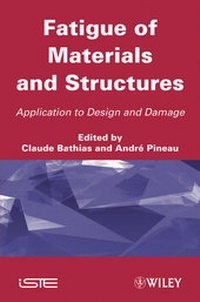
Fatigue of Materials and Structures
Application to Design
Will be published approx. on 14. January 2011
Book
Hardback
358 pages
978-1-84821-291-6 (ISBN)
Description
The design of mechanical structures with predictable and improved durability cannot be achieved without a thorough understanding of the mechanisms of fatigue damage and more specifically the relationships between the microstructure of materials and their fatigue properties.
Written by leading researchers in the field, this book, along with the complementary books Fatigue of Materials and Structures: Fundamentals and Application to Damage and Design (both also edited by Claude Bathias and André Pineau), provides an authoritative, comprehensive and unified treatment of the mechanics and micromechanisms of fatigue in metals, polymers and composites. Each chapter is devoted to one of the major classes of materials or to different types of fatigue damage, thereby providing overall coverage of the field.
This book deals with multiaxial fatigue, thermomechanical fatigue, fretting-fatigue, influence of defects on fatigue life, cumulative damage and damage tolerance, and will be an important and much used reference for students, practicing engineers and researchers studying fracture and fatigue in numerous areas of materials science and engineering, mechanical, nuclear and aerospace engineering.
More details
Product info
gebunden
Edition
1. Auflage
Language
English
Place of publication
London
United Kingdom
Target group
Professional and scholarly
Product notice
sewn/stitched
Paper over boards
Dimensions
Height: 240 mm
Width: 162 mm
Thickness: 25 mm
Weight
657 gr
ISBN-13
978-1-84821-291-6 (9781848212916)
Schweitzer Classification
Other editions
Additional editions
E-Book
03/2013
Wiley-ISTE
€149.99
Available for download
E-Book
03/2013
Wiley-ISTE
€149.99
Available for download
Person
Claude Bathias is Emeritus Professor at the University of Paris 10-La Defense. He started his career as a research engineer in the aerospace and military industry where he remained for 20 years before becoming director of the CNRS laboratory ERA 914 at the University of Compiegne. He has launched two international conferences about fatigue: International Conference on the Fatigue of Composite Materials (ICFC) and Very High Cycle Fatigue (VHCF).
Andre Pineau is Professor at Mines ParisTech and a member of the French Academy of Engineering. He has published about 300 papers in international journals and edited or co-edited 10 books. His main research fields are phase transformations, fatigue and fracture of metallic materials.
Andre Pineau is Professor at Mines ParisTech and a member of the French Academy of Engineering. He has published about 300 papers in international journals and edited or co-edited 10 books. His main research fields are phase transformations, fatigue and fracture of metallic materials.
Content
Foreword xi
Stephen D. ANTOLOVICH
Chapter 1. Multiaxial Fatigue 1
Marc BLETRY and Georges CAILLETAUD
1.1 Introduction 1
1.2. Experimental aspects 12
1.3. Criteria specific to the unlimited endurance domain 15
1.4. Low cycle fatigue criteria 30
1.5. Calculating methods of the lifetime under multiaxial conditions 35
1.6. Conclusion 40
1.7. Bibliography 41
Chapter 2. Cumulative Damage 47
Jean-Louis CHABOCHE
2.1. Introduction 47
2.2. Nonlinear fatigue cumulative damage 49
2.3. A nonlinear cumulative fatigue damage model 63
2.4. Damage law of incremental type 77
2.5. Cumulative damage under fatigue-creep conditions 95
2.6. Conclusion 103
2.7. Bibliography 104
Chapter 3. Damage Tolerance Design 111
Raphael CAZES
3.1. Background 112
3.2. Evolution of the design concept of "fatigue" phenomenon 112
3.3. Impact of damage tolerance on design 115
3.4. Calculation of a "stress intensity factor" 119
3.5. Performing some "damage tolerance" calculations 127
3.6. Application to the residual strength of thin sheets 131
3.7. Propagation of cracks subjected to random loading in the aeronautic industry 135
3.8. Conclusion 144
3.9. Damage tolerance within the gigacyclic domain 147
3.10. Bibliography 149
Chapter 4. Defect Influence on the Fatigue Behavior of Metallic Materials 151
Gilles BAUDRY
4.1. Introduction 151
4.2. Some facts 152
4.3. Approaches 166
4.4. A few examples 171
4.5. Prospects 180
4.6. Conclusion 185
4.7. Bibliography 186
Chapter 5. Fretting Fatigue: Modeling and Applications 195
Marie-Christine BAIETTO-DUBORG and Trevor LINDLEY
5.1 Introduction 195
5.2. Experimental methods 198
5.3. Fretting fatigue analysis 203
5.4. Applications under fretting conditions 214
5.5. Palliatives to combat fretting fatigue 224
5.6. Conclusions 225
5.7 Bibliography 226
Chapter 6. Contact Fatigue 231
Ky DANG VAN
6.1. Introduction 231
6.2. Classification of the main types of contact damage 232
6.3. A few results on contact mechanics 239
6.4. Elastic limit 248
6.5. Elastoplastic contact 249
6.6. Application to modeling of a few contact fatigue issues 254
6.7. Conclusion 268
6.8. Bibliography 269
Chapter 7?I?IThermal Fatigue 271
Eric CHARKALUK and Luc REMY
7.1. Introduction 271
7.2. Characterization tests 276
7.3. Constitutive and damage models at variable temperatures 294
7.4. Applications 314
7.5. Conclusion 325
7.6. Bibliography 326
List of Authors 339
Index 341
Stephen D. ANTOLOVICH
Chapter 1. Multiaxial Fatigue 1
Marc BLETRY and Georges CAILLETAUD
1.1 Introduction 1
1.2. Experimental aspects 12
1.3. Criteria specific to the unlimited endurance domain 15
1.4. Low cycle fatigue criteria 30
1.5. Calculating methods of the lifetime under multiaxial conditions 35
1.6. Conclusion 40
1.7. Bibliography 41
Chapter 2. Cumulative Damage 47
Jean-Louis CHABOCHE
2.1. Introduction 47
2.2. Nonlinear fatigue cumulative damage 49
2.3. A nonlinear cumulative fatigue damage model 63
2.4. Damage law of incremental type 77
2.5. Cumulative damage under fatigue-creep conditions 95
2.6. Conclusion 103
2.7. Bibliography 104
Chapter 3. Damage Tolerance Design 111
Raphael CAZES
3.1. Background 112
3.2. Evolution of the design concept of "fatigue" phenomenon 112
3.3. Impact of damage tolerance on design 115
3.4. Calculation of a "stress intensity factor" 119
3.5. Performing some "damage tolerance" calculations 127
3.6. Application to the residual strength of thin sheets 131
3.7. Propagation of cracks subjected to random loading in the aeronautic industry 135
3.8. Conclusion 144
3.9. Damage tolerance within the gigacyclic domain 147
3.10. Bibliography 149
Chapter 4. Defect Influence on the Fatigue Behavior of Metallic Materials 151
Gilles BAUDRY
4.1. Introduction 151
4.2. Some facts 152
4.3. Approaches 166
4.4. A few examples 171
4.5. Prospects 180
4.6. Conclusion 185
4.7. Bibliography 186
Chapter 5. Fretting Fatigue: Modeling and Applications 195
Marie-Christine BAIETTO-DUBORG and Trevor LINDLEY
5.1 Introduction 195
5.2. Experimental methods 198
5.3. Fretting fatigue analysis 203
5.4. Applications under fretting conditions 214
5.5. Palliatives to combat fretting fatigue 224
5.6. Conclusions 225
5.7 Bibliography 226
Chapter 6. Contact Fatigue 231
Ky DANG VAN
6.1. Introduction 231
6.2. Classification of the main types of contact damage 232
6.3. A few results on contact mechanics 239
6.4. Elastic limit 248
6.5. Elastoplastic contact 249
6.6. Application to modeling of a few contact fatigue issues 254
6.7. Conclusion 268
6.8. Bibliography 269
Chapter 7?I?IThermal Fatigue 271
Eric CHARKALUK and Luc REMY
7.1. Introduction 271
7.2. Characterization tests 276
7.3. Constitutive and damage models at variable temperatures 294
7.4. Applications 314
7.5. Conclusion 325
7.6. Bibliography 326
List of Authors 339
Index 341