

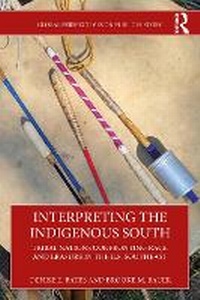
Interpreting the Indigenous South
Tribal Nations Confronting Race and Erasure in the U.S. Southeast
1st Edition
Will be published approx. on 21. September 2026
Book
Paperback/Softback
208 pages
978-1-032-02040-2 (ISBN)
Description
Interpreting the Indigenous South reframes public history as a space of Indigenous authority and self-representation, where communities define how their histories are told, their knowledge preserved, and their relationships to place understood.
In the American South, where Indigenous histories have long been obscured by narratives of disappearance, Native nations are not only present but are actively reclaiming how their stories are told. Drawing on vivid examples from across the region, this book shows how tribal nations have transformed museums, archives, landscapes, and public platforms into instruments of cultural survival and continuity. The book reveals how Indigenous communities are using public history as a living practice to sustain their identities and project their futures. From environmental stewardship and commemorative journeys to digital storytelling and intergenerational teaching, what outsiders may dismiss as performance or tourism emerges as strategic practice.
By exploring different methodological approaches and providing multiple examples of how tribal communities are involved in the co-production of knowledge and historical interventions, this book will appeal to students and scholars of Native American studies and history, as well as public history practitioners.
In the American South, where Indigenous histories have long been obscured by narratives of disappearance, Native nations are not only present but are actively reclaiming how their stories are told. Drawing on vivid examples from across the region, this book shows how tribal nations have transformed museums, archives, landscapes, and public platforms into instruments of cultural survival and continuity. The book reveals how Indigenous communities are using public history as a living practice to sustain their identities and project their futures. From environmental stewardship and commemorative journeys to digital storytelling and intergenerational teaching, what outsiders may dismiss as performance or tourism emerges as strategic practice.
By exploring different methodological approaches and providing multiple examples of how tribal communities are involved in the co-production of knowledge and historical interventions, this book will appeal to students and scholars of Native American studies and history, as well as public history practitioners.
More details
Series
Language
English
Place of publication
London
United Kingdom
Publishing group
Taylor & Francis Ltd
Target group
College/higher education
Professional and scholarly
Postgraduate, Professional, and Undergraduate Advanced
Illustrations
19 s/w Abbildungen, 19 s/w Photographien bzw. Rasterbilder
19 Halftones, black and white; 19 Illustrations, black and white
Dimensions
Height: 229 mm
Width: 152 mm
ISBN-13
978-1-032-02040-2 (9781032020402)
Copyright in bibliographic data and cover images is held by Nielsen Book Services Limited or by the publishers or by their respective licensors: all rights reserved.
Schweitzer Classification
Other editions
Additional editions

Denise E. Bates | Brooke M. Bauer
Interpreting the Indigenous South
Tribal Nations Confronting Race and Erasure in the U.S. Southeast
E-Book
approx. 09/2026
Taylor & Francis
€55.49
Not yet available
Brooke M. Bauer | Denise E. Bates
Interpreting the Indigenous South
Tribal Nations Confronting Race and Erasure in the U.S. Southeast
Book
approx. 09/2026
1st Edition
Global Perspectives on Public History
€191.50
Not yet published
Denise E. Bates | Brooke M. Bauer
Interpreting the Indigenous South
Tribal Nations Confronting Race and Erasure in the U.S. Southeast
E-Book
approx. 09/2026
Taylor & Francis
€55.49
Not yet available
Persons
Denise E. Bates is a Professor of History and Dean of University College at Tufts University. She is the author of The Other Movement: Indian Rights and Civil Rights in the Deep South (2012) and Basket Diplomacy: Leadership, Alliance-Building, and Resilience among the Coushatta Tribe of Louisiana, 1884-1984 (2020).
Brooke M. Bauer, a citizen of the Catawba Nation, is an Associate Professor in the Department of History at the University of Tennessee - Knoxville, chair of the UTK Native American and Indigenous Studies Program, and the author of Becoming Catawba: Catawba Indian Women and Nation-building, 1540-1840 (2023).
Brooke M. Bauer, a citizen of the Catawba Nation, is an Associate Professor in the Department of History at the University of Tennessee - Knoxville, chair of the UTK Native American and Indigenous Studies Program, and the author of Becoming Catawba: Catawba Indian Women and Nation-building, 1540-1840 (2023).
Content
Introduction 1. We Are Still Here: Confronting Historical Silences 2. For Safekeeping: Collecting and Stewarding Cultural Knowledge 3. Re-Mapping the South: Indigenous Geographies and Homeland Representations 4. Telling Our Stories: Tribal Displays and Public Education in the South 5. Beyond the Museum: Indigenous Public Presence in the South 6. Carrying the Story Forward: Some Final Thoughts on the Future of Southern Tribal Public History