

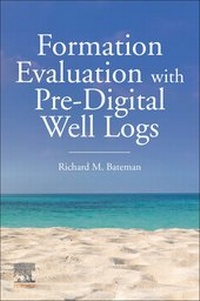
Formation Evaluation with Pre-Digital Well Logs
Published on 11. February 2020
Book
Paperback/Softback
284 pages
978-0-12-820232-6 (ISBN)
Description
Formation Evaluation with Pre-Digital Well Logs covers the practical use of legacy materials for formation evaluation using wireline logging equipment from 1927 until the introduction of digital logging in the 1960s and '70s. The book provides powerful interpretation techniques that can be applied today when an analyst is faced with a drawer full of old "E logs." It arms the engineer, geologist and petrophysicist with the tools needed to profitably plan re-completions or in-fill drilling in old fields that may have been acquired for modern deeper and/or horizontal drilling.
More details
Language
English
Place of publication
United States
Target group
Professional and scholarly
Geologists, Geophysicists, Exploration, Geologists, Log Analysts, Petrophysicists. Economists, Managers, Bankers, Reserve Estimators and Certifiers
Illustrations
Approx. 137 illustrations (12 in full color)
Dimensions
Height: 229 mm
Width: 152 mm
Weight
450 gr
ISBN-13
978-0-12-820232-6 (9780128202326)
Copyright in bibliographic data and cover images is held by Nielsen Book Services Limited or by the publishers or by their respective licensors: all rights reserved.
Schweitzer Classification
Other editions
Additional editions
Richard M. Bateman
Formation Evaluation with Pre-Digital Well Logs
E-Book
02/2020
Elsevier
€144.00
Available for download
Person
Richard M. Bateman was educated in the UK obtaining his M.A. in Natural Science, Physics from Oxford University. He began his career in the oil industry in South America as a field engineer for Schlumberger. He worked in many North and South American field locations and later spent three years at the Schlumberger Doll Research Centre in Ridgefield, Connecticut. He subsequently joined Amoco International Oil Company (now BP) and travelled extensively throughout the world from their Chicago headquarters finding oil and gas and teaching others how to do so. Richard has also held posts as Chief Petrophysicist of Halliburton Logging Services, Engineering Manager for Bridas (now Pan American Energy), Manager for Gaffney Cline and Associates' Latin American operations, based in Buenos Aires, and as a well log interpretation and petrophysics instructor for PetroSkills/OGCI. Richard has authored four books and multiple patents and technical papers. He is a Senior and Life Member of the SPE and is also active with the SPWLA and the SCA. Richard recently retired as a member of the faculty of Texas Tech University as an Associate Professor in the Petroleum Engineering Department.
Content
Section I The Mechanics of reading old E-Log paper prints1. Introduction2. Applications
Section II Sources for Rt & Rxo3. Resistivity Logging Tools
Section III Sources for Porosity4. Sonic5. Count-Rate Neutron6. Gamma Gamma (Uncompensated) Density7. Sidewall (Epithermal) Neutron and Compensated (Thermal) Neutron8. Microlog9. SP
Section IV Saturation Determination and Archive Alternatives10. Rocky Mountain Method11. Pickett and Hingle Plots12. Log Analysis in Empty holes13. Quick-look Methods (Rwa, F-Overlay)
Section V Permeability Estimates14. Timur, Wyllie and Rose, Resistivity Gradients and SP
Section VI Lithology15. Neutron, Density and Sonic Crossplots, Gamma Ray and SP
Section VII Miscellaneous16. Dipmeter17. Formation Tester18. Early Computer Processed Interpretations (CPI)
Section II Sources for Rt & Rxo3. Resistivity Logging Tools
Section III Sources for Porosity4. Sonic5. Count-Rate Neutron6. Gamma Gamma (Uncompensated) Density7. Sidewall (Epithermal) Neutron and Compensated (Thermal) Neutron8. Microlog9. SP
Section IV Saturation Determination and Archive Alternatives10. Rocky Mountain Method11. Pickett and Hingle Plots12. Log Analysis in Empty holes13. Quick-look Methods (Rwa, F-Overlay)
Section V Permeability Estimates14. Timur, Wyllie and Rose, Resistivity Gradients and SP
Section VI Lithology15. Neutron, Density and Sonic Crossplots, Gamma Ray and SP
Section VII Miscellaneous16. Dipmeter17. Formation Tester18. Early Computer Processed Interpretations (CPI)