

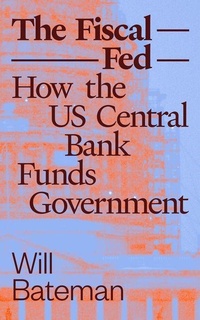
The Fiscal Fed
How the US Central Bank Funds Government
Will be published approx. on 30. October 2026
Book
Paperback/Softback
208 pages
978-0-226-85128-0 (ISBN)
Description
A revelatory history of how the Federal Reserve finances American power.
Central banks, we are told, are economic superpowers that must remain independent of modern democratic governments. The US Federal Reserve's presumed insulation from politics affords it autonomy and credibility to control inflation and promote economic stability-or so the story goes.
In The Fiscal Fed, Will Bateman offers a deeply sourced, empirical history that shows the Fed's primary function is actually, and has always been, fiscal-sustaining the market for Treasury borrowing that makes up the difference between federal spending and federal revenue. Bateman combs Fed meeting transcripts, staff notes, financial accounts, and legal documents to trace loans and public-debt purchases since the central bank's founding. The result is a milestone work that reveals how, for most of the Fed's history, its transactions were aimed at government financing-either by providing cheap credit to close budget gaps or by manipulating yields on government debt. The Fed's support for government finance is a feature, not a bug, of American economic institutions.
Central banks, we are told, are economic superpowers that must remain independent of modern democratic governments. The US Federal Reserve's presumed insulation from politics affords it autonomy and credibility to control inflation and promote economic stability-or so the story goes.
In The Fiscal Fed, Will Bateman offers a deeply sourced, empirical history that shows the Fed's primary function is actually, and has always been, fiscal-sustaining the market for Treasury borrowing that makes up the difference between federal spending and federal revenue. Bateman combs Fed meeting transcripts, staff notes, financial accounts, and legal documents to trace loans and public-debt purchases since the central bank's founding. The result is a milestone work that reveals how, for most of the Fed's history, its transactions were aimed at government financing-either by providing cheap credit to close budget gaps or by manipulating yields on government debt. The Fed's support for government finance is a feature, not a bug, of American economic institutions.
More details
Series
Language
English
Place of publication
Chicago
United States
Publishing group
The University of Chicago Press
Target group
Professional and scholarly
Illustrations
4 halftones, 3 tables
Dimensions
Height: 216 mm
Width: 140 mm
Weight
454 gr
ISBN-13
978-0-226-85128-0 (9780226851280)
Copyright in bibliographic data and cover images is held by Nielsen Book Services Limited or by the publishers or by their respective licensors: all rights reserved.
Schweitzer Classification
Person
Will Bateman is a professor at the Australian National University, College of Law, Governance and Policy. His research has been published in the Modern Law Review, Oxford Journal of Legal Studies,Review of International Political Economy, and he is the author of Public Finance and Parliamentary Constitutionalism.
Content
Preface
Introduction
1. Exceptional Monetary Dominance
2. The Fiscal Fed's Prehistory
3. The Fiscal Fed's Birth: World War and the Debt Market
4. Fiscal Support During the Great Depression
5. Controlling Yields: War Finance
6. Fiscal Support in the Golden Age of Capitalism
7. The Anti-Fiscal Fed
8. The Fiscal Fed Redux
9. "We're Monetizing the Deficit"
10. Theorizing the Fiscal Fed
Conclusion: An Exceptionally Fiscal Fed?
Appendix
Acknowledgments
Notes
Bibliography
Index
Introduction
1. Exceptional Monetary Dominance
2. The Fiscal Fed's Prehistory
3. The Fiscal Fed's Birth: World War and the Debt Market
4. Fiscal Support During the Great Depression
5. Controlling Yields: War Finance
6. Fiscal Support in the Golden Age of Capitalism
7. The Anti-Fiscal Fed
8. The Fiscal Fed Redux
9. "We're Monetizing the Deficit"
10. Theorizing the Fiscal Fed
Conclusion: An Exceptionally Fiscal Fed?
Appendix
Acknowledgments
Notes
Bibliography
Index