

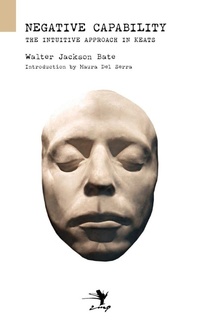
Negative Capability
The Intuitive Approach in Keats
Published on 26. July 2012
Book
Paperback/Softback
128 pages
978-0-9836972-3-7 (ISBN)
Description
Walter Jackson Bate's canonical 1939 study of Keats's concept of negative capability is a genealogical treatise that unearths the socio-political, aesthetic, and intellectual composition of Keats's most famous poetic idea. He discloses its relation to Hazlitt's idea of "gusto" and to Shakespearean notions of impersonality and intensity while also demonstrating how negative capability presages Bergson's conceptual interpretation of intellect and intuition.
Bate reveals how the key elements of Keats's poetic concept are disinterestedness, sympathy, impersonality, and dramatic poetry, defining negative capability as "the ability to negate or lose one's identity in something larger than oneself - a sympathetic openness to the concrete reality without, an imaginative identification, a relishing and understanding of it."
With 'negative capability,' Keats railed against the rampant egotism of his epoch and challenged the certainty of its claims to knowledge. While embracing reality, Keats urged the necessity of abiding in uncertainties, mysteries, and doubts.
This new edition brings back into print Bate's indispensable work and features an introduction by the distinguished Italian poet, playwright, and literary critic Maura Del Serra. With its republication, Eliot's proclamation on Keats is given new force: that "there is hardly one statement of Keats about poetry which ... will not be found to be true..."
More details
Edition
Revised ed.
Language
English
Place of publication
United States
Product notice
Paperback (trade)
Illustrations
black & white illustrations
Dimensions
Height: 203 mm
Width: 127 mm
Thickness: 8 mm
Weight
147 gr
ISBN-13
978-0-9836972-3-7 (9780983697237)
Copyright in bibliographic data and cover images is held by Nielsen Book Services Limited or by the publishers or by their respective licensors: all rights reserved.
Schweitzer Classification