

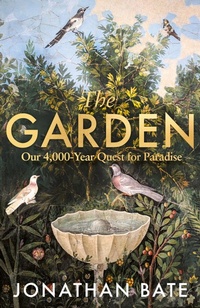
The Garden
Our 4,000 Year Quest for Paradise
Will be published approx. on 22. October 2026
Book
Hardback
592 pages
978-0-00-861055-5 (ISBN)
Description
From the Garden of Eden to Gethsemane, from the Hanging Gardens of Babylon to the pleasure gardens of Versailles, from the Zen gardens of Kyoto to the landscapes of Capability Brown and New York's High Line, the garden has always been far more than somewhere to grow things.
It is where humanity has worked out its relationship with the natural world - the place where culture, spirituality and nature converge. An inspiration for poets, painters and philosophers across four thousand years and every civilisation on earth.
In this magnificent work of scholarship, one of our greatest literary critics and cultural historians takes us on an extraordinary journey through the gardens of both the world and the human imagination. Sweeping in scope and ambition, this sumptuous and richly illustrated book reveals the garden as a place where we have always worked out our deepest longings for beauty, order, innocence and belonging. Drawing on poetry, painting, philosophy, mythology and religion - from Ovid and the Song of Solomon to Shakespeare, Jane Austen and Emily Dickinson - he shows how the garden has inspired our greatest art and consoled us in our darkest hours.
Here is the space where, as Andrew Marvell wrote, we may annihilate 'all that's made / To a green thought in a green shade' - that perfect, paradoxical stillness in which the mind empties itself into nature and finds itself restored.
Gardening is the most popular leisure activity in Britain. More than 27 million of us tend a plot, a window box, a rooftop or a patch of earth. Illustrated with more than 150 beautiful images, this book reminds us that it is to the garden, private and public, that we turn for solace, sustenance and sanity. It is a reminder that wherever we human beings have settled, we have reached, instinctively, towards the garden.
It is where humanity has worked out its relationship with the natural world - the place where culture, spirituality and nature converge. An inspiration for poets, painters and philosophers across four thousand years and every civilisation on earth.
In this magnificent work of scholarship, one of our greatest literary critics and cultural historians takes us on an extraordinary journey through the gardens of both the world and the human imagination. Sweeping in scope and ambition, this sumptuous and richly illustrated book reveals the garden as a place where we have always worked out our deepest longings for beauty, order, innocence and belonging. Drawing on poetry, painting, philosophy, mythology and religion - from Ovid and the Song of Solomon to Shakespeare, Jane Austen and Emily Dickinson - he shows how the garden has inspired our greatest art and consoled us in our darkest hours.
Here is the space where, as Andrew Marvell wrote, we may annihilate 'all that's made / To a green thought in a green shade' - that perfect, paradoxical stillness in which the mind empties itself into nature and finds itself restored.
Gardening is the most popular leisure activity in Britain. More than 27 million of us tend a plot, a window box, a rooftop or a patch of earth. Illustrated with more than 150 beautiful images, this book reminds us that it is to the garden, private and public, that we turn for solace, sustenance and sanity. It is a reminder that wherever we human beings have settled, we have reached, instinctively, towards the garden.
Reviews / Votes
PRAISE FOR BRIGHT STAR, GREEN LIGHT: 'Keats is unmissably present throughout Fitzgerald's work ... [Bate] borrows a classic form to pay tribute to the broadest, extratemporal similarities between Keats and ... Fitzgerald' Sunday Times 'Keats was Fitzgerald's guiding star ... An energetic and highly engaging game of literary ping-pong across the ages. Life, writing and inspiration are served and returned in a rapid rally of ideas ... What an immensely charismatic pair they are ... Powerful ... Go now, read this book' Laura Freeman, The Times 'A daring, dizzying attempt to connect Keats and F Scott Fitzgerald has plenty to take pleasure in ... Bate, whose recent biography of Wordsworth I admired, is at his best when he zeroes in on the work: his feeling for it, by being so exacting, is infectious, especially in the case of Keats ... But in the end, the principal achievement of this pairing is to remind us of the way that literature connects us' Rachel Cooke, Observer 'Admirable ... lively and well researched ... Bate's book is certainly an excellent introduction to each writer ... satisfying, engaging and accessible ... well designed to make us return to the work of both Keats and his 'Keatzian' devotee' New Statesman 'Bate tells the tales of these accursed creatures frightfully well' Daily Mail 'With a fine-tuned ear for poetic language, a master-biographer's eye for the revealing detail, and an astonishing mental filing system that recognizes countless meaningful matches among the works and lives of these two great, doomed writers, Jonathan Bate has written a wonderfully illuminating and moving book' Robert Watson, Distinguished Professor of English, UCLAMore details
Language
English
Place of publication
London
United Kingdom
Publishing group
HarperCollins Publishers
Dimensions
Height: 240 mm
Width: 159 mm
Thickness: 21 mm
Weight
270 gr
ISBN-13
978-0-00-861055-5 (9780008610555)
Copyright in bibliographic data and cover images is held by Nielsen Book Services Limited or by the publishers or by their respective licensors: all rights reserved.
Schweitzer Classification
Other editions
Additional editions

E-Book
approx. 10/2026
William Collins
€17.99
Not yet available
Person
Sir Jonathan Bate is the author of twenty books, including biographies, all of which won prizes, of English literature's three great poets of nature: William Wordsworth, Ted Hughes and John Clare. Foundation Professor of Environmental Humanities at Arizona State University and a Senior Research Fellow at Oxford University, where he was formerly Provost of Worcester College, he is widely regarded as one of the world's leading Shakespeare scholars as well as a pioneer of ecological approaches to literature and culture. The citation for his knighthood described him as 'truly a Renaissance man'. He has a reading knowledge of ancient Greek, Latin, Italian, French and German, but will ensure that colleagues with relevant expertise check his treatment of Chinese, Arabic, Russian, Japanese and Hispanic sources. He is a keen gardener himself.