

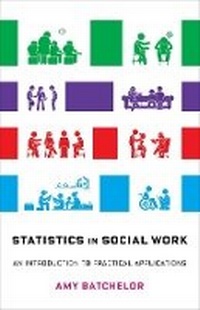
Statistics in Social Work
An Introduction to Practical Applications
Will be published approx. on 19. November 2019
Book
Paperback/Softback
208 pages
978-0-231-19327-6 (ISBN)
Description
Understanding statistical concepts is essential for social work professionals. It is key to understanding research and reaching evidence-based decisions in your own practice-but that is only the beginning. If you understand statistics, you can determine the best interventions for your clients. You can use new tools to monitor and evaluate the progress of your client or team. You can recognize biased systems masked by complex models and the appearance of scientific neutrality. For social workers, statistics are not just math, they are a critical practice tool.
This concise and approachable introduction to statistics limits its coverage to the concepts most relevant to social workers. Statistics in Social Work guides students through concepts and procedures from descriptive statistics and correlation to hypothesis testing and inferential statistics. Besides presenting key concepts, it focuses on real-world examples that students will encounter in a social work practice. Using concrete illustrations from a variety of potential concentrations and populations, Amy Batchelor creates clear connections between theory and practice-and demonstrates the important contributions statistics can make to evidence-based and rigorous social work practice.
This concise and approachable introduction to statistics limits its coverage to the concepts most relevant to social workers. Statistics in Social Work guides students through concepts and procedures from descriptive statistics and correlation to hypothesis testing and inferential statistics. Besides presenting key concepts, it focuses on real-world examples that students will encounter in a social work practice. Using concrete illustrations from a variety of potential concentrations and populations, Amy Batchelor creates clear connections between theory and practice-and demonstrates the important contributions statistics can make to evidence-based and rigorous social work practice.
Reviews / Votes
Statistics in Social Work is a practical and effective resource for social work students. Batchelor requires no prior knowledge of statistics from her readers and explains topics in plain language with relatable examples. Most importantly, she offers a social justice perspective that emphasizes and integrates the core value of the social work profession. -- Ashley Davis, Boston University This is an excellent introduction to statistics for both students and practitioners in social work-it demystifies terms and procedures and uses real world examples to help the reader to see the everyday applicability of statistical knowledge, whether in practice or in study. -- John Devaney, coauthor of <i>Quantitative Research Methods for Social Work: Making Social Work Count</i>More details
Language
English
Place of publication
New York
United States
Target group
Professional and scholarly
Product notice
Paperback (trade)
Illustrations
50 figures
Dimensions
Height: 216 mm
Width: 140 mm
ISBN-13
978-0-231-19327-6 (9780231193276)
Copyright in bibliographic data and cover images is held by Nielsen Book Services Limited or by the publishers or by their respective licensors: all rights reserved.
Schweitzer Classification
Other editions
Additional editions
E-Book
11/2019
Columbia University Press
€29.49
Available for download
Book
11/2019
Columbia University Press
€124.00
Shipment within 10-20 days
Person
Amy Batchelor has taught Introduction to Statistics at the Columbia University School of Social Work since 2016. She also works on federal budget policy in Washington, DC.
Content
Acknowledgments
1. Introduction
2. Creating Useful Data
3. Understanding People and Populations
4. Variance: The Distance Between Us
5. The Statistics of Relationships
6. Sampling: The Who and the How
7. What Works? Hypothesis Testing and Inferential Statistics
8. When Two Is Not Enough: Testing with Multiple Groups
9. An Introduction to Advanced Concepts
Appendix I: Glossary
Appendix II: Answer Key for Review Questions
Appendix III: Equations Cheat Sheet
References
1. Introduction
2. Creating Useful Data
3. Understanding People and Populations
4. Variance: The Distance Between Us
5. The Statistics of Relationships
6. Sampling: The Who and the How
7. What Works? Hypothesis Testing and Inferential Statistics
8. When Two Is Not Enough: Testing with Multiple Groups
9. An Introduction to Advanced Concepts
Appendix I: Glossary
Appendix II: Answer Key for Review Questions
Appendix III: Equations Cheat Sheet
References