

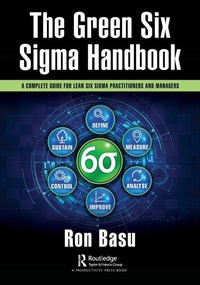
The Green Six Sigma Handbook
A Complete Guide for Lean Six Sigma Practitioners and Managers
1st Edition
Published on 8. September 2022
Book
Paperback/Softback
664 pages
978-1-032-21401-6 (ISBN)
Description
This book is a hands-on single-source reference of tools, techniques, and processes integrating both Lean and Six Sigma. This comprehensive handbook provides up-to-date guidance on how to use these tools and processes in different settings, such as start-up companies and stalled projects, as well as establish enterprises where the ongoing drive is to improve processes, profitability, and long-term growth. It contains the "hard" Six Sigma approach as well as the flexible approach of FIT SIGMA, which is adaptable to manufacturing and service industries and also public sector organisations. You will also discover how climate change initiatives can be accelerated to sustainable outcomes by the holistic approach of Green Six Sigma.
The book is about what we can do now with leadership, training, and teamwork in every sphere of our businesses. Lean, originally developed by Toyota, is a set of processes and tools aimed at minimising wastes. Six Sigma provides a set of data-driven techniques to minimise defects and improve processes. Integrating these two approaches provides a comprehensive and proven approach that can transform an organisation. To make change happen, we need both digital tools and analog approaches. We know that there has been a continuous push to generate newer approaches to operational excellence, such as Total Quality Management, Six Sigma, Lean Sigma, Lean Six Sigma, and FIT SIGMA.
It is vital that we harness all our tools and resources to regenerate the economy after the Covid-19 pandemic and make climate change initiatives successful for the survival of our planet. Six Sigma and its hybrids (e.g., Lean Six Sigma) should also play a significant part. Over the last three decades, operational performance levels of both public sector and private sector organisations improved significantly and Lean Six Sigma has also acted as a powerful change agent. We urgently need an updated version of these tools and approaches.
The Green Six Sigma Handbook not only applies appropriate Lean and Six Sigma tools and approaches, fitness for the purpose, but it aims at sustainable changes. This goal of sustainability is a stable bridge between Lean Six Sigma and climate change initiatives. Hence, when the tools and approaches of Lean Six Sigma are focused and adapted primarily to climate change demands, we get Green Six Sigma.
The book is about what we can do now with leadership, training, and teamwork in every sphere of our businesses. Lean, originally developed by Toyota, is a set of processes and tools aimed at minimising wastes. Six Sigma provides a set of data-driven techniques to minimise defects and improve processes. Integrating these two approaches provides a comprehensive and proven approach that can transform an organisation. To make change happen, we need both digital tools and analog approaches. We know that there has been a continuous push to generate newer approaches to operational excellence, such as Total Quality Management, Six Sigma, Lean Sigma, Lean Six Sigma, and FIT SIGMA.
It is vital that we harness all our tools and resources to regenerate the economy after the Covid-19 pandemic and make climate change initiatives successful for the survival of our planet. Six Sigma and its hybrids (e.g., Lean Six Sigma) should also play a significant part. Over the last three decades, operational performance levels of both public sector and private sector organisations improved significantly and Lean Six Sigma has also acted as a powerful change agent. We urgently need an updated version of these tools and approaches.
The Green Six Sigma Handbook not only applies appropriate Lean and Six Sigma tools and approaches, fitness for the purpose, but it aims at sustainable changes. This goal of sustainability is a stable bridge between Lean Six Sigma and climate change initiatives. Hence, when the tools and approaches of Lean Six Sigma are focused and adapted primarily to climate change demands, we get Green Six Sigma.
More details
Language
English
Place of publication
London
United Kingdom
Publishing group
Taylor & Francis Ltd
Target group
Professional and scholarly
Professional
Illustrations
125 s/w Abbildungen, 125 s/w Zeichnungen
125 Line drawings, black and white; 125 Illustrations, black and white
Dimensions
Height: 254 mm
Width: 178 mm
Thickness: 37 mm
Weight
1282 gr
ISBN-13
978-1-032-21401-6 (9781032214016)
Copyright in bibliographic data and cover images is held by Nielsen Book Services Limited or by the publishers or by their respective licensors: all rights reserved.
Schweitzer Classification
Other editions
Additional editions
Book
09/2022
1st Edition
Productivity Press
€205.50
Shipment within 10-20 days
E-Book
09/2022
1st Edition
Productivity Press
€64.49
Available for download
E-Book
09/2022
1st Edition
Productivity Press
€64.49
Available for download
Person
Dr Ron Basu is Director of RB Consultants and a Visiting Executive Fellow at Henley Business School. He is also a Visiting Professor at SKEMA Graduate School of Management, Lille. Previously he worked as a Management Consultant with A.T. Kearney and then held senior management roles in blue-chip companies like Unilever and GlaxoSmthKline.
Content
Part 1: Foundations of Six Sigma and Lean Chapter 1: Quality and Operations Excellence Chapter 2: Evolution of Six Sigma, Lean Sigma and Green Six Sigma Chapter 3: More of Green Six Sigma Chapter 4: Green Six Sigma Projects Management using DMAICS Chapter 5: The Scope of Green Six Sigma Tools and Techniques Chapter 6: Green Six Sigma and Digital Revolution Chapter 7: Green Six Sigma in Manufacturing, Services and Projects Part 2: Tools for Green Six Sigma Chapter 8: Tools for Definition Chapter 9: Tools for Measurement Chapter 10: Tools for Analysis Chapter 11: Tools for Improvement Chapter 12: Tools for Control Chapter 13: Tools for Sustain Part 3: Techniques for Green Six Sigma Chapter 14: Quantitative Techniques Chapter 15: Qualitative Techniques Part 4: Green Six Sigma and Climate Change Chapter 16: Climate Change Challenges Chapter 17: International and National Climate Change Initiatives Chapter 18: Green Six Sigma and Clean Energy Chapter 19: Green Six Sigma and Green Supply Chain Chapter 20: Green Six Sigma and Green Transport Chapter 21: Green Six Sigma and Retrofitting Buildings Chapter 22: Green Six Sigma and Climate Adaptation Part 5: Implementation of Green Six Sigma Chapter 23: Case Studies Chapter 24: Making It Happen Chapter 25: Afterword