

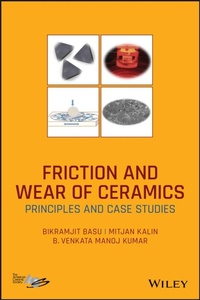
Friction and Wear of Ceramics: Principles and Case Studies
Principles and Case Studies
1st Edition
Published on 25. June 2020
Book
Hardback
640 pages
978-1-119-53838-7 (ISBN)
Description
This book covers the area of tribology broadly, providing important introductory chapters to fundamentals, processing, and applications of tribology. The book is designed primarily for easy and cohesive understanding for students and practicing scientists pursuing the area of tribology with focus on materials. This book helps students and practicing scientists alike understand that a comprehensive knowledge about the friction and wear properties of advanced materials is essential to further design and development of new materials.
The description of the wear micromechanisms of various materials will provide a strong background to the readers as how to design and develop new tribological materials. This book also places importance on the development of new ceramic composites in the context of tribological applications. The various sections of the book discuss fundamentals of nature and properties of materials, friction and wear of structural ceramics, bioceramics, biocomposites, and nanoceramics, as well as lightweight composites and friction and wear of ceramics in a cryogenic environment.
Some of the key features of the book include: Fundamentals section highlights the salient issues of ceramic processing and mechanical properties of important oxide and non-oxide ceramic systems; State of the art research findings on important ceramic composites are included and an understanding on the behavior of silicon carbide (SiC) based ceramic composites in dry sliding wear conditions is presented as a case study; Erosion wear behavior of ceramics, in which case studies on high temperature erosion behavior of SiC based composites and zirconium diboride (ZrB2) based composites is also covered; Wear behavior of ceramic coatings is rarely discussed in any tribology related books therefore a case study explaining the abrasion wear behavior of WC-Co coating is provided. Finally an appendix chapter is included in which a collection of several types of questions including multiple choice, short answer and long answer ae provided.
More details
Other editions
Additional editions
Bikramjit Basu | Mitjan Kalin | B. V. Manoj Kumar
Friction and Wear of Ceramics
Principles and Case Studies
E-Book
05/2020
1st Edition
Wiley
€162.99
Available for download
Bikramjit Basu | Mitjan Kalin | B. V. Manoj Kumar
Friction and Wear of Ceramics
Principles and Case Studies
E-Book
05/2020
1st Edition
Wiley
€167.99
Available for download
Persons
Bikramjit Basu, PhD, is currently a Professor at the Materials Research Center with joint appointment at the Centre for Biosystems Science and Engineering, and Interdisciplinary center for Energy Research at Indian Institute of Science, Bangalore. He served on the faculty of Indian Institute of Technology Kanpur during 2001-2011. As a researcher, he has made pioneering contributions towards innovative research at the intersection of multiple Engineering disciplines and Natural Sciences, to develop a wide spectrum of structural ceramics with wear resistance properties.
Mitjan Kalin, PhD, is currently a Professor at the Faculty of Mechanical Engineering, University of Ljubljana, where he is the Head of the Laboratory for Tribology and Interface Nanotechnology and the Chair for Tribology and Maintenance Technology. Dr Kalin's areas of research are the wear and friction mechanisms of advanced materials, nanoscale interface phenomena, and boundary films for novel green-lubrication technologies, including his widely recognized contribution to the lubrication of DLC coatings.
B. Venkata Manoj Kumar, PhD, is currently working as Associate Professor at Department of Metallurgical and Materials Engineering, Indian Institute of Technology, Roorkee. With the primary theme of understanding microstructure-property relations, Dr. Kumar has been actively involved in processing advanced ceramic systems like SiC, B4C, ZrB2 etc., and studying the influence of microstructural characteristics on their material removal mechanisms when subjected to varieties of wear and machining conditions.
Content
About the Authors
Foreword by Dr. Sanak Mishra
Foreword by Prof. Koji Kato
Preface
Section I: Fundamentals of Ceramics
Chapter 1: Introduction: Ceramics and Tribology
1.1 Introduction
1.2 Classification of engineering materials
1.3 Engineering ceramics
1.4 Structural ceramics: typical properties and tribological applications
1.5 Structure of the book
1.6 Closure
References
Chapter 2: Processing of bulk ceramics and coatings
2.1 Introduction
2.2 Conventional processing of ceramics
2.2.1 Sintering mechanism
2.2.2 Conventional processing of ceramics
2.2.2.1 Powder processing and Compaction
2.2.2.2 Pressureless sintering
2.2.3 Advanced processing of ceramics
2.2.3.1 Hot pressing
2.2.3.2 Microwave sintering
2.2.3.3. Spark plasma sintering
2.3 Thermal spray based coating deposition
2.3.1. Basics of thermal spray deposition
2.3.1.1 Plasma spray deposition
2.3.1.1.2 Flame spray deposition
2.3.1.3 Wire arc spray deposition
2.3.1.4 High-velocity-oxy-fuel (HVOF) spray deposition
2.3.1.5 Detonation sprayed coatings (DSC)
2.3.2 Bond strength of thermal sprayed coatings
2.3.2.1 Bond mechanism
2.3.2.2 Test methods
2.3.3 Coating structure
2.3.3.1 Particle and substrate material properties
2.3.3.2 Particle temperature and velocity
2.3.4 Case study: WC-Co coating
2.4 Closure
References
Chapter 3: Conventional and advanced machining processes
3.1 Introduction
3.2 Conventional machining
3.3. Advanced machining processes
3.3.1 Electrodischarge machining (EDM)
3.3.1.1 Working principle
3.3.1.2 EDM process variables
3.3.1.3 EDM parameters
3.3.1.4 Surface analysis
3.3.1.5 EDM of ceramic-based composites
3.4 Closure
References
Chapter 4: Mechanical properties of ceramics
4.1 Defining stress and strain
4.2 Comparison of tensile behavior
4.3 Brittle fracture of ceramics
4.4. Cracking in Brittle Materials
4.5 Experimental assessment of mechanical properties
4.5.1 Hardness
4.5.2 Compressive strength
4. 5.3 Flexural Strength
4.5.4 Tensile strength
4.5.5 Elastic modulus
4.5.6 Fracture toughness
4.5.6.1 Notched beam tests
4.5.6.2 Indentation microfracture method
4.5.7 Practical guidelines for the for reliable measurements
4.6 Closure
References
Section II: Fundamentals of Tribology
Chapter 5: Contact surface characteristics
5.1 Nature and roughness of contact surfaces
5.2 Surface roughness measurement
5.2.1 Stylus method
5.2.2 Atomoc force microscopy
5.2.3 Optical interferometry
5.2.4 Laser surface profilometry
5.2.5. Scanning electron microscopy
5.3 Bearing area curve and cumulative distribution function
5.4 Nominal vs. real contact area
5.5 Hertzian contact stress
5.6 Closure
References
Chapter 6: Friction and interface temperatures
6.1 Theory of friction
6.1.1. Friction laws and mechanisms
6.2 Types of friction
6.2.1 Static and kinetic friction
6.2.2 Slip-stick friction
6.2.3 Rolling friction
6.3 Friction of engineering material classes
6.4 Frictional heating and temperature at the interface
6. 4. 1 Heating due to friction
6. 4. 2 Understanding the temperature in the contact: the bulk and flash temperatures
6.5 Analytical models to predict the temperatures in the contact
6.6 Implications of important contact temperature models
6.6.1. Archard model
6.6.2. Kong-Ashby model
6.6 Closure
References
Chapter 7: Wear of ceramics and lubrication
7.1 Introduction
7.2. Testing methods and quantification of wear of materials
7.3 Classification of wear mechanisms
7.3.1 Tribomechanical wear
7.3.1.1 Adhesive wear
7.3.1.2 Abrasive wear
7.3.1.3 Fatigue wear
7.3.1.4 Fretting wear
7.3.1.5 Erosive wear
7.3.2 Tribochemical wear
7.3.2.1. Oxidative wear
7.4 Lubrication
7.4.1 Regimes of lubrication and the Stribeck curve
7.4.2 Influence of lubricant composition, contact pressure and temperature on lubrication
7.5 Closure
References
Section III: Sliding Wear of Ceramics
Chapter 8: Case Study: Sliding wear of SiC ceramics
8.1 Introduction
8.2. Materials and experiments
8.3 Friction and wear behavior SiC ceramics sintered with small amount of yttria additive
8.4 Influence of mechanical properties on sliding wear of SiC ceramics
8.5. Wear mechanisms
8.6 Closure
References
Chapter 9: Case study: Counterbody and temperature dependent sliding wear of SiC-WC Ceramics
9.1 Introduction
9.2. Microstructure and mechanical characteristics of SiC-WC composites
9.3. Influence of counterbody and WC content
9.3.1. Friction and wear behavior
9.3.2. Mechanisms of material removal
9.3.3. Friction and wear of SiC-WC composites: system-dependent properties
9.3.4 Wear mechanisms as function of counterbody and WC content
9.4. Reciprocated sliding wear behavior of SiC-WC composites
9.4.1. Frictional and wear behavior
9.4.2. Critical analysis of wear mechanisms
9.4.2.1.Debris analysis
9.4.2.2. Effect of temperature
9.4.2.3. Effect of test configuration on wear behavior
9.5. Sub-surface investigation of worn SiC-WC composites
9.5.1. Sub-surface damages and corresponding inferences
9.5.2 Cross-sectional microstructural analysis and interfacial characteristics
9.5.3. Sub-surface plastic deformation:
9.6. Closure:
Chapter 10: Sliding wear of zirconia-toughened alumina
10.1 Introduction
10.2 Mechanical properties of ZTA
10.3 Sliding wear properties of ZTA
10.4 Correlating cracking mediated wear with theoretical analysis
10.5 Closure
Chapter 11: Case study: Abrasive wear of detonation sprayed WC-12Co coatings
11.1 Introduction
11.2 Coatings and abrasive wear
11.3. Abrasive wear results
11.4 Surface and sub-surface damage mechanisms
11.5 Closure
References
Chapter 12: Case study: Solid-lubricant interaction and friction at lubricated contacts
12.1 Introduction
12.2 Materials and sliding wear experiments
12.3 Wetting and spreading properties
12.4 Surface energies of different class of materials
12.5 Wetting evaluation of engineering surfaces
12.6 Effect of wetting on EHL friction
12.7 Correlation between spreading parameter and friction
12.8 Closure
References
Section IV: Erosive Wear of Ceramics
Chapter 13: Case Study: Erosive wear of SiC-WC composites
13.1 Introduction
13.2 Materials and erosion tests
13.3 Influence of type of erodent on erosion behaviour
13.4 Influence of impingement angle and WC content on erosion behavior
13.5 Correlating erosion behaviour with microstructural characteristics
13.6 Correlating erosion behaviour with mechanical properties
13.7 Erosion behaviour at high temperature
13.8 Closure
References
Chapter 14: Case Study: Thermo-erosive behavior of ZrB2-SiC composites
14.1 Introduction
14.2 High temperature erosion tests and computational modeling
14.3 Computational modeling of thermo-erosive behaviour
14.4 High temperature erosion test results
14.5 Transient thermal studies using Finite Element analysis
14.6 Coupled thermo-structural analysis
14.7 Thermo-erosive behavior
14.8 Closure
References
Chapter 15: Case Study: Erosive wear of WC-Co coating
15.1 Introduction
15.2 Materials and erosion experiments
15.3 Erosion wear mechanisms (surface damage)
15.4 Erosion wear mechanisms (sub-surface damage)
15.5 Correlating wear mechanism with erodent and coating properties
15.6 Closure
References
Section V: Machining induced wear of cermets
Chapter 16: Crater wear of TiCN cermets in conventional machining
16.1 Introduction
16.2 TiCN cermets and machining conditions
16.3 Wear mechanisms of TiCN-WC-Ni cermets
16.4 Machining with TiCN-WC-TaC-Ni-Co cermet tools
16.5 Correlating cermet composition, microstructure and wear during machining
16.6 Closure
References
Chapter 17: Wear of TiCN-based cermets in electrodischarge machining
17.1 Introduction
17.2 Materials and EDM tests
17.3 Wear of TiCN-cermets during EDM
17.4 Mechanisms of material removal during EDM
17.5 Closure
References
Section VI: Future scope
Chapter 18: Perspective
18.1 Innovation cycle for wear resistant materials
18.2 in situ diagnosis of tribological interactions
18.3 High temperature wear testing
18.4 Modeling and simulation in tribology
18.5 Tribomaterialomics- a new concept
18.6 Education and mentoring of next generation researchers
References
Appendix: Appraisal
A. I Multiple choice questions
A. II Select the appropriate combination
A. III Fill in the blanks with the most appropriate response
A. IV Mention the appropriate material/equipment in the blank
A. V Identify whether the following statements are True/False:
A. VI Short review questions and descriptive questions
A. VII Analytical questions
A. VIII Model answers