

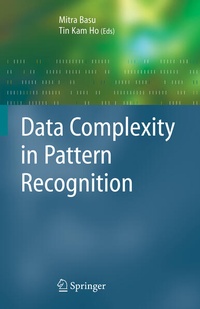
Data Complexity in Pattern Recognition
Published on 22. October 2010
Book
Paperback/Softback
XVI, 300 pages
978-1-84996-557-6 (ISBN)
Description
Machines capable of automatic pattern recognition have many fascinating uses in science & engineering as well as in our daily lives. Algorithms for supervised classification, where one infers a decision boundary from a set of training examples, are at the core of this capability.
This book takes a close view of data complexity & its role in shaping the theories & techniques in different disciplines & asks:
- What is missing from current classification techniques?
- When the automatic classifiers are not perfect, is it a deficiency of the algorithms by design, or is it a difficulty intrinsic to the classification task?
- How do we know whether we have exploited to the fullest extent the knowledge embedded in the training data?
Uunique in its comprehensive coverage & multidisciplinary approach from various methodological & practical perspectives, researchers & practitioners will find this book an insightful reference to learn about current available techniques as well as application areas.
More details
Series
Edition
Softcover reprint of hardcover 1st ed. 2006
Language
English
Place of publication
London
United Kingdom
Target group
Professional and scholarly
Research
Illustrations
XVI, 300 p.
Dimensions
Height: 235 mm
Width: 155 mm
Thickness: 18 mm
Weight
482 gr
ISBN-13
978-1-84996-557-6 (9781849965576)
DOI
10.1007/978-1-84628-172-3
Schweitzer Classification
Other editions
Additional editions
Mitra Basu | Tin Kam Ho
Data Complexity in Pattern Recognition
E-Book
12/2006
1st Edition
Springer
€149.79
Available for download
Mitra Basu | Tin Kam Ho
Data Complexity in Pattern Recognition
Book
10/2006
Springer
€160.49
Shipment within 15-20 days
Content
Theory and Methodology.- Measures of Geometrical Complexity in Classification Problems.- Object Representation, Sample Size, and Data Set Complexity.- Measures of Data and Classifier Complexity and the Training Sample Size.- Linear Separability in Descent Procedures for Linear Classifiers.- Data Complexity, Margin-Based Learning, and Popper's Philosophy of Inductive Learning.- Data Complexity and Evolutionary Learning.- Classifier Domains of Competence in Data Complexity Space.- Data Complexity Issues in Grammatical Inference.- Applications.- Simple Statistics for Complex Feature Spaces.- Polynomial Time Complexity Graph Distance Computation for Web Content Mining.- Data Complexity in Clustering Analysis of Gene Microarray Expression Profiles.- Complexity of Magnetic Resonance Spectrum Classification.- Data Complexity in Tropical Cyclone Positioning and Classification.- Human-Computer Interaction for Complex Pattern Recognition Problems.- Complex Image Recognition and Web Security.