

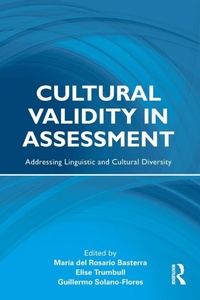
Cultural Validity in Assessment
Addressing Linguistic and Cultural Diversity
1st Edition
Published on 20. December 2010
Book
Paperback/Softback
320 pages
978-0-415-99980-9 (ISBN)
Description
What is assessment and how is it a cultural practice? How does failure to account for linguistic and cultural variation among students jeopardize assessment validity? What is required to achieve cultural validity in assessment? This resource for practicing and prospective teachers - as well as others concerned with fair and valid assessment - provides a thorough grounding in relevant theory, research, and practice. The book lays out criteria for culturally valid assessment and recommends specific strategies that teachers can use to design and implement culturally valid classroom assessments.
Assessment plays a powerful role in the process of education in the US and has a disproportionately negative impact on students who do not come from mainstream, middle-class backgrounds. Given the significance of testing in education today, cultural validity in assessment is an urgent issue facing educators. This book is essential reading for addressing this important, relevant topic.
Assessment plays a powerful role in the process of education in the US and has a disproportionately negative impact on students who do not come from mainstream, middle-class backgrounds. Given the significance of testing in education today, cultural validity in assessment is an urgent issue facing educators. This book is essential reading for addressing this important, relevant topic.
More details
Series
Language
English
Place of publication
London
United Kingdom
Publishing group
Taylor & Francis Ltd
Target group
College/higher education
Illustrations
33 s/w Zeichnungen, 19 s/w Tabellen
19 Tables, black and white; 33 Line drawings, black and white
Dimensions
Height: 229 mm
Width: 152 mm
Thickness: 17 mm
Weight
466 gr
ISBN-13
978-0-415-99980-9 (9780415999809)
Copyright in bibliographic data and cover images is held by Nielsen Book Services Limited or by the publishers or by their respective licensors: all rights reserved.
Schweitzer Classification
Other editions
Additional editions
Maria del Rosario Basterra | Elise Trumbull | Guillermo Solano-Flores
Cultural Validity in Assessment
Addressing Linguistic and Cultural Diversity
E-Book
04/2011
Routledge
€76.49
Available for download
Maria del Rosario Basterra | Elise Trumbull | Guillermo Solano-Flores
Cultural Validity in Assessment
Addressing Linguistic and Cultural Diversity
E-Book
04/2011
Routledge
€76.49
Available for download
Maria del Rosario Basterra | Elise Trumbull | Guillermo Solano-Flores
Cultural Validity in Assessment
Addressing Linguistic and Cultural Diversity
Book
12/2010
1st Edition
Routledge
€251.50
Shipment within 15-20 days
Persons
Maria del Rosario Basterra is Independent Educational Consultant, Washington, DC, specializing in issues related to English language learners, language minority students, multicultural education, and preschool education.
Elise Trumbull is Independent Educational Consultant, Oakland, CA, specializing in issues related to language and culture in schooling, and Lecturer, California State University, Northridge, Department of Educational Psychology and Counseling.
Guillermo Solano-Flores is Associate Professor, Bilingual Education and English as a Second Language, University of Colorado at Boulder.
Elise Trumbull is Independent Educational Consultant, Oakland, CA, specializing in issues related to language and culture in schooling, and Lecturer, California State University, Northridge, Department of Educational Psychology and Counseling.
Guillermo Solano-Flores is Associate Professor, Bilingual Education and English as a Second Language, University of Colorado at Boulder.
Content
Foreword
Eugene Garcia
Preface
Acknowledgments
PART I
Cultural Validity in Assessment-Basic Concepts
1. Assessing the Cultural Validity of Assessment Practices: An Introduction-Guillermo Solano-Flores
2. The Role of Language in Assessment- Elise Trumbull and Guillermo Solano-Flores
PART II
Assessing Students of Linguistically and Culturally Diverse Backgrounds
3. Assessing English Language Learners: Critical Issues- Jamal Abedi
4. Cognition, Culture, Language, and Assessment: How to Select Culturally Valid Assessments in the Classroom- Maria del Rosario Basterra
5. Using Appropriate Assessment Processes: How to Get Accurate Information about the Academic Knowledge and Skills of English Language Learners - Rebecca Kopriva and Ursula Sexton
6. Ensuring Valid Educational Assessments for ELL Students: Scores, Score Interpretation, and Assessment Uses- Richard P. Duran
7. Promoting Cultural Validity in the Assessment of Bilingual Special Education Students- John J. Hoover and Janette Klingner
8. Overview of Current Federal Policies in Assessment and Accountability and Their Impact on ELL Students- Julia Lara and Magda Chia
PART III
Field Efforts to Increase Cultural Validity in Assessment
9. Language Arts: Designing and Using a Reading Assessment for Learners Transitioning to English-Only Instruction- Elise Trumbull and Nanette Koelsch
10. Addressing the Language Demands of Mathematics Assessment: Using a Language Framework and Field Research Findings- Elise Trumbull and Guillermo Solano-Flores
11. Science and Literacy Assessments with English Language Learners- Okhee Lee, Alexandra Santau, and Jaime Maerten-Rivera
PART IV
Conclusion
12. Reflections on the Promise of Cultural Validity in Assessment- Elise Trumbull, Maria del Rosario Basterra, and Guillermo Solano-Flores
Eugene Garcia
Preface
Acknowledgments
PART I
Cultural Validity in Assessment-Basic Concepts
1. Assessing the Cultural Validity of Assessment Practices: An Introduction-Guillermo Solano-Flores
2. The Role of Language in Assessment- Elise Trumbull and Guillermo Solano-Flores
PART II
Assessing Students of Linguistically and Culturally Diverse Backgrounds
3. Assessing English Language Learners: Critical Issues- Jamal Abedi
4. Cognition, Culture, Language, and Assessment: How to Select Culturally Valid Assessments in the Classroom- Maria del Rosario Basterra
5. Using Appropriate Assessment Processes: How to Get Accurate Information about the Academic Knowledge and Skills of English Language Learners - Rebecca Kopriva and Ursula Sexton
6. Ensuring Valid Educational Assessments for ELL Students: Scores, Score Interpretation, and Assessment Uses- Richard P. Duran
7. Promoting Cultural Validity in the Assessment of Bilingual Special Education Students- John J. Hoover and Janette Klingner
8. Overview of Current Federal Policies in Assessment and Accountability and Their Impact on ELL Students- Julia Lara and Magda Chia
PART III
Field Efforts to Increase Cultural Validity in Assessment
9. Language Arts: Designing and Using a Reading Assessment for Learners Transitioning to English-Only Instruction- Elise Trumbull and Nanette Koelsch
10. Addressing the Language Demands of Mathematics Assessment: Using a Language Framework and Field Research Findings- Elise Trumbull and Guillermo Solano-Flores
11. Science and Literacy Assessments with English Language Learners- Okhee Lee, Alexandra Santau, and Jaime Maerten-Rivera
PART IV
Conclusion
12. Reflections on the Promise of Cultural Validity in Assessment- Elise Trumbull, Maria del Rosario Basterra, and Guillermo Solano-Flores