

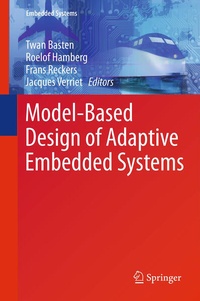
Model-Based Design of Adaptive Embedded Systems
Published on 8. February 2015
Book
Paperback/Softback
XIV, 306 pages
978-1-4899-9619-0 (ISBN)
Description
This book describes model-based development of adaptive embedded systems, which enable improved functionality using the same resources. The techniques presented facilitate design from a higher level of abstraction, focusing on the problem domain rather than on the solution domain, thereby increasing development efficiency. Models are used to capture system specifications and to implement (manually or automatically) system functionality. The authors demonstrate the real impact of adaptivity on engineering of embedded systems by providing several industrial examples of the models used in the development of adaptive embedded systems.
More details
Series
Edition
2013 ed.
Language
English
Place of publication
New York
United States
Target group
Professional and scholarly
Research
Illustrations
XIV, 306 p.
Dimensions
Height: 235 mm
Width: 155 mm
Thickness: 18 mm
Weight
487 gr
ISBN-13
978-1-4899-9619-0 (9781489996190)
DOI
10.1007/978-1-4614-4821-1
Schweitzer Classification
Other editions
Additional editions
Twan Basten | Roelof Hamberg | Frans Reckers
Model-Based Design of Adaptive Embedded Systems
Book
03/2013
Springer
€106.99
Shipment within 15-20 days
Twan Basten | Roelof Hamberg | Frans Reckers
Model-Based Design of Adaptive Embedded Systems
E-Book
03/2013
1st Edition
Springer
€96.29
Available for download
Content
Adaptivity in Professional Printing Systems.- Aspects of Adaptive Systems Engineering: A Professional Printing Case.- Piezo Printhead Control: Jetting Any Drop at Any Time.- Adaptive Strategies for Productive Toner Printers.- Reasoning with Uncertainty about System Behaviour: Making Printing Systems Adaptive.- Supporting the Architecting Process of Adaptable Systems.- Model-Driven Design-Space Exploration for Software-Intensive Embedded Systems.- Engineering Embedded Software: Managing Complexity and Evolution.- Reflections on the Octopus Project.