

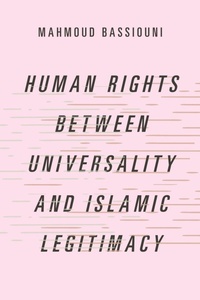
Human Rights Between Universality and Islamic Legitimacy
Published on 20. December 2024
Book
Hardback
312 pages
978-0-19-775389-7 (ISBN)
Description
Are concepts of human rights universal? If so, how does one reconcile them with schools of thought that Western regimes often view as hostile to universal human rights, such as Islamic fundamentalism? This question often ends in the assumption that Sharia law cannot be reconciled with human rights or that there needs to be a one-way adaption of Sharia to human rights concepts. Others view the application of human rights ideas to Sharia as an imperial intrusion.
In Human Rights Between Universality and Islamic Legitimacy, Mahmoud Bassiouni addresses the debate surrounding the compatibility of Islam and human rights. He argues that to understand their compatibility, we need to better understand the dynamic way in which Islamic tradition has evolved relative to international human rights. He asserts that existing Islamic human rights schemes have not been able to formulate an approach that adequately balances the double requirement of universality and Islamic legitimacy, and have done little to contribute to a more profound and methodologically coherent understanding of human rights. Including analyses of different Muslim positions, Bassiouni identifies their merits and shortcomings and asks how we can rethink and answer open questions in human rights philosophy by bringing the resources of the Islamic tradition to bear upon them.
Overall, Human Rights Between Universality and Islamic Legitimacy engages current debates on human rights in the field of political theory and offers an Islamically informed perspective, which at times substantiates, at other times challenges, orthodox understandings of human rights. As a result, Bassiouni shows how an engagement with the Islamic legal tradition can contribute to the construction of a more sound and coherent theory of human rights.
In Human Rights Between Universality and Islamic Legitimacy, Mahmoud Bassiouni addresses the debate surrounding the compatibility of Islam and human rights. He argues that to understand their compatibility, we need to better understand the dynamic way in which Islamic tradition has evolved relative to international human rights. He asserts that existing Islamic human rights schemes have not been able to formulate an approach that adequately balances the double requirement of universality and Islamic legitimacy, and have done little to contribute to a more profound and methodologically coherent understanding of human rights. Including analyses of different Muslim positions, Bassiouni identifies their merits and shortcomings and asks how we can rethink and answer open questions in human rights philosophy by bringing the resources of the Islamic tradition to bear upon them.
Overall, Human Rights Between Universality and Islamic Legitimacy engages current debates on human rights in the field of political theory and offers an Islamically informed perspective, which at times substantiates, at other times challenges, orthodox understandings of human rights. As a result, Bassiouni shows how an engagement with the Islamic legal tradition can contribute to the construction of a more sound and coherent theory of human rights.
More details
Series
Language
English
Place of publication
New York
United States
Target group
College/higher education
Product notice
sewn/stitched
Cloth over boards
Dimensions
Height: 246 mm
Width: 165 mm
Thickness: 33 mm
Weight
567 gr
ISBN-13
978-0-19-775389-7 (9780197753897)
Copyright in bibliographic data and cover images is held by Nielsen Book Services Limited or by the publishers or by their respective licensors: all rights reserved.
Schweitzer Classification
Other editions
Additional editions
Mahmoud Bassiouni
Human Rights Between Universality and Islamic Legitimacy
E-Book
09/2024
OUP eBook
€94.49
Available for download
Mahmoud Bassiouni
Human Rights Between Universality and Islamic Legitimacy
E-Book
09/2024
OUP eBook
€94.49
Available for download
Person
Mahmoud Bassiouni is an Assistant Professor in Political Science at Goethe University Frankfurt. He teaches and writes on the philosophy of human rights, political secularism, and Islamic political and legal thought.
Content
Acknowledgments
I. Contexts of Muslim Human Rights Discourse
1. The Contemporary Context
2. Historical Context
3. Theological Context
II. Reconstructing the Muslim Discourse on Human Rights
4. Rejection and Incompatibility
5. Appropriation
6. Assimilation
7. Summary and Outlook
III. Islamic Foundations of a Universal Conception of Human Rights
8. The Purpose of Islamic Law (Maqasid Al-Sharia)
9. A Critical Review
10. New Conceptions of the Maqasid
IV. Human Rights and Human Needs
11. Conceptions of Human Rights
12. Human Needs
13. Human Rights as Institutions for the Protection of Human Needs
Conclusion
References
Index
I. Contexts of Muslim Human Rights Discourse
1. The Contemporary Context
2. Historical Context
3. Theological Context
II. Reconstructing the Muslim Discourse on Human Rights
4. Rejection and Incompatibility
5. Appropriation
6. Assimilation
7. Summary and Outlook
III. Islamic Foundations of a Universal Conception of Human Rights
8. The Purpose of Islamic Law (Maqasid Al-Sharia)
9. A Critical Review
10. New Conceptions of the Maqasid
IV. Human Rights and Human Needs
11. Conceptions of Human Rights
12. Human Needs
13. Human Rights as Institutions for the Protection of Human Needs
Conclusion
References
Index