

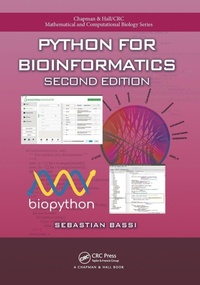
Python for Bioinformatics
2nd Edition
Published on 10. July 2017
Book
Paperback/Softback
424 pages
978-1-138-03526-3 (ISBN)
Description
In today's data driven biology, programming knowledge is essential in turning ideas into testable hypothesis. Based on the author's extensive experience, Python for Bioinformatics, Second Edition helps biologists get to grips with the basics of software development. Requiring no prior knowledge of programming-related concepts, the book focuses on the easy-to-use, yet powerful, Python computer language.
This new edition is updated throughout to Python 3 and is designed not just to help scientists master the basics, but to do more in less time and in a reproducible way. New developments added in this edition include NoSQL databases, the Anaconda Python distribution, graphical libraries like Bokeh, and the use of Github for collaborative development.
This new edition is updated throughout to Python 3 and is designed not just to help scientists master the basics, but to do more in less time and in a reproducible way. New developments added in this edition include NoSQL databases, the Anaconda Python distribution, graphical libraries like Bokeh, and the use of Github for collaborative development.
More details
Series
Edition
2nd edition
Language
English
Place of publication
London
United Kingdom
Publishing group
Taylor & Francis Ltd
Target group
Professional and scholarly
Academic, Professional, and Professional Practice & Development
Illustrations
12 s/w Tabellen, 2 s/w Zeichnungen, 59 s/w Abbildungen, 57 s/w Photographien bzw. Rasterbilder
12 Tables, black and white; 2 Line drawings, black and white; 57 Halftones, black and white; 59 Illustrations, black and white
Dimensions
Height: 254 mm
Width: 178 mm
Thickness: 25 mm
Weight
866 gr
ISBN-13
978-1-138-03526-3 (9781138035263)
Copyright in bibliographic data and cover images is held by Nielsen Book Services Limited or by the publishers or by their respective licensors: all rights reserved.
Schweitzer Classification
Other editions
Additional editions
Sebastian Bassi
Python for Bioinformatics
E-Book
08/2017
2nd Edition
Chapman & Hall/CRC
€104.99
Available for download
Sebastian Bassi
Python for Bioinformatics
E-Book
08/2017
2nd Edition
Chapman & Hall/CRC
€104.99
Available for download
Sebastian Bassi
Python for Bioinformatics
Book
07/2017
2nd Edition
CRC Press
€275.29
Shipment within 10-20 days
Previous edition
Sebastian Bassi
Python for Bioinformatics
Book
10/2009
1st Edition
Chapman & Hall/CRC
€105.55
Article exhausted; check for reprint
Person
Sebastian Bassi is a Biotechnologist with experience both in software development and bioinformatics research. He worked more than four years for an agribusiness company doing molecular marker database curation. He also helped the EU-SOL project with the bioinformatics support of the international effort to sequence the tomato genome. Both positions involved Python development and intensive data manipulation. While working on this project also collaborated with the development of a web application to query a micro RNA database, which was published at BMC Plant Biology (doi:10.1186/1471-2229-10-240). He also worked on the first Linux distribution for bioinformatics (DNALinux). The last five years we had been working at Globant where he was involved in several projects for leading companies. During this time he was exposed to a myriad of technologies such as Django, Selenium, MongoDB, PostgreSQL, Amazon Web Services (he is an AWS Certified Solutions Architect), PHP and Ruby (among others). He is frequently invited to Python conferences such as Pycon and SciPy.
Content
Introduction. First Steps with Python. Basic Programming: Data Types. Programming: Flow Control. Code Modularizing. Handling Files. Error Handling. Introduction to Object Oriented Programming. Introduction to Biopython. Web Applications. XML. Introduction to Databases. Collaborative Development. Regular Expressions. Unicode. Graphics. Sequence Manipulation in Batch. Web Application for Filtering Vector Communication. Primer Design Flanking a Variable Length Region. Calculating Melting Temperature from a Set of Primers. Converting XML Blast File into HTML. Infering Splicing Sites. DNA Mutations with Restrictions. Web Server for Multiple Alignment. Drawing Marker Positions Using Data Stored in a Database. Appendix.