

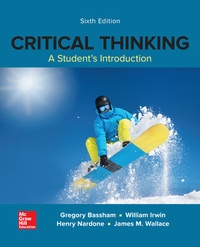
Critical Thinking: A Student's Introduction
6th Edition
Published on 3. December 2018
Book
Paperback/Softback
544 pages
978-0-07-803839-6 (ISBN)
Description
In a hyper-connected digital world buzzing with both information and illogic, facts and spin, critical thinking has never been more challenging or important. This popular, learner-friendly text gives today's students the critical reasoning tools they need to survive and thrive--in school, in their careers, and in life. It covers all the basics of critical thinking, using class-tested real-world examples and a proven step-by-step approach. Its comprehensiveness allows instructors to tailor the material to their individual teaching styles, resulting in an exceptionally versatile text.
More details
Content
Critical Thinking: A Student's Introduction, 6e
CHAPTER 1: Introduction to Critical Thinking
CHAPTER 2: Recognizing Arguments
CHAPTER 3: Basic Logical Concepts
CHAPTER 4: Language
CHAPTER 5: Logical Fallacies--1
CHAPTER 6: Logical Fallacies--2
CHAPTER 7: Analyzing Arguments
CHAPTER 8: Evaluating Arguments and Truth Claims
CHAPTER 9: A Little Categorical Logic
CHAPTER 10: A Little Propositional Logic
CHAPTER 11: Inductive Reasoning
CHAPTER 12: Finding, Evaluating and Using Sources
CHAPTER 13: Writing Argumentative Essays
CHAPTER 14: Thinking Critically about the Media
CHAPTER 15: Science and Pseudoscience
CHAPTER 1: Introduction to Critical Thinking
CHAPTER 2: Recognizing Arguments
CHAPTER 3: Basic Logical Concepts
CHAPTER 4: Language
CHAPTER 5: Logical Fallacies--1
CHAPTER 6: Logical Fallacies--2
CHAPTER 7: Analyzing Arguments
CHAPTER 8: Evaluating Arguments and Truth Claims
CHAPTER 9: A Little Categorical Logic
CHAPTER 10: A Little Propositional Logic
CHAPTER 11: Inductive Reasoning
CHAPTER 12: Finding, Evaluating and Using Sources
CHAPTER 13: Writing Argumentative Essays
CHAPTER 14: Thinking Critically about the Media
CHAPTER 15: Science and Pseudoscience