

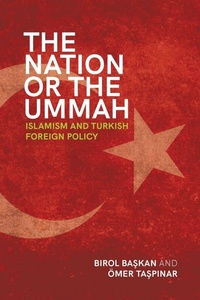
The Nation or the Ummah
Islamism and Turkish Foreign Policy
Published on 2. July 2022
Book
Paperback/Softback
222 pages
978-1-4384-8648-2 (ISBN)
Description
Explains why Turkey embraced the Arab Spring despite the risk both domestically and internationally.
Turkey's enthusiastic embrace of the Arab Spring set in motion a dynamic that fundamentally altered its relations with the United States, Russia, Qatar, Egypt, Saudi Arabia, the United Arab Emirates, and Iran, and transformed Turkey from a soft power to a hard power in the tangled geopolitics of the Middle East. Birol Baskan and OEmer Taspinar argue that the ruling Justice and Development Party's (AKP) Islamist background played a significant role in the country's decision to embrace the uprisings and the subsequent foreign policy direction the country has pursued. They demonstrate that religious ideology is endogenous to-shaping and in turn being shaped by-Turkey's various engagements in the Middle East. The Nation or the Ummah emphasizes that while Islamist religious ideology does not provide specific policy prescriptions, it does shape the way the ruling elite sees and interprets the context and the structural boundaries they operate within.
Turkey's enthusiastic embrace of the Arab Spring set in motion a dynamic that fundamentally altered its relations with the United States, Russia, Qatar, Egypt, Saudi Arabia, the United Arab Emirates, and Iran, and transformed Turkey from a soft power to a hard power in the tangled geopolitics of the Middle East. Birol Baskan and OEmer Taspinar argue that the ruling Justice and Development Party's (AKP) Islamist background played a significant role in the country's decision to embrace the uprisings and the subsequent foreign policy direction the country has pursued. They demonstrate that religious ideology is endogenous to-shaping and in turn being shaped by-Turkey's various engagements in the Middle East. The Nation or the Ummah emphasizes that while Islamist religious ideology does not provide specific policy prescriptions, it does shape the way the ruling elite sees and interprets the context and the structural boundaries they operate within.
Reviews / Votes
"...this book is a valuable contribution to the field of Turkish studies. Two top experts provide a very good overview of Turkish foreign policy and propose a framework for understanding Turkey's policy choices in the Arab Spring. The book also provides a good case study for those who want to analyze the intersection of domestic and foreign policy and how ideology can be relevant in foreign policy decisions. It will therefore be useful for a broad audience interested in Turkish politics, Islamism, or foreign policy analysis." - Bustan: The Middle East Book Review"...highly topical and timely ... this book is a very good read for students of Turkish politics, Islamism, religion, international relations, and foreign policy." - Middle East Journal
More details
Language
English
Place of publication
Albany, NY
United States
Target group
Professional and scholarly
US School Grade: College Graduate Student and over
Product notice
Paperback (trade)
Dimensions
Height: 229 mm
Width: 152 mm
Thickness: 14 mm
Weight
371 gr
ISBN-13
978-1-4384-8648-2 (9781438486482)
Copyright in bibliographic data and cover images is held by Nielsen Book Services Limited or by the publishers or by their respective licensors: all rights reserved.
Schweitzer Classification
Other editions
Additional editions
E-Book
12/2021
1st Edition
De Gruyter
from
€84.99
Available for download
Persons
Birol Baskan is non-resident scholar at the Middle East Institute. He is the author of several books, including Turkey and Qatar in the Tangled Geopolitics of the Middle East and From Religious Empires to Secular States: State Secularization in Turkey, Iran, and Russia. OEmer Taspinar is Professor of National Security Strategy at the National War College and Senior Fellow at the Brookings Institution. He is the author of several books, including What the West is Getting Wrong about the Middle East: Why Islam is Not the Problem.
Content
Acknowledgments
Introduction
1. Turkey's Traditional Kemalist Foreign Policy
2. JDP's First Decade
3. The Arab Spring
4. Islamism at Work
Conclusion: Reflections on the so-called Turkish Model
Notes
Bibliography
Index
Introduction
1. Turkey's Traditional Kemalist Foreign Policy
2. JDP's First Decade
3. The Arab Spring
4. Islamism at Work
Conclusion: Reflections on the so-called Turkish Model
Notes
Bibliography
Index