

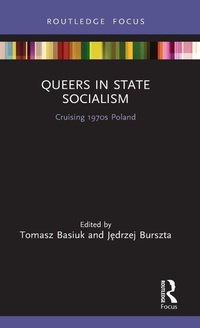
Queers in State Socialism
Cruising 1970s Poland
1st Edition
Published on 23. October 2020
Book
Hardback
132 pages
978-0-367-56334-9 (ISBN)
Description
This short collection of essays engages with queer lives and activism in 1970s Poland, illustrating discourses about queerness and a trajectory of the struggle for rights which clearly sets itself apart, and differs from a Western-based narrative of liberation.
Contributors to this volume paint an uneven landscape of queer life in state-socialist Poland in the 1970s and early 1980s. They turn to oral history interviews and archival sources which include police files, personal letters, literature and criticism, writings by sexuality experts, and documentation of artistic practice. Unlike most of Europe, Poland did not penalize same-sex acts, although queer people were commonly treated with suspicion and vilified. But while many homosexual men and most lesbian women felt invisible and alone, some had the sense of belonging to a fledgling community. As they looked to the West, hoping for a sexual revolution that never quite arrived, they also preserved informal queer institutions dating back to the prewar years and used them to their advantage. Medical experts conversed with peers across the Iron Curtain but developed their own "socialist" methods and successfully prompted the state to recognize transgender rights, even as that state remained determined to watch and intimidate homosexual men. Literary critics, translators, and art historians began debating-and they debate still-how to read gestures defying gender and sexual norms: as an aspect of some global "gay" formation or as stemming from locally grounded queer traditions.
Emphasizing the differences of Poland's LGBT history from that of the "global" West while underscoring the existing lines of communication between queer subjects on either side of the Iron Curtain, this book will be of key interest to scholars and students in gender and sexuality studies, social history, and politics.
Contributors to this volume paint an uneven landscape of queer life in state-socialist Poland in the 1970s and early 1980s. They turn to oral history interviews and archival sources which include police files, personal letters, literature and criticism, writings by sexuality experts, and documentation of artistic practice. Unlike most of Europe, Poland did not penalize same-sex acts, although queer people were commonly treated with suspicion and vilified. But while many homosexual men and most lesbian women felt invisible and alone, some had the sense of belonging to a fledgling community. As they looked to the West, hoping for a sexual revolution that never quite arrived, they also preserved informal queer institutions dating back to the prewar years and used them to their advantage. Medical experts conversed with peers across the Iron Curtain but developed their own "socialist" methods and successfully prompted the state to recognize transgender rights, even as that state remained determined to watch and intimidate homosexual men. Literary critics, translators, and art historians began debating-and they debate still-how to read gestures defying gender and sexual norms: as an aspect of some global "gay" formation or as stemming from locally grounded queer traditions.
Emphasizing the differences of Poland's LGBT history from that of the "global" West while underscoring the existing lines of communication between queer subjects on either side of the Iron Curtain, this book will be of key interest to scholars and students in gender and sexuality studies, social history, and politics.
More details
Series
Language
English
Place of publication
London
United Kingdom
Publishing group
Taylor & Francis Ltd
Target group
College/higher education
Illustrations
2 s/w Abbildungen, 2 s/w Photographien bzw. Rasterbilder, 5 s/w Tabellen
5 Tables, black and white; 2 Halftones, black and white; 2 Illustrations, black and white
Dimensions
Height: 222 mm
Width: 145 mm
Thickness: 12 mm
Weight
326 gr
ISBN-13
978-0-367-56334-9 (9780367563349)
Copyright in bibliographic data and cover images is held by Nielsen Book Services Limited or by the publishers or by their respective licensors: all rights reserved.
Schweitzer Classification
Other editions
Additional editions
Book
04/2022
1st Edition
Routledge
€36.00
Shipment within 15-20 days
E-Book
10/2020
1st Edition
Routledge
€31.49
Available for download
E-Book
10/2020
1st Edition
Routledge
€31.49
Available for download
Persons
Tomasz Basiuk is Associate Professor at the University of Warsaw. He authored Exposures: American Gay Men's Life Writing since Stonewall (2013), a monograph on the novelist William Gaddis (published in Polish in 2003); co-edited, with Dominika Ferens and Tomasz Sikora, three volumes of essays on queer studies: Odmiany odmienca/A Queer Mixture (2002), Parametry pozadania (2006), and Out Here (2006); guest-edited a special journal issue on gender and sexuality (Dialogue and Universalism XX.5-6, 2010); and co-edited, with Krystyna Mazur and Sylwia Kuzma-Marowska, The American Uses of History. Essays on Public Memory (2011). He is the co-founder of the online queer studies journal InterAlia (since 2006), a former Fulbright visiting scholar at the CUNY Graduate Center, and a Research Fellow at Indiana University at Bloomington. Basiuk served as Principal Investigator in the HERA-funded "Cruising the 1970s. Unearthing Pre-HIV/AIDS Queer Sexual Cultures."
Jedrzej Burszta holds a PhD in cultural studies from the SWPS University in Warsaw (2019). He is Affiliated Faculty Member at the American Studies Center, University of Warsaw. His research interests include ethnography, queer theory, American speculative fiction, and popular culture. In 2015, together with Zuzanna Grebecka, he authored an ethnography of personal memories of the Soviet Army stationing in Legnica during state socialism in Poland, entitled Mowiono "druga Moskwa." Wspomnienia legniczan o stacjonowaniu Armii Radzieckiej w latach 1945-1993 (They Called it "Little Moscow." Memories of Soviet Army Stationing in Legnica in the Years 1945-1933). He is also a novelist and writes for the theatre.
Jedrzej Burszta holds a PhD in cultural studies from the SWPS University in Warsaw (2019). He is Affiliated Faculty Member at the American Studies Center, University of Warsaw. His research interests include ethnography, queer theory, American speculative fiction, and popular culture. In 2015, together with Zuzanna Grebecka, he authored an ethnography of personal memories of the Soviet Army stationing in Legnica during state socialism in Poland, entitled Mowiono "druga Moskwa." Wspomnienia legniczan o stacjonowaniu Armii Radzieckiej w latach 1945-1993 (They Called it "Little Moscow." Memories of Soviet Army Stationing in Legnica in the Years 1945-1933). He is also a novelist and writes for the theatre.
Content
1. Introduction: queers in the People's Republic of Poland: an uneven landscape Part 1: Socialities and their literary models 2. Three circles of male homosexual life in state-socialist Poland 3. One's younger self in personal testimony and literary translation 4. "Transgression has become a fact": a Gothic genealogy of queerness in the People's Republic of Poland 5. Queens and faggots, Petites Folles et Pedales: representation of Communist-era Polish queers in translations of Lubiewo ( Lovetown ) Part 2: Expert discourses 6. Diagnosing transsexualism, diagnosing society: the blurred genres of Polish sexology in the 1970s and 1980s 7. "Treatment is possible and effective?": Polish sexologists and queers in correspondence in late state socialism 8. "No authorities are interested in us, no one interferes in our affairs?": policing homosexual men in the People's Republic of Poland Part 3: Queer intelligibility and unintelligibility 9. "No one talked about it": the paradoxes of lesbian identity in pre-1989 Poland 10. Queer (in)visibility in the art of the People's Republic of Poland