

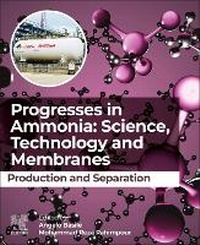
Progresses in Ammonia: Science, Technology and Membranes
Production and Separation
Published on 8. February 2024
Book
Paperback/Softback
440 pages
978-0-323-88502-7 (ISBN)
Description
Progresses in Ammonia: Science, Technology, and Membranes: Production and Separation covers the production and separation of ammonia. Ammonia is considered a very important inorganic basic. It plays an essential role in the manufacture of fertilizer, as well as in the production of plastics, fibers, explosives, and intermediates for dyes and pharmaceuticals. Beginning with the discussion of composite membrane-based systems, this book explores ammonia synthesis, ammonia separation through membrane distillation, ammonia recovery from wastewater and salty liquids, and ammonia emission control. Model-based analysis has also been used extensively in this book through various case studies. Therefore this book is a valuable resource for postgraduate students, researchers, energy producers, and R&D managers.
More details
Language
English
Place of publication
Philadelphia
United States
Target group
Professional and scholarly
Dimensions
Height: 235 mm
Width: 191 mm
Weight
450 gr
ISBN-13
978-0-323-88502-7 (9780323885027)
Copyright in bibliographic data and cover images is held by Nielsen Book Services Limited or by the publishers or by their respective licensors: all rights reserved.
Schweitzer Classification
Other editions
Additional editions
Angelo Basile | Mohammad Reza Rahimpour
Progresses in Ammonia: Science, Technology and Membranes
Production and Separation
E-Book
02/2024
Elsevier
€200.00
Available for download
Persons
Angelo Basile is a Full Professor and a leading authority in membrane science and technology. Since 2014, he has served as Full Professor in Systems, Methods and Technologies of Chemical Engineering Processes at CNR-ITM in Rende, Italy. His work covers hydrogen purification and production using membrane reactors, CO? capture, process intensification, and the treatment of industrial effluents with advanced membrane operations. Basile has edited many scientific books and authored numerous book chapters, bridging complex research with clear knowledge for engineers and scientists. Motivated by the role of AI/ML in accelerating membrane process design and automation, he supports integrating data-driven methods for smart plants and reaction-separation optimisation.
Prof. Mohammad Reza Rahimpour is a professor in Chemical Engineering at Shiraz University, Iran. He received his Ph.D. in Chemical Engineering from Shiraz University joint with University of Sydney, Australia 1988. He started his independent career as Assistant Professor in September 1998 at Shiraz University. Prof. M.R. Rahimpour, was a Research Associate at University of California, Davis from 2012 till 2017. During his stay in University of California, he developed different reaction networks and catalytic processes such as thermal and plasma reactors for upgrading of lignin bio-oil to biofuel with collaboration of UCDAVIS. He has been a Chair of Department of Chemical Engineering at Shiraz University from 2005 till 2009 and from 2015 till 2020. Prof. M.R. Rahimpour leads a research group in fuel processing technology focused on the catalytic conversion of fossil fuels such as natural gas, and renewable fuels such as bio-oils derived from lignin to valuable energy sources. He provides young distinguished scholars with perfect educational opportunities in both experimental methods and theoretical tools in developing countries to investigate in-depth research in the various field of chemical engineering including carbon capture, chemical looping, membrane separation, storage and utilization technologies, novel technologies for natural gas conversion and improving the energy efficiency in the production and use of natural gas industries.
Prof. Mohammad Reza Rahimpour is a professor in Chemical Engineering at Shiraz University, Iran. He received his Ph.D. in Chemical Engineering from Shiraz University joint with University of Sydney, Australia 1988. He started his independent career as Assistant Professor in September 1998 at Shiraz University. Prof. M.R. Rahimpour, was a Research Associate at University of California, Davis from 2012 till 2017. During his stay in University of California, he developed different reaction networks and catalytic processes such as thermal and plasma reactors for upgrading of lignin bio-oil to biofuel with collaboration of UCDAVIS. He has been a Chair of Department of Chemical Engineering at Shiraz University from 2005 till 2009 and from 2015 till 2020. Prof. M.R. Rahimpour leads a research group in fuel processing technology focused on the catalytic conversion of fossil fuels such as natural gas, and renewable fuels such as bio-oils derived from lignin to valuable energy sources. He provides young distinguished scholars with perfect educational opportunities in both experimental methods and theoretical tools in developing countries to investigate in-depth research in the various field of chemical engineering including carbon capture, chemical looping, membrane separation, storage and utilization technologies, novel technologies for natural gas conversion and improving the energy efficiency in the production and use of natural gas industries.
Content
Composite membrane based systems
Polymer membrane -based systems
Ceramic-membrane cells for electrocatalytic ammonia synthesis
Membrane reactors for ammonia synthesis/production
Membrane distillation for ammonia separation
Ammonia and hydrogen production by immobilized cyanobacteria in membranes
Ammonia recovery from water, wastewater, and radioactive wastewater
Ammonia recovery from salty liquids (ammonium solution, urea, etc.)
Recovery of ammonia from agricultural and animal waste
Electrochemically driven extraction and recovery of ammonia from human urine
Ammonia emission control using membranes
Ammonia and fuel cell technology
Ammonia electrode membrane
Polymer membrane -based systems
Ceramic-membrane cells for electrocatalytic ammonia synthesis
Membrane reactors for ammonia synthesis/production
Membrane distillation for ammonia separation
Ammonia and hydrogen production by immobilized cyanobacteria in membranes
Ammonia recovery from water, wastewater, and radioactive wastewater
Ammonia recovery from salty liquids (ammonium solution, urea, etc.)
Recovery of ammonia from agricultural and animal waste
Electrochemically driven extraction and recovery of ammonia from human urine
Ammonia emission control using membranes
Ammonia and fuel cell technology
Ammonia electrode membrane