

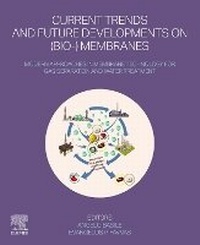
Current Trends and Future Developments on (Bio-) Membranes
Modern Approaches in Membrane Technology for Gas Separation and Water Treatment
Published on 21. November 2023
Book
Paperback/Softback
574 pages
978-0-323-99311-1 (ISBN)
Description
Modern Approaches in Membrane Technology for Gas Separation and Water Treatment presents condensed information on novel and promising membrane materials. The book answers some major questions from the membrane community about three promising materials that are to be introduced at industrial scale. It introduces recent, out of the box, ideas concerning the application of new methods capable to enhance the membrane separation efficiency. Sections cover potential commercialization, important question on three famous membrane materials, and new approaches in membrane technology.
Finally, the book describes and discusses three novel ideas about the potential effect of the magnetic field on membrane separation efficiency, the use of cryogenic technology on membrane separations, and the use of nanobubble technology on water membrane processes.
Finally, the book describes and discusses three novel ideas about the potential effect of the magnetic field on membrane separation efficiency, the use of cryogenic technology on membrane separations, and the use of nanobubble technology on water membrane processes.
More details
Language
English
Place of publication
Philadelphia
United States
Target group
Professional and scholarly
Product notice
Paperback (trade)
Dimensions
Height: 235 mm
Width: 191 mm
Thickness: 30 mm
Weight
978 gr
ISBN-13
978-0-323-99311-1 (9780323993111)
Copyright in bibliographic data and cover images is held by Nielsen Book Services Limited or by the publishers or by their respective licensors: all rights reserved.
Schweitzer Classification
Other editions
Additional editions
Angelo Basile | Evangelos P. Favvas
Current Trends and Future Developments on (Bio-) Membranes
Modern Approaches in Membrane Technology for Gas Separation and Water Treatment
E-Book
11/2023
Elsevier
€200.00
Available for download
Persons
Angelo Basile is a Full Professor and a leading authority in membrane science and technology. Since 2014, he has served as Full Professor in Systems, Methods and Technologies of Chemical Engineering Processes at CNR-ITM in Rende, Italy. His work covers hydrogen purification and production using membrane reactors, CO? capture, process intensification, and the treatment of industrial effluents with advanced membrane operations. Basile has edited many scientific books and authored numerous book chapters, bridging complex research with clear knowledge for engineers and scientists. Motivated by the role of AI/ML in accelerating membrane process design and automation, he supports integrating data-driven methods for smart plants and reaction-separation optimisation.
Evangelos P. Favvas is a Senior Researcher at the Institute of Nanoscience and Nanotechnology in NCSR "Demokritos?, Athens - Greece. He has 80 scientific papers in peer-reviewed journals and 100 articles in international congresses; editor of 2 scientific books, 2 Greek and 4 worldwide patents. His research interests embrace the experimental study of gas separation, with emphasis on carbon dioxide and hydrogen separations, using membranes, sorbents and hybrid porous materials. The in-situ study of condensation process using the combination of X-ray and neutron scattering and adsorption techniques is another filed of his interests.
Evangelos P. Favvas is a Senior Researcher at the Institute of Nanoscience and Nanotechnology in NCSR "Demokritos?, Athens - Greece. He has 80 scientific papers in peer-reviewed journals and 100 articles in international congresses; editor of 2 scientific books, 2 Greek and 4 worldwide patents. His research interests embrace the experimental study of gas separation, with emphasis on carbon dioxide and hydrogen separations, using membranes, sorbents and hybrid porous materials. The in-situ study of condensation process using the combination of X-ray and neutron scattering and adsorption techniques is another filed of his interests.
Content
Part 1 New, promising to be commercialized, membrane
materials and units
1. Review on polymeric membrane materials for gas separations which are
stated above the Robeson's trade-off upper bound
2. New inorganic membranes for gas separations which are stated above the
Robeson's trade-off upper bound
3. New nonporous fillers-based hybrid membranes for gas separations and water
treatment process
4. New commercial membranes for gas separations and water desalination
processes
Part 2 New membrane manufacturing materials
5. New metal-organic frameworks and other porous filler-based hybrid
membranes for gas separation and wastewater treatment
6. Polymers of intrinsic microporosity and their applicability in pilot-scale
membrane units
7. SiC porous membranes. How possible could be the production of
high selective porous SiC membranes?
8. Carbon and graphene oxide materials and their potential applications in
membrane separation technology
9. Solvent and material selection for greener membrane manufacturing
10. New polymeric and inorganic membrane materials for water separation
Part 3 The next decade's ideas about the future
membrane technology
11. Hybrid membranes, liquid/solid, for the enhancement of membrane gas
selectivity. The example of ionic liquid membrane
12. Cryogenic-membrane gas separation hybrid processes
13. New perspectives in gas separations (CO2/CH4, H2/CH4) using membranes
14. New perspectives in O2/N2 gas separation
15. Recent advances in the application of magnetic/electromagnetic
field for water desalination
16. Applications of graphene oxide in reverse osmosis membranes
17. Membrane water processes and nanobubble technology
materials and units
1. Review on polymeric membrane materials for gas separations which are
stated above the Robeson's trade-off upper bound
2. New inorganic membranes for gas separations which are stated above the
Robeson's trade-off upper bound
3. New nonporous fillers-based hybrid membranes for gas separations and water
treatment process
4. New commercial membranes for gas separations and water desalination
processes
Part 2 New membrane manufacturing materials
5. New metal-organic frameworks and other porous filler-based hybrid
membranes for gas separation and wastewater treatment
6. Polymers of intrinsic microporosity and their applicability in pilot-scale
membrane units
7. SiC porous membranes. How possible could be the production of
high selective porous SiC membranes?
8. Carbon and graphene oxide materials and their potential applications in
membrane separation technology
9. Solvent and material selection for greener membrane manufacturing
10. New polymeric and inorganic membrane materials for water separation
Part 3 The next decade's ideas about the future
membrane technology
11. Hybrid membranes, liquid/solid, for the enhancement of membrane gas
selectivity. The example of ionic liquid membrane
12. Cryogenic-membrane gas separation hybrid processes
13. New perspectives in gas separations (CO2/CH4, H2/CH4) using membranes
14. New perspectives in O2/N2 gas separation
15. Recent advances in the application of magnetic/electromagnetic
field for water desalination
16. Applications of graphene oxide in reverse osmosis membranes
17. Membrane water processes and nanobubble technology