

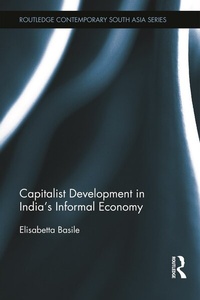
Capitalist Development in India's Informal Economy
1st Edition
Published on 25. April 2013
Book
Hardback
230 pages
978-0-415-64268-2 (ISBN)
Description
This book explores the economy and society of Provincial India in the post-Green Revolution period. It argues that the low 'quality' of capital development in India's villages and small towns is the joint outcome of the informal economic organisation, that is strongly biased in favour of capital, and of the complex stratification of the workforce along class and caste lines.
Focusing on the processes of growth induced by the introduction of the high-yield varieties in agriculture, the book demonstrates that a low-road pattern of capitalist development has been emerging in provincial India: firms compete over price and not over efficiency, with a constant pressure to reduce costs, in particular labour costs. The book shows that low-skilled employment prevails and low wages and poor working conditions are widespread.
Based on original empirical research, the book makes a valuable contribution to the debate on varieties of capitalism, in particular of the Global South. It is of interest to academics working in the fields of Development Studies, Political Economy and South Asian Studies.
Focusing on the processes of growth induced by the introduction of the high-yield varieties in agriculture, the book demonstrates that a low-road pattern of capitalist development has been emerging in provincial India: firms compete over price and not over efficiency, with a constant pressure to reduce costs, in particular labour costs. The book shows that low-skilled employment prevails and low wages and poor working conditions are widespread.
Based on original empirical research, the book makes a valuable contribution to the debate on varieties of capitalism, in particular of the Global South. It is of interest to academics working in the fields of Development Studies, Political Economy and South Asian Studies.
Reviews / Votes
"[...] a must for whoever is interested in the (bleak) reality of Indian development, but a crucially important addition to the panoply of methodological tools at the disposal of social scientists working on India." - The International Spectator"...the book by Elisabetta Basile enlarges our understanding of
India's contemporary capitalism. Relying on a robust theoretical framework and developing an
in-depth empirical analysis, the author disentangles the processes of socio-economic change,
as well as the structures and relations that have been supporting rural non-farm growth."
Christine Lutringer
European Journal of Development Research (2015) 27, 623-624
More details
Series
Language
English
Place of publication
London
United Kingdom
Publishing group
Taylor & Francis Ltd
Target group
College/higher education
Illustrations
2 s/w Abbildungen, 2 s/w Zeichnungen, 38 s/w Tabellen
38 Tables, black and white; 2 Line drawings, black and white; 2 Illustrations, black and white
Dimensions
Height: 234 mm
Width: 156 mm
Weight
620 gr
ISBN-13
978-0-415-64268-2 (9780415642682)
Copyright in bibliographic data and cover images is held by Nielsen Book Services Limited or by the publishers or by their respective licensors: all rights reserved.
Schweitzer Classification
Other editions
Additional editions
Elisabetta Basile
Capitalist Development in India's Informal Economy
Book
10/2017
1st Edition
Routledge
€59.60
Shipment within 10-20 days
Elisabetta Basile
Capitalist Development in India's Informal Economy
E-Book
06/2013
1st Edition
Routledge
€41.99
Available for download
Elisabetta Basile
Capitalist Development in India's Informal Economy
E-Book
06/2013
1st Edition
Routledge
€41.99
Available for download
Person
Elisabetta Basile is Professor of Applied Economics in the Faculty of Economics at the University of Rome, Italy. She is co-convenor of the Europe-Asia Working Group of the European Association of Development and Training Institutions (EADI), and has worked extensively on capitalist change in Europe and in India.
Content
1. The complexity of capitalist development in Provincial India Part 1: Analysing Non-Farm Capitalism in Provincial India 2. A Marxist/Institutionalist framework for the analysis of contemporary capitalism 3. Introducing non-farm capitalism in Provincial India 4. Exploring class structure in Provincial India 5. Caste-based interest representation and the hegemony of capital in India's civil society Part 2: A Marxist/Institutionalist Analysis of Capitalism in Arni 6. Long-term change in Arni's economy 7. Institutional and spatial embeddedness in Arni's silk economy 8. Capital's hegemony in Arni's corporatist civil society 9. The low road of capitalism