

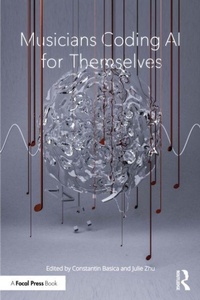
Musicians Coding AI for Themselves
1st Edition
Will be published approx. on 1. September 2026
Book
Paperback/Softback
438 pages
978-1-041-01666-3 (ISBN)
Description
Musicians Coding AI for Themselves blends cutting edge academic research with the real-world experiences of musicians working the intersection of music and AI. This book not only reflects on the philosophical implications of AI in music but also offers readers insights into the technical inner workings of bespoke, artist-crafted AI systems.
The chapters are written by emerging and innovative coder-musicians who present their own artistic practice and research, with a focus on creative, ethical, collaborative, and educational uses of AI. Interviews with leading musicians who have incorporated AI into their work traverse diverse topics, from behind-the-scenes details of how each artist uses AI in their music to the greater conceptual impact of AI on the arts, the future of music technology, and the creative process.
This book will be of interest to practicing musicians who wish to harness the creative potential of AI in their music and understand its implications for the industry on a wider scale. It will also be of interest to students of music composition, music studies, experimental music, music technology and human-computer interaction.
The chapters are written by emerging and innovative coder-musicians who present their own artistic practice and research, with a focus on creative, ethical, collaborative, and educational uses of AI. Interviews with leading musicians who have incorporated AI into their work traverse diverse topics, from behind-the-scenes details of how each artist uses AI in their music to the greater conceptual impact of AI on the arts, the future of music technology, and the creative process.
This book will be of interest to practicing musicians who wish to harness the creative potential of AI in their music and understand its implications for the industry on a wider scale. It will also be of interest to students of music composition, music studies, experimental music, music technology and human-computer interaction.
More details
Language
English
Place of publication
London
United Kingdom
Publishing group
Taylor & Francis Ltd
Target group
College/higher education
Professional and scholarly
Postgraduate, Professional Practice & Development, and Undergraduate Advanced
Illustrations
38 s/w Photographien bzw. Rasterbilder, 2 s/w Tabellen, 38 s/w Abbildungen
2 Tables, black and white; 38 Halftones, black and white; 38 Illustrations, black and white
Dimensions
Height: 234 mm
Width: 156 mm
ISBN-13
978-1-041-01666-3 (9781041016663)
Copyright in bibliographic data and cover images is held by Nielsen Book Services Limited or by the publishers or by their respective licensors: all rights reserved.
Schweitzer Classification
Other editions
Additional editions
Constantin Basica | Julie Zhu
Musicians Coding AI for Themselves
E-Book
approx. 09/2026
Routledge
€52.49
Not yet available
Constantin Basica | Julie Zhu
Musicians Coding AI for Themselves
E-Book
approx. 09/2026
Routledge
€52.49
Not yet available

Constantin Basica | Julie Zhu
Musicians Coding AI for Themselves
Book
approx. 09/2026
1st Edition
Taylor & Francis
€191.50
Not yet published
Persons
Constantin Basica, DMA, is a Romanian composer whose work focuses on symbiotic interrelations between music, video, and performers. His music has been presented internationally by distinguished artists at events such as MATA Festival, Ars Electronica Festival (Bucharest Garden), World New Music Days, George Enescu Festival, and the International Computer Music Conference. He earned his doctorate in composition and completed postdoctoral training at Stanford University. In recent years, he has collaborated with researchers on developing AI tools for co-creativity that explore "translations" between media. Basica is a lecturer in music at Stanford's Center for Computer Research in Music and Acoustics (CCRMA).
Julie Zhu, DMA, is a composer, artist, and carillonist. Her work stands interstitial to instrumental music, electronics, and performance within settings ranging from chamber music stagings to museum sound installations to experimental film scores. Concision and poetry characterize her music, with commissions from Radio France, Dark Music Days Reykjavik, GMEM Marseille, GRAME Lyon, and Chamber Music America. Her research on music and AI focuses on the project Deep Drawing, which tests a machine's ability to bring the intricate noises of drawing and writing to visual life. Zhu is an assistant professor of performing arts technology at the University of Michigan.
Julie Zhu, DMA, is a composer, artist, and carillonist. Her work stands interstitial to instrumental music, electronics, and performance within settings ranging from chamber music stagings to museum sound installations to experimental film scores. Concision and poetry characterize her music, with commissions from Radio France, Dark Music Days Reykjavik, GMEM Marseille, GRAME Lyon, and Chamber Music America. Her research on music and AI focuses on the project Deep Drawing, which tests a machine's ability to bring the intricate noises of drawing and writing to visual life. Zhu is an assistant professor of performing arts technology at the University of Michigan.
Content
1. Prelude Personal and Peculiar 2. Movement I Machine Learning at the Artist Scale 3. Interlude I Interview with Laetitia Sonami 4. Movement II Notochord: Designing and Experiencing a Low Latency MIDI Language Model 5. Interlude II Interview with George Lewis 6. Movement III Machine Grain of Musical AI Voices: Coding Extra-Normal Values in Live Performance with AI Models 7. Interlude III Interview with Jennifer Walshe 8. Movement IV The Last Piece: Training AI on a Composer's Brainwaves 9. Interlude IV Interview with Nao Tokui 10. Intermission Ethics, Authorship, and Creativity in the Age of ChatGPT 11. Interlude V Interview with Ge Wang 12. Movement V Deep Drawing 13. Interlude VI Interview with Pierre Alexandre Tremblay 14. Movement VI The Neural Tape Loop 15. Interlude VII Interview with Holly Herndon 16. Movement VII Pandora's Dream: Building a Software Framework for AI-Mediated Live Music Practice 17. Interlude VIII Interview with CJ Carr 18. Movement VIII The Sweet Spot: Human-AI Alignment with Randomness, Complexity, and Machine Learning 19. Postlude Shifts in Creative Practice with Intelligent Machines 20. Encore A Collection of Claims on AI Arts Practice