


Europe and the Eastern Other
Comparative Perspectives on Politics, Religion and Culture before the Enlightenment
Published on 13. December 2012
Book
Hardback
166 pages
978-0-7391-3803-8 (ISBN)
Description
Europe and the Eastern Other critically evaluates and supports the argument for adopting an intercultural or comparative approach in western political theory. Hassan Bashir examines the encounters between Europeans and their eastern others before the European Enlightenment and illustrates that the West's cultural others have played a foundational role in developing a distinct western cultural self-understanding. This analysis includes records of eyewitness accounts of European visitors in Eastern lands during the medieval and early modern periods, including William of Rubruck's account of the Mongol lands in mid-thirteenth century, observations of the first Jesuit mission in the court of Mughal Indian emperor Akbar the Great, and circumstances in late Ming China as recorded in the journals of Jesuit missionary and scholar Matteo Ricci. This work illustrates the dynamism and complexity involved in an inter-cultural encounter and highlights the fact that cultural self-understanding is often deeply rooted in how we understand our cultural others.
Reviews / Votes
This short contribution to the emerging field of comparative political theory is predicated on the need to open political theory to non-Western theorists, works, processes, and events; show how these reflect non-Western cultural dispositions; and bring more rigor to political theory scholarship and practice writ large. Bashir (Texas A&M Univ., Qatar) discusses three cross-cultural exchanges between Europeans and non-Westerners during the medieval and premodern periods. The three case studies-which focus on encounters between Europeans and Mongols in the 13th century, Europeans and the Mughals in India under the rule of Akbar the Great, and Europeans and the Chinese literati during the late Ming period-provide a sense of progression in the history of Europeans' relations with cultural others. The studies are based on a wide range of primary texts, such as official court histories, personal diaries, relevant correspondence, and eyewitness accounts left by Western representatives in Eastern lands. The volume will interest comparative political theorists. Summing Up: Recommended. Upper-division undergraduate, graduate, and research collections. * Choice Reviews * In the present monograph, Hassan Bashir seeks to make a contribution to Comparative Political Theory (CPT). Departing from what he characterises as the common practice in this sub-field of constructing dialogues between Western thinkers and 'cultural others', Bashir examines four historic cases of cross-cultural contact from the pre-Enlightenment period: William of Rubruck's reports of his journey to the Mongol lands (1253-5); the Jesuits' reflection on their Mission to Akbar 's Court in India (1580-3); the Jesuit scientist Matteo Ricci's experiences while seeking to Christianise China (1582-1610); and the Dominican Barthome de La Casas' (1484-1566) advocacy role for the indigenous peoples of the New World. With a focus on their political theory dimensions, these examples are employed to lend weight to Bashir's claims concerning some erroneous foundational assumptions common in CPT. . . .[R]eflective readers are left with several cogent points of consideration regarding comparative political theorising on interrelated methodological and contextual levels. * Political Studies Review * Hassan Bashir's Europe and the Eastern Other is dazzling in both the breadth of its conception and the depth of its analysis, offering innovative and startling insights into intercultural and cross-cultural contact and dialogue between pre-modern Europe and non-Western societies and polities. Bashir's study constitutes an indispensable contribution to an exciting emergent area of scholarly investigation. -- Cary J. Nederman, Texas A&M University Europe and the Eastern Other reminds us what comparative political theory-and political theory in general-stands to gain by examining cross-cultural exchanges between West and non-West before the European Enlightenment. Bashir provides an important contribution to the study of comparative political theory, deepening our understanding of why precisely we should be engaging in such study: namely, because the foundations of one's own cultural self-understanding are developed in contrast to knowledge about cultural others. -- Farah Godrej, University of California, RiversideMore details
Language
English
Place of publication
United States
Publishing group
Bloomsbury Publishing Plc
Target group
College/higher education
Dimensions
Height: 235 mm
Width: 157 mm
Thickness: 13 mm
Weight
381 gr
ISBN-13
978-0-7391-3803-8 (9780739138038)
Copyright in bibliographic data and cover images is held by Nielsen Book Services Limited or by the publishers or by their respective licensors: all rights reserved.
Schweitzer Classification
Other editions
Additional editions
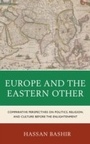
Hassan Bashir
Europe and the Eastern Other
Comparative Perspectives on Politics, Religion and Culture Before the Enlightenment
E-Book
12/2012
1st Edition
Lexington Books
€49.49
Available for download
Person
Hassan Bashir is assistant professor of political science at Texas A&M University's campus in Doha, Qatar.
Content
Chapter 1: Introduction: Towards a more Inclusive Discipline of Political Theory
Chapter 2: Between Euro-Centrism and Euro-Denial: The case for Comparative Political Theory
Chapter 3: "No People and a Foolish Nation": The Thirteenth Century Mongol Empire Through Western Eyes
Chapter 4: "Wise men of the Franks": Jesuit Missionaries at the Court of Indian Emperor Akbar the Great
Chapter 5: "Delusions of Celestial Perfection": The Encounter between Jesuit Missionaries and the Chinese Literati in Early Modern China
Chapter 6: Conclusions: Otherness, Canonicity and Comparative Political Theory
Chapter 2: Between Euro-Centrism and Euro-Denial: The case for Comparative Political Theory
Chapter 3: "No People and a Foolish Nation": The Thirteenth Century Mongol Empire Through Western Eyes
Chapter 4: "Wise men of the Franks": Jesuit Missionaries at the Court of Indian Emperor Akbar the Great
Chapter 5: "Delusions of Celestial Perfection": The Encounter between Jesuit Missionaries and the Chinese Literati in Early Modern China
Chapter 6: Conclusions: Otherness, Canonicity and Comparative Political Theory