

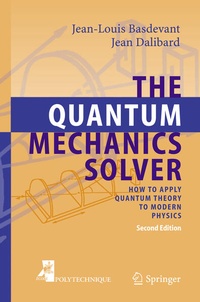
The Quantum Mechanics Solver
How to Apply Quantum Theory to Modern Physics
2nd Edition
Published on 13. September 2005
Book
Hardback
XIV, 292 pages
978-3-540-27721-7 (ISBN)
Description
Quantum mechanics is an endless source of new questions and fascinating observations. Examples can be found in fundamental physics and in applied physics, in mathematical questions as well as in the currently popular debates ontheinterpretationofquantummechanicsanditsphilosophicalimplications. Teaching quantum mechanics relies mostly on theoretical courses, which are illustrated by simple exercises often of a mathematical character. Red- ing quantum physics to this type of problem is somewhat frustrating since very few, if any, experimental quantities are available to compare the results with. For a long time, however, from the 1950s to the 1970s, the only alter- tive to these basic exercises seemed to be restricted to questions originating from atomic and nuclear physics, which were transformed into exactly soluble problems and related to known higher transcendental functions. In the past ten or twenty years, things have changed radically. The dev- opment of high technologies is a good example. The one-dimensional squa- well potential used to be a rather academic exercise for beginners. The em- gence of quantum dots and quantum wells in semiconductor technologies has changed things radically. Optronics and the associated developments in inf- redsemiconductorandlasertechnologieshaveconsiderablyelevatedthesocial rank of the square-well model. As a consequence, more and more emphasis is given to the physical aspects of the phenomena rather than to analytical or computational considerations.
Reviews / Votes
From the reviews of the second edition:
"This problem based textbook is a concise and particularly useful reference of quantum mechanics as used in a large range of modern applications in physics. . At the end of each section worked solutions, references and general comments are given . . this book of problems would be very useful for any physics departmental, or indeed individual research group, library. Highly recommended." (Lloyd C L Hollenberg, Australian Physics, Vol. 32 (6), 2007)
More details
Edition
2nd ed. 2006
Language
English
Place of publication
Berlin
Germany
Publishing group
Springer Berlin
Target group
Professional and scholarly
Graduate
Edition type
Revised edition
Illustrations
XIV, 292 p.
Dimensions
Height: 23.5 cm
Width: 15.5 cm
Weight
1340 gr
ISBN-13
978-3-540-27721-7 (9783540277217)
DOI
10.1007/3-540-29464-3
Schweitzer Classification
Other editions
New editions
Jean-Louis Basdevant | Jean Dalibard
The Quantum Mechanics Solver
How to Apply Quantum Theory to Modern Physics
Book
06/2019
3rd Edition
Springer
€85.59
Shipment within 7-9 days
Additional editions
Jean-Louis Basdevant | Jean Dalibard
The Quantum Mechanics Solver
How to Apply Quantum Theory to Modern Physics
Book
10/2010
2nd Edition
Springer
€69.54
Article exhausted; check for reprint
Jean-Louis Basdevant | Jean Dalibard
The Quantum Mechanics Solver
How to Apply Quantum Theory to Modern Physics
E-Book
12/2005
2nd Edition
Springer
€71.64
Available for download
Previous edition
Jean-Louis Basdevant | Jean Dalibard
The Quantum Mechanics Solver
How to Apply Quantum Theory to Modern Physics
Book
03/2000
Springer
€85.59
Article exhausted; check for reprint
Content
Elementary Particles, Nuclei and Atoms.- Neutrino Oscillations.- Summary of Quantum Mechanics.- Quantum Entanglement and Measurement.- The EPR Problem and Bell's Inequality.- Complex Systems.- Exact Results for the Three-Body Problem.- Atomic Clocks.- Neutron Interferometry.- Spectroscopic Measurement on a Neutron Beam.- Analysis of a Stern-Gerlach Experiment.- Measuring the Electron Magnetic Moment Anomaly.- Decay of a Tritium Atom.- The Spectrum of Positronium.- The Hydrogen Atom in Crossed Fields.- Energy Loss of Ions in Matter.- Schrödinger's Cat.- Quantum Cryptography.- Direct Observation of Field Quantization.- Ideal Quantum Measurement.- The Quantum Eraser.- A Quantum Thermometer.- Properties of a Bose-Einstein Condensate.- Magnetic Excitons.- A Quantum Box.- Colored Molecular Ions.- Hyperfine Structure in Electron Spin Resonance.- Probing Matter with Positive Muons.- Quantum Reflection of Atoms from a Surface.- Laser Cooling and Trapping.- Bloch Oscillations.