

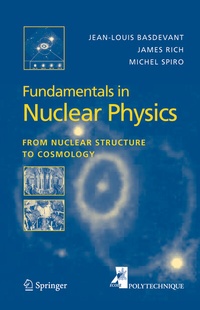
Fundamentals in Nuclear Physics
From Nuclear Structure to Cosmology
Published on 6. June 2005
Book
Hardback
XIV, 516 pages
978-0-387-01672-6 (ISBN)
Description
Nuclear physics began one century ago during the "miraculous decade" - tween 1895 and 1905 when the foundations of practically all modern physics were established. The period started with two unexpected spino?s of the Crooke's vacuum tube: Roentgen's X-rays (1895) and Thomson's electron (1897), the ?rst elementary particle to be discovered. Lorentz and Zeemann developed the the theory of the electron and the in?uence of magnetism on radiation. Quantum phenomenology began in December, 1900 with the - pearance of Planck's constant followed by Einstein's 1905 proposal of what is now called the photon. In 1905, Einstein also published the theories of relativity and of Brownian motion, the ultimate triumph of Boltzman's s- tistical theory, a year before his tragic death. For nuclear physics, the critical discovery was that of radioactivity by Becquerel in 1896. By analyzing the history of science, one can be convinced that there is some rationale in the fact that all of these discoveries came nearly sim- taneously, after the scienti?cally triumphant 19th century. The exception is radioactivity, an unexpected baby whose discovery could have happened s- eral decades earlier. Talentedscientists,theCuries,Rutherford,andmanyothers,tookthe- servationofradioactivityandconstructedtheideasthatarethesubjectofthis book. Of course, the discovery of radioactivity and nuclear physics is of much broader importance. It lead directly to quantum mechanics via Rutherford's planetary atomic model and Bohr's interpretation of the hydrogen spectrum. This in turn led to atomic physics, solid state physics, and material science.
Reviews / Votes
The authors are well-regarded scientists who work at the interface of nuclear and particle physics and astrophysics... The text succeeds quite well in its aims.... [T]he authors have found the right balance between presenting nuclear physics as a domain of fundamental research and exploring its applications in neutrino physics, plasma physics, astrophysics, and cosmology.
-A. Baha Balantekin, University of Wisconsin, Madison, in Physics Today
More details
Edition
2005 ed.
Language
English
Place of publication
New York
United States
Target group
Primary & secondary/elementary & high school
Graduate
Product notice
sewn/stitched
Cloth over boards
Illustrations
184 s/w Abbildungen
XIV, 516 p. 184 illus.
Dimensions
Height: 241 mm
Width: 161 mm
Thickness: 35 mm
Weight
955 gr
ISBN-13
978-0-387-01672-6 (9780387016726)
DOI
10.1007/b106774
Schweitzer Classification
Other editions
Additional editions
Jean-Louis Basdevant | James Rich | Michael Spiro
Fundamentals in Nuclear Physics
From Nuclear Structure to Cosmology
Book
10/2010
Springer
€85.59
Shipment within 15-20 days
Jean-Louis Basdevant | James Rich | Michael Spiro
Fundamentals in Nuclear Physics
From Nuclear Structure to Cosmology
E-Book
01/2006
1st Edition
Springer
€85.59
Available for download
Content
Introduction.- Basic concepts of Nuclear Physics.- Nuclear Models and Stability of the Nucleus.- Nuclear Reactions.- Nuclear Decays and Fundamental Interactions.- Radioactivity and all that.- Fission.- Fusion.- Nuclear Astrophysics.- Nuclear Cosmology.- Relativistic kinematics.- Accelerators.- Time-dependent perturbation theory.- Nutron transport.- Solutions and Hints for Selected Exercises.- Tables of numerical values.- Table of Nuclei.- References.- Index.