

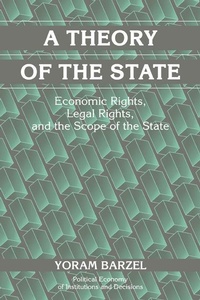
A Theory of the State
Economic Rights, Legal Rights, and the Scope of the State
Published on 3. December 2001
Book
Hardback
308 pages
978-0-521-80605-3 (ISBN)
Description
This book models the emergence of the state, and the forces that shape it. State creation is bound to protection needs. A specialized protector-ruler is efficient, but is also self-seeking. Individuals will install a ruler only after they create a mechanism to control him. Among the offshoots of the organized protection are legal system and decision-making procedures that include voting. The initial 'state of nature' may gradually evolve into a rule-of-law state. The state endows individuals with rights by delineating what it will protect. Enforcement, however, is never perfect. People use third parties such as firms to enforce agreements. As commodities become standardized, scale economies increase. In order to exploit the economies of within-state enforcement, the state will expand the contact enforcement territory by treaty or by conquest. The force may explain the creation of rule-of-law empires.
More details
Series
Language
English
Place of publication
Cambridge
United Kingdom
Target group
Professional and scholarly
Illustrations
Worked examples or Exercises
Dimensions
Height: 235 mm
Width: 157 mm
Thickness: 23 mm
Weight
653 gr
ISBN-13
978-0-521-80605-3 (9780521806053)
Copyright in bibliographic data and cover images is held by Nielsen Book Services Limited or by the publishers or by their respective licensors: all rights reserved.
Schweitzer Classification
Other editions
Additional editions
Book
12/2001
Cambridge University Press
€40.70
Shipment within 15-20 days
Person
Content
Preface; 1. Introduction; Part I. The Emergence of Protection and Third-Party Enforcement: 2. The state and the enforcement of agreements; 3. Third-party enforcement and the state; 4. The choice among enforcement forms; 5. Anonymous exchange, mixed enforcement and vertical integration; 6. Jurisdictional issues; 7. Collective action and collective decisions; 8. Tying the protector's hand: the agreement between subjects and protector; Part II. The Emergence of Legal Institutions: 9. Legal rights; 10. The state's enhancement of market trade; 11. The size and scope of the state; Part III. The Character of the State: 12. Merger and local autonomy; 13. The distinction between 'legitimate' and 'criminal' states; 14. Power, violent conflict and political evolution; 15. The time path of change under dictatorships and under rule-of-law regimes; 16. Recapitulation and an epilogue; References; Index.