

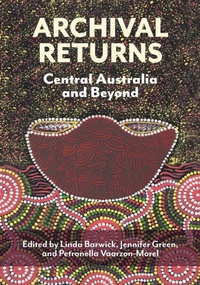
Archival Returns
Central Australia and Beyond
Published on 3. February 2020
Book
Paperback/Softback
372 pages
978-1-74332-672-5 (ISBN)
Description
Archival Returns: Central Australia and Beyond was co-published with the University of Hawai'i Press. It is also available in open access through the Language Documentation & Conservation journal.
Winner of the Australian Society of Archivists Mander Jones Award
Place-based cultural knowledge - of ceremonies, songs, stories, language, kinship and ecology - binds Australian Indigenous societies together. Over the last 100 years or so, records of this knowledge in many different formats - audiocassettes, photographs, films, written texts, maps, and digital recordings - have been accumulating at an ever-increasing rate. Yet this extensive documentary heritage is dispersed. In many cases, the Indigenous people who participated in the creation of the records, or their descendants, have little idea of where to find the records or how to access them. Some records are held precariously in ad hoc collections, and their caretakers may be perplexed as to how to ensure that they are looked after.
Archival Returns: Central Australia and Beyond explores the strategies and practices by which cultural heritage materials can be returned to their communities of origin, and the issues this process raises for communities, as well as for museums, galleries, and other cultural institutions.
Winner of the Australian Society of Archivists Mander Jones Award
Place-based cultural knowledge - of ceremonies, songs, stories, language, kinship and ecology - binds Australian Indigenous societies together. Over the last 100 years or so, records of this knowledge in many different formats - audiocassettes, photographs, films, written texts, maps, and digital recordings - have been accumulating at an ever-increasing rate. Yet this extensive documentary heritage is dispersed. In many cases, the Indigenous people who participated in the creation of the records, or their descendants, have little idea of where to find the records or how to access them. Some records are held precariously in ad hoc collections, and their caretakers may be perplexed as to how to ensure that they are looked after.
Archival Returns: Central Australia and Beyond explores the strategies and practices by which cultural heritage materials can be returned to their communities of origin, and the issues this process raises for communities, as well as for museums, galleries, and other cultural institutions.
Reviews / Votes
"The book is a successful attempt to move beyond arguments for the rights of indigenous communities into the more logistical arenas of how these rights, principles and cultural practices can be upheld in record-keeping and archival contexts." -- Kirsty Fife * Archives and Records * 'Archival Returns holds great potential for inspiring First Nations communities, researchers and cultural institution practitioners in their own community-centred initiatives and research ... This volume helpfully offers, through case studies, a number of tools that older and younger generations in Aboriginal communities can employ to protect, manage and maintain place-based cultural learning in archival materials.' -- Mariko Smith * Aboriginal History Journal * 'I realized that what I had gained from this book was so much more than specialist or technical knowledge. The authors explore many different layers of meaning, providing the opportunity to reflect on why the process of returning knowledge back to Country and the decolonization of archives, libraries, and museums are vital steps for sovereignty and self-determination of Aboriginal peoples and communities ... recommended reading for archivists, anthropologists, curators, and any other professionals working to promote sovereignty and self-determination of Aboriginal peoples within the information sector.' -- Monica Galassi * Information & Culture * "reveals layers of complexity in the deceptively simple process of repatriation or archival return ... important for folklorists, ethnomusicologists, archivists, and anthropologists working with Aboriginal communities and cultural-heritage materials, but it warrants attention from a broader audience ... highlights tangible and inspiring efforts to decolonize the work of cultural-heritage institutions." -- David Lewis * Journal of Folklore Research Reviews *More details
Series
Language
English
Place of publication
Sydney
Australia
Target group
Professional and scholarly
Interest Age: From 17 years
Product notice
Paperback (UK-trade)
Illustrations
Illustrations
Dimensions
Height: 254 mm
Width: 178 mm
Thickness: 21 mm
Weight
703 gr
ISBN-13
978-1-74332-672-5 (9781743326725)
Copyright in bibliographic data and cover images is held by Nielsen Book Services Limited or by the publishers or by their respective licensors: all rights reserved.
Schweitzer Classification
Persons
Linda Barwick is a musicologist and professor at the University of Sydney's Sydney Conservatorium of Music. She is a Fellow of the Australian Academy of the Humanities and a member of the Australian Institute of Aboriginal and Torres Strait Islander Studies.
Jennifer Green is a postdoctoral fellow at the University of Melbourne. She has worked for over four decades with Indigenous people in Central Australia documenting languages, cultural history, art, social organisation and connections to country.
Petronella Vaarzon-Morel is an anthropologist with long-term experience working with Warlpiri and other Indigenous peoples in Central Australia. She is an honorary research associate at the Sydney Conservatorium of Music, the University of Sydney.
Jennifer Green is a postdoctoral fellow at the University of Melbourne. She has worked for over four decades with Indigenous people in Central Australia documenting languages, cultural history, art, social organisation and connections to country.
Petronella Vaarzon-Morel is an anthropologist with long-term experience working with Warlpiri and other Indigenous peoples in Central Australia. She is an honorary research associate at the Sydney Conservatorium of Music, the University of Sydney.
Content
List of figures
List of tables
Foreword
Editors' preface
The contributors
List of abbreviations
1. Conundrums and consequences: doing digital archival returns in Australia by Linda Barwick, Jennifer Green, Petronella Vaarzon-Morel & Katya Zissermann
2. Deciphering Arrernte archives: the intermingling of textual and living knowledge by Jason Gibson, Shaun Angeles & Joel Liddle
3. Reflections on the preparation and delivery of Carl Strehlow's heritage dictionary (1909) to the Western Aranda people by Anna Kenny
4. Returning recordings of songs that persist: the Anmatyerr traditions of akiw and anmanty by Jason Gibson
5. Incorporating archival cultural heritage materials into contemporary Warlpiri women's yawulyu spaces by Georgia Curran
6. Enlivening people and country: the Lander Warlpiri cultural mapping project by Petronella Vaarzon-Morel & Luke Kelly
7. (Re)turning research into pedagogical practice: a case study of translational language research in Warlpiri by Carmel O'Shannessy, Samantha Disbray, Barbara Martin & Gretel Macdonald
8. 'The songline is alive in Mukurtu': return, reuse, and respect by Kimberly Christen
9. 'For the children ...': Aboriginal Australia, cultural access, and archival obligation by Brenda Croft, Sandy Toussaint, Felicity Meakins & Patrick McConvell
10. Working at the interface: the Daly Languages Project by Rachel Nordlinger, Ian Green & Peter Hurst
11. 'We never had any photos of my family': archival return, film, and a personal history by Fred Myers & Lisa Stefanoff
12. Return of a travelling song: wanji-wanji in the Pintupi region of Central Australia by Myfany Turpin
13. Never giving up: negotiating, culture-making, and the infinity of the archive by Sabra Thorner, Linda Rive, John Dallwitz & Janet Inyika
14. Nura's vision: Nura's voice by Suzanne Bryce, Julia Burke & Linda Rive
15. i-Tjuma: the journey of a collection - from documentation to delivery by Elizabeth Marrkilyi Ellis, Jennifer Green & Inge Kral
16. Ever-widening circles: consolidating and enhancing Wirlomin Noongar archival material in the community by Clint Bracknell & Kim Scott
Index
List of tables
Foreword
Editors' preface
The contributors
List of abbreviations
1. Conundrums and consequences: doing digital archival returns in Australia by Linda Barwick, Jennifer Green, Petronella Vaarzon-Morel & Katya Zissermann
2. Deciphering Arrernte archives: the intermingling of textual and living knowledge by Jason Gibson, Shaun Angeles & Joel Liddle
3. Reflections on the preparation and delivery of Carl Strehlow's heritage dictionary (1909) to the Western Aranda people by Anna Kenny
4. Returning recordings of songs that persist: the Anmatyerr traditions of akiw and anmanty by Jason Gibson
5. Incorporating archival cultural heritage materials into contemporary Warlpiri women's yawulyu spaces by Georgia Curran
6. Enlivening people and country: the Lander Warlpiri cultural mapping project by Petronella Vaarzon-Morel & Luke Kelly
7. (Re)turning research into pedagogical practice: a case study of translational language research in Warlpiri by Carmel O'Shannessy, Samantha Disbray, Barbara Martin & Gretel Macdonald
8. 'The songline is alive in Mukurtu': return, reuse, and respect by Kimberly Christen
9. 'For the children ...': Aboriginal Australia, cultural access, and archival obligation by Brenda Croft, Sandy Toussaint, Felicity Meakins & Patrick McConvell
10. Working at the interface: the Daly Languages Project by Rachel Nordlinger, Ian Green & Peter Hurst
11. 'We never had any photos of my family': archival return, film, and a personal history by Fred Myers & Lisa Stefanoff
12. Return of a travelling song: wanji-wanji in the Pintupi region of Central Australia by Myfany Turpin
13. Never giving up: negotiating, culture-making, and the infinity of the archive by Sabra Thorner, Linda Rive, John Dallwitz & Janet Inyika
14. Nura's vision: Nura's voice by Suzanne Bryce, Julia Burke & Linda Rive
15. i-Tjuma: the journey of a collection - from documentation to delivery by Elizabeth Marrkilyi Ellis, Jennifer Green & Inge Kral
16. Ever-widening circles: consolidating and enhancing Wirlomin Noongar archival material in the community by Clint Bracknell & Kim Scott
Index