

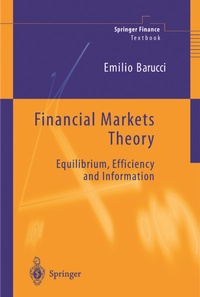
Financial Markets Theory
Equilibrium, Efficiency and Information
Published on 21. October 2012
Book
Paperback/Softback
XII, 467 pages
978-1-4471-1093-4 (ISBN)
Description
The first book to combine the latest discussion on financial market theory
with precision mathematics and how practical results influence research,
Financial Markets Theory, addresses the need for a book like this to
accompany the most popular related titles. Using simple maths and an
introductory background to the economics required, anyone studying or
working in financial markets should have a copy of this book. It covers
all the key topics with exercises and examples that make it ideal for
self-study or as an advanced graduate textbook, but it includes so much
recent research that it is also a vital handbook for practitioners working
in banks, insurance, investment funds and financial consultancy.
More details
Series
Edition
Softcover reprint of the original 1st ed. 2003
Language
English
Place of publication
London
United Kingdom
Target group
Professional and scholarly
Research
Illustrations
XII, 467 p.
Dimensions
Height: 23.5 cm
Width: 15.5 cm
Weight
735 gr
ISBN-13
978-1-4471-1093-4 (9781447110934)
DOI
10.1007/978-1-4471-0089-8
Schweitzer Classification
Other editions
New editions
Book
06/2017
2nd Edition
Springer
€128.39
Shipment within 15-20 days
Additional editions
Book
12/2002
Springer
€90.90
Article exhausted; check for reprint
Content
1 Prerequisites.- 1.1 Choices under Certainty.- 1.2 General Equilibrium Theory.- 1.3 Pareto Optimality.- 2 Choices under Risk.- 2.1 Expected Utility Theory.- 2.2 Risk Aversion.- 2.3 Portfolio Problem.- 2.4 Insurance Demand and Prudence.- 2.5 Notes, References and Exercises.- 3 Stochastic Dominance, Mutual Funds Separation and Portfolio Frontier.- 3.1 Stochastic Dominance.- 3.2 Mean-Variance Analysis.- 3.3 Portfolio Frontier (risky assets).- 3.4 Portfolio Frontier (risky assets and a risk free asset).- 3.5 Mutual Funds Separation.- 3.6 Notes, References and Exercises.- 4 General Equilibrium Theory and Risk Exchange.- 4.1 Risk Sharing and Pareto Optimality.- 4.2 Asset Markets.- 4.3 Intertemporal Consumption.- 4.4 The Fundamental Asset Pricing Theorem I.- 4.5 Notes, References and Exercises.- 5 Risk Premium: Capital Asset Pricing Model and Asset Pricing Theory.- 5.1 Capital Asset Pricing Model (CAPM).- 5.2 Empirical Tests of the CAPM.- 5.3 Arbitrage Pricing Theory (APT).- 5.4 Empirical Tests of the APT.- 5.5 Notes, References and Exercises.- 6 Multiperiod Market Models.- 6.1 Portfolio Choice, Consumption and Equilibrium.- 6.2 The Fundamental Asset Pricing Theorem II.- 6.3 Risk Premium and Factor Models.- 6.4 The No Arbitrage Fundamental Equation and Bubbles.- 6.5 Empirical Tests: Price-Dividend Process.- 6.6 Empirical Tests: CCAPM, ICAPM and Risk Premium.- 6.7 Notes, References and Exercises.- 7 Information and Financial Markets.- 7.1 The Role of Information in Financial Markets.- 7.2 On the Possibility of Efficient Markets.- 7.3 On the Impossibility of Efficient Markets.- 7.4 Multiperiod Models.- 7.5 Empirical Analysis.- 7.6 Notes, References and Exercises.- 8 Uncertainty, Rationality and Heterogeneity.- 8.1 Uncertainty, Risk and Probability.- 8.2 On Expected Utility Theory.- 8.3 Heterogeneous Agents and Substantial Rationality.- 8.4 Bounded Rationality, Incomplete Information and Learning.- 8.5 Imperfect and Incomplete Markets.- 9 Financial Markets Microstructure.- 9.1 The Role of Information under non-Perfect Competition.- 9.2 Order Driven Markets.- 9.3 Quote Driven Markets.- 9.4 Multiperiod Market Models.- 10 Corporate Finance.- 10.1 Modigliani-Miller Theorem.- 10.2 Asymmetric Information.- 10.3 Agency Models.- 11 Intermediation and Regulation.- 11.1 Institutional Investors, Intermediation and Financial Markets.- 11.2 Market Design.- 11.3 Market Abuse: Insider Trading and Market Manipulation.- References.