

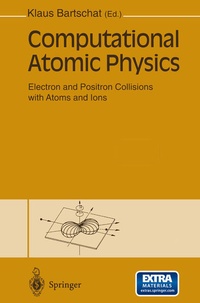
Computational Atomic Physics
Electron and Positron Collisions with Atoms and Ions
Published on 23. August 2014
Book
Paperback/Softback
XVIII, 249 pages
978-3-642-64655-3 (ISBN)
Description
This unique reference book for graduate students in the field of atomic physics provides a rich source for practical application of advanced quantum mechanics. Numerous suggested problems and ten programs bring the reader to a deeper unterstanding of the theory and methods.
More details
Edition
Softcover reprint of the original 1st ed. 1996
Language
English
Place of publication
Berlin
Germany
Publishing group
Springer Berlin
Target group
Primary & secondary/elementary & high school
Graduate
Illustrations
13 s/w Abbildungen
XVIII, 249 p. 13 illus.
Dimensions
Height: 235 mm
Width: 155 mm
Thickness: 15 mm
Weight
417 gr
ISBN-13
978-3-642-64655-3 (9783642646553)
DOI
10.1007/978-3-642-61010-3
Schweitzer Classification
Other editions
Additional editions
Book
02/1996
Springer
€85.59
Article exhausted; check different version
Persons
Content
1. Electron-Atom Scattering Theory: An Overview.- Abstract.- 1.1 Introduction.- 1.2 Potential Scattering.- 1.3 Perturbation Approaches.- 1.4 The Close-Coupling Expansion.- 1.5 Computer Program for Potential Scattering.- 1.6 Summary.- 1.7 Suggested Problems.- Acknowledgments.- References.- 2. Core Potentials for Quasi One-Electron Systems.- Abstract.- 2.1 Introduction.- 2.2 Theory.- 2.3 The Algorithm.- 2.4 Computer Program.- 2.5 Test Run.- 2.6 Summary.- 2.7 Suggested Problems.- Acknowledgments.- References.- 3. Energies and Oscillator Strengths Using Configuration Interaction Wave Functions.- Abstract.- 3.1 Introduction.- 3.2 Hydrogen-Like Ions.- 3.3 Two-Electron Atoms and Ions.- 3.4 Many-Electron Atoms and Ions.- 3.5 Configuration Interaction Methods.- 3.6 Transition Probabilities and Oscillator Strengths.- 3.7 The Codes.- 3.8 Examples.- 3.9 Summary.- 3.10 Suggested Problems.- References.- 4. The Distorted-Wave Method for Elastic Scattering and Atomic Excitation.- Abstract.- 4.1 Introduction.- 4.2 Theory.- 4.3 First-Order Amplitudes.- 4.4 Partial-Wave Expansion of the T Matrix.- 4.5 Computer Program.- 4.6 Summary.- 4.7 Suggested Problems.- Acknowledgments.- References.- 5. Distorted-Wave Methods for Ionization.- Abstract.- 5.1 Introduction.- 5.2 Theory.- 5.3 Reduction of the (e,2e) Amplitudes to Computational Form.- 5.4 Computer Program.- 5.5 Summary.- 5.6 Suggested Problems.- Acknowledgments.- References.- 6. The Close-Coupling Approximation.- Abstract.- 6.1 Introduction.- 6.2 Theory.- 6.3 The Numerical Solution of the Close-Coupling Equations.- 6.4 The Born Approximation.- 6.5 Computer Program.- 6.6 Summary.- 6.7 Suggested Problems.- Acknowledgments.- References.- 7. The R-Matrix Method.- Abstract.- 7.1 Introduction.- 7.2 General R-Matrix Theory.- 7.3 Electron-Hydrogen-like Ion Scattering.- 7.4 Computational Solution of the Electron-Hydrogen-Like Ion-Collision Problem.- 7.5 Computer Program.- 7.6 Summary.- 7.7 Suggested Problems.- Acknowledgments.- References.- 8. Momentum-Space Convergent-Close-Coupling Method for a Model e-H Scattering Problem.- Abstract.- 8.1 Introduction.- 8.2 Theory.- 8.3 Numerical Solution.- 8.4 Computer Program.- 8.5 Summary.- 8.6 Suggested Problems.- References.- 9. The Calculation of Spherical Bessel and Coulomb Functions.- Abstract.- 9.1 Introduction.- 9.2 Spherical Bessel Functions.- 9.3 Recurrence Relations for Spherical Bessel Functions.- 9.4 Evaluation of the Continued Fraction.- 9.5 The Programs SBESJY and RICBES.- 9.6 Recurrence Relations for Coulomb Functions.- 9.7 The Program C0UL90.- 9.8 Test Data.- 9.9 Summary.- 9.10 Suggested Problems.- Acknowledgments.- References.- 10. Scattering Amplitudes for Electron-Atom Scattering.- Abstract.- 10.1 Introduction.- 10.2 Definition of the Scattering Amplitudes.- 10.3 Convergence of Partial Wave Expansions.- 10.4 Symmetry Properties of Scattering Amplitudes.- 10.5 Computer Program.- 10.6 Summary.- 10.7 Suggested Problems.- Acknowledgments.- References.- 11. Density Matrices: Connection Between Theory and Experiment.- Abstract.- 11.1 Introduction.- 11.2 Scattering Amplitudes.- 11.3 Density Matrices.- 11.4 Irreducible Tensor Operators and State Multipoles.- 11.5 Observables.- 11.6 2S ? 2P° Transitions.- 11.7 Computer Program.- 11.8 Summary.- 11.9 Suggested Problems.- Acknowledgments.- References.