

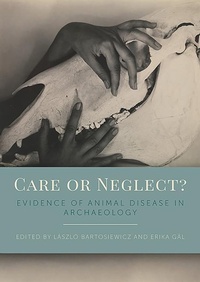
Care or Neglect?
Evidence of Animal Disease in Archaeology
Published on 31. January 2018
Book
Paperback/Softback
300 pages
978-1-78570-889-3 (ISBN)
Description
Animals have always been integral to culture. Their interaction with humans has intensified since the onset of domestication resulting in higher incidences of animal disease due to human intervention. At the same time, human care has counter-balanced pressures of natural selection, reducing morbidity among wild animals. Prior to the emergence of a veterinary record, animal disease can only be traced by analysing pathological symptoms on excavated animal remains. This volume presents a collection of studies in the discipline of animal palaeopathology. An international team of experts offer reviews of animal welfare at ancient settlements from both prehistoric and historic periods across Eurasia.
Several chapters are devoted to the diseases of dog and horse, two animals of prominent emotional importance in many civilisations. Curious phenomena observed on the bones of poultry, sheep, pig and even fish are discussed within their respective cultural contexts. Many poorly healed bones are suggestive of neglect in the case of ordinary livestock. On the other hand, a great degree of compassion may be presumed behind the long survival of seriously ill companion animals. In addition to furthering our better technical understanding of animal disease in the past, this volume also mirrors the diversity of human attitudes towards animals during our millennia-long relationship. Some animal bones show signs of extreme cruelty but others also reveal the great attention paid to the recovery of sick animals. Such attitudes tend to be a largely hidden yet are characteristic aspects of how people relate to the surrounding world and, ultimately, to each other.
Several chapters are devoted to the diseases of dog and horse, two animals of prominent emotional importance in many civilisations. Curious phenomena observed on the bones of poultry, sheep, pig and even fish are discussed within their respective cultural contexts. Many poorly healed bones are suggestive of neglect in the case of ordinary livestock. On the other hand, a great degree of compassion may be presumed behind the long survival of seriously ill companion animals. In addition to furthering our better technical understanding of animal disease in the past, this volume also mirrors the diversity of human attitudes towards animals during our millennia-long relationship. Some animal bones show signs of extreme cruelty but others also reveal the great attention paid to the recovery of sick animals. Such attitudes tend to be a largely hidden yet are characteristic aspects of how people relate to the surrounding world and, ultimately, to each other.
More details
Language
English
Place of publication
Oxford
United Kingdom
Target group
Professional and scholarly
Product notice
Paperback (trade)
Unsewn / adhesive bound
Dimensions
Height: 239 mm
Width: 170 mm
Thickness: 20 mm
Weight
658 gr
ISBN-13
978-1-78570-889-3 (9781785708893)
Copyright in bibliographic data and cover images is held by Nielsen Book Services Limited or by the publishers or by their respective licensors: all rights reserved.
Schweitzer Classification
Other editions
Additional editions
E-Book
02/2018
OXBOW BOOKS
€29.49
Available for download
Bartosiewicz Laszlo Bartosiewicz | Gal Erika Gal
Care or Neglect?
Evidence of Animal Disease in Archaeology
E-Book
02/2018
Oxbow Books
€29.49
Available for download
Persons
Laszlo Bartosiewicz is Professor in Osteoarchaeology at the University of Stockholm. He was granted a Senior Doctorate in Animal Science by the Hungarian Academy of Sciences in 2000. His research concerns animal-human relationships as shown by archaeological finds from various periods. Erika Gal is a Senior Research Fellow at the Hungarian Academy of Sciences Budapest. She completed her PhD in Palaeontology at the University of Bucharest in 2002. Her research focuses on the study of animal remains from archaeological sites in the Carpathian Basin with special interest in bird bones.
Content
Foreword, Laszlo Bartosiewicz and Erika Gal
Laszlo Bartosiewicz and Erika Gal: Introduction: care, neglect and the "osteological paradox"
Kamilla Pawlowska: Animal diseases in Neolithic societies: Catalhoeyuek (Turkey) in the spotlight
Laszlo Bartosiewicz, Eva A. Nyerges and Anna Zs. Biller: Palaeopathology at the Eneolithic tell settlement of Polyanitsa (Bulgaria) investigated by Sandor Boekoenyi
Erika Gal and Guenther Karl Kunst: Limping to the temple - Palaeopathology at a Roman sacrificial site in Carnuntum, Austria.
Nemanja Markovic, Oliver Stevanovic, Maciej Janeczek, Darko Marinkovic, Nikola Krstic and Vujadin Ivanisevic: Animal Health in Caricin Grad (Justiniana Prima) in Time of Transition: Preliminary Results
Yasha Hourani: Congenital anomalies and traumatic injuries in dogs from Laodicea in Canaan (Hellenistic Beirut, Lebanon)
Lauren Bellis: Reviewing the pathology and welfare of dogs in Roman Britain
Henriette Baron: Four Equestrian Burials from the Avar Cemetery at Vienna Csokorgasse, Austria: The health of horses and dogs
William Taylor and Tumurbaatar Tuvshinjargal: Horseback Riding, Asymmetry, and Changes to the Equine Skull: Evidence for mounted riding in Mongolia's Late Bronze Age
Pamela J. Cross: Where have all the Mares Gone? Sex and "gender" related pathology in archaeological horses: clues to horse husbandry and use practices
Kyra Lyublyanovics: Pelvic fracture in horse: a late medieval case from Karcag-Orgondaszentmiklos, eastern Hungary
Laszlo Bartosiewicz: Taphonomy and disease prevalence in animal palaeopathology: The proverbial "veterinary horse"
Henriette Baron: From arthrosis to necrosis: Many, many pathological chickens from the Avar cemetery at Vienna Csokorgasse
Annamaria Barany: "Babos" (spotted) pigs in Zalavar/Mosaburg, SW Hungary: Possible causes of a tusk pathology
Yves Darton and Isabelle Rodet-Belarbi: Damage caused by permanent fetters in present-day sheep on the island of Delos (Greece)
Marta Daroczi-Szabo and Laszlo Daroczi-Szabo: Medieval multi-horned sheep from present-day Budapest, Hungary
Jennifer Harland and Wim Van Neer: Weird Fish: Defining a role for fish bone pathologies
Hanna Kivikero: Skeletal anomalies in medieval and early modern fish: A case study from Castle Kastelholm in the Baltic Sea
Laszlo Bartosiewicz and Erika Gal: Introduction: care, neglect and the "osteological paradox"
Kamilla Pawlowska: Animal diseases in Neolithic societies: Catalhoeyuek (Turkey) in the spotlight
Laszlo Bartosiewicz, Eva A. Nyerges and Anna Zs. Biller: Palaeopathology at the Eneolithic tell settlement of Polyanitsa (Bulgaria) investigated by Sandor Boekoenyi
Erika Gal and Guenther Karl Kunst: Limping to the temple - Palaeopathology at a Roman sacrificial site in Carnuntum, Austria.
Nemanja Markovic, Oliver Stevanovic, Maciej Janeczek, Darko Marinkovic, Nikola Krstic and Vujadin Ivanisevic: Animal Health in Caricin Grad (Justiniana Prima) in Time of Transition: Preliminary Results
Yasha Hourani: Congenital anomalies and traumatic injuries in dogs from Laodicea in Canaan (Hellenistic Beirut, Lebanon)
Lauren Bellis: Reviewing the pathology and welfare of dogs in Roman Britain
Henriette Baron: Four Equestrian Burials from the Avar Cemetery at Vienna Csokorgasse, Austria: The health of horses and dogs
William Taylor and Tumurbaatar Tuvshinjargal: Horseback Riding, Asymmetry, and Changes to the Equine Skull: Evidence for mounted riding in Mongolia's Late Bronze Age
Pamela J. Cross: Where have all the Mares Gone? Sex and "gender" related pathology in archaeological horses: clues to horse husbandry and use practices
Kyra Lyublyanovics: Pelvic fracture in horse: a late medieval case from Karcag-Orgondaszentmiklos, eastern Hungary
Laszlo Bartosiewicz: Taphonomy and disease prevalence in animal palaeopathology: The proverbial "veterinary horse"
Henriette Baron: From arthrosis to necrosis: Many, many pathological chickens from the Avar cemetery at Vienna Csokorgasse
Annamaria Barany: "Babos" (spotted) pigs in Zalavar/Mosaburg, SW Hungary: Possible causes of a tusk pathology
Yves Darton and Isabelle Rodet-Belarbi: Damage caused by permanent fetters in present-day sheep on the island of Delos (Greece)
Marta Daroczi-Szabo and Laszlo Daroczi-Szabo: Medieval multi-horned sheep from present-day Budapest, Hungary
Jennifer Harland and Wim Van Neer: Weird Fish: Defining a role for fish bone pathologies
Hanna Kivikero: Skeletal anomalies in medieval and early modern fish: A case study from Castle Kastelholm in the Baltic Sea