

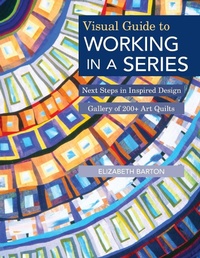
Visual Guide to Working in a Series
Next Steps in Inspired Design * Gallery of 200+ Art Quilts
Published on 29. September 2013
Book
Paperback/Softback
112 pages
978-1-60705-661-4 (ISBN)
Description
Deepen your quilt artistry by creating quilts in a series. This inspiring guide from art quilter Elizabeth Barton is for quilt artists who have mastered the basics and want to explore deeper levels of creativity and skill. Learn how making a series of quilts can help you generate more ideas, find new subtleties in favorite subjects, and build a body of work for shows. Packed with hands-on lessons and examples, this book will transform your work and enlarge your creative vision forever.
Reviews / Votes
Following on from Elizabeth Barton's last book Inspired to Design: Seven Steps to Successful Art Quilts, this book looks at moving your work forward and considers working in a series. The previous book focused on elements of design for art quilts in order to demystify a subject that often causes terror for people who don't know where to start. In that book, there was a lot of useful advice on how to approach a design, from inspiration to creating a visual structure through line, grids and letters and then evaluating your work objectively. This book moves on from that and tackles the subject of how to start looking at creating work in a series. Split into five sections, each covering a specific area, the start of the book is a very useful exercise in planning your series work as it maps out the reasons and benefits of this kind of approach. From developing your own style to exploring an idea more thoroughly, some interesting points are raised. The age-old problem of people feeling they cannot draw is one that is worked around and you don't feel that this is the be-all and end-all of planning art quilts, whether in a series or not. I liked Elizabeth Barton's approach to this subject. She suggests you go back to your previous work and look for common themes, or areas of interest that come up, and how your work is organised visually. From that, the next step is to find a theme for your series, which may come from an object or fabric texture and consider how that fits in with what you want to achieve. The chapters flow into each other and the aim is for the work to evolve in the same way. There is an interesting section on using photo editing software to manipulate your images to create a range of different visuals without altering the cohesiveness of your series. There are a huge number of photographs of art quilts, from the author and other quilters that show their work in this sphere. Different quilts in each series are examined, so that you see what choices were made to change elements of the quilts but retain the identity of the series. This is a really interesting book and offers good guidance for those who want to explore how to work with a larger range but have a common thread running throughout. Samantha Packer-Workshop On The WebMore details
Language
English
Place of publication
Concord
United States
Product notice
Paperback (trade)
Illustrations
211 colour
Dimensions
Height: 280 mm
Width: 216 mm
Thickness: 8 mm
Weight
448 gr
ISBN-13
978-1-60705-661-4 (9781607056614)
Copyright in bibliographic data and cover images is held by Nielsen Book Services Limited or by the publishers or by their respective licensors: all rights reserved.
Schweitzer Classification
Other editions
Additional editions
Elizabeth Barton
Visual Guide to Working in a Series
Next Steps in Inspired Design - Gallery of 200+ Art Quilts
E-Book
12/2013
1st Edition
C&T Publishing
€11.49
Available for download
Person
Elizabeth Barton is a well-known fiber artist who travels, teaches, and makes art quilts. Reflected light, translucency and the effects of time are recurring themes in her work, which is often influenced by her childhood in York, England. Elizabeth lives in Athens, GA. www.elizabethbarton.blogspot.com
Content
Table of Contents
Chapter 1: Thinking
Introduction
Definition of working in a series
Why one should work in a series
When should you work in a series
How long should a series be
Paving the way
Chapter 2: Getting to work: finding your theme
Begin by looking back
Variations on a constant
A central idea
Themeand variations
Form:a simple unit
Form:texture: arashi shibori, monoprinting
Form:line
Content:different views of the same thing
Content:nature
Content:time
Content:narrative
Choosingyour best fit
Considerthe display
Chapter 3: Getting to work: exploring the theme
How to work in a series
Sequentialor simultaneous
Decidingupon a theme
Developingparameters
Deciding on techniques
tracing
sketching in pencil
sketching in watercolor
collage
photocopying
photographing
computer software
Chapter 4: Working the Series: discovering art techniques
developingintuition
strong color schemes and the use of simultaneous contrast
value patterns (chiaroscuro, or Notan)
applying landscape composition painting guidelines to art
the illusion of depth
working from photographs, the problems thereof
the dynamic quilt
focal areas and emphasis
underlying structural patterns
positive and negative space
visual pathways
shibui, the power of the mark of the hand
Chapter 5: Showing Your Work
Qualities to Strive For
Originality
Attention Getting
Strong Composition
Communication of Intention
Mark of the Hand
Good Technique
Energy
Good From a Distance, Better Close Up
Learning from Jurors' Statements
Critique Groups
End Notes
Bibliography
About the Author
Chapter 1: Thinking
Introduction
Definition of working in a series
Why one should work in a series
When should you work in a series
How long should a series be
Paving the way
Chapter 2: Getting to work: finding your theme
Begin by looking back
Variations on a constant
A central idea
Themeand variations
Form:a simple unit
Form:texture: arashi shibori, monoprinting
Form:line
Content:different views of the same thing
Content:nature
Content:time
Content:narrative
Choosingyour best fit
Considerthe display
Chapter 3: Getting to work: exploring the theme
How to work in a series
Sequentialor simultaneous
Decidingupon a theme
Developingparameters
Deciding on techniques
tracing
sketching in pencil
sketching in watercolor
collage
photocopying
photographing
computer software
Chapter 4: Working the Series: discovering art techniques
developingintuition
strong color schemes and the use of simultaneous contrast
value patterns (chiaroscuro, or Notan)
applying landscape composition painting guidelines to art
the illusion of depth
working from photographs, the problems thereof
the dynamic quilt
focal areas and emphasis
underlying structural patterns
positive and negative space
visual pathways
shibui, the power of the mark of the hand
Chapter 5: Showing Your Work
Qualities to Strive For
Originality
Attention Getting
Strong Composition
Communication of Intention
Mark of the Hand
Good Technique
Energy
Good From a Distance, Better Close Up
Learning from Jurors' Statements
Critique Groups
End Notes
Bibliography
About the Author