

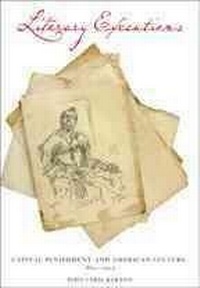
Literary Executions
Capital Punishment and American Culture, 1820-1925
Will be published approx. on 9. September 2014
Book
Hardback
344 pages
978-1-4214-1332-7 (ISBN)
Description
Drawing from legal and extralegal discourse but focusing on imaginative literature, Literary Executions examines representations of, responses to, and arguments for and against the death penalty in the United States over the long nineteenth century. John Cyril Barton creates a generative dialogue between artistic relics and legal history. He looks to novels, short stories, poems, and creative nonfiction as well as legislative reports, trial transcripts, legal documents, newspaper and journal articles, treatises, and popular books (like The Record of Crimes, A Defence of Capital Punishment, and The Gallows, the Prison, and the Poor House), all of which were part of the debate over the death penalty. Barton focuses on several canonical figures-James Fenimore Cooper, Nathaniel Hawthorne, Lydia Maria Child, Walt Whitman, Herman Melville, and Theodore Dreiser - and offers new readings of their work in light of the death penalty controversy.
Barton also gives close attention to a host of then-popular-but-now-forgotten writers - particularly John Neal, Slidell MacKenzie, William Gilmore Simms, Sylvester Judd, and George Lippard - whose work helped shape or was shaped by the influential anti-gallows movement. Analyzing the tension between sovereignty and social responsibility in a democratic republic, Barton argues that the high stakes of capital punishment dramatize the confrontation between the citizen-subject and sovereign authority in its starkest terms. In bringing together the social and the aesthetic, Barton shows how legal forms informed literary forms and traces the emergence of the modern State in terms of the administration of lawful death. By engaging the politics and poetics of capital punishment, Literary Executions contends that the movement to abolish the death penalty in the United States should be seen as an important part of the context that brought about the flowering of the American Renaissance during the antebellum period and that influenced literature later in the nineteenth and early twentieth centuries.
Barton also gives close attention to a host of then-popular-but-now-forgotten writers - particularly John Neal, Slidell MacKenzie, William Gilmore Simms, Sylvester Judd, and George Lippard - whose work helped shape or was shaped by the influential anti-gallows movement. Analyzing the tension between sovereignty and social responsibility in a democratic republic, Barton argues that the high stakes of capital punishment dramatize the confrontation between the citizen-subject and sovereign authority in its starkest terms. In bringing together the social and the aesthetic, Barton shows how legal forms informed literary forms and traces the emergence of the modern State in terms of the administration of lawful death. By engaging the politics and poetics of capital punishment, Literary Executions contends that the movement to abolish the death penalty in the United States should be seen as an important part of the context that brought about the flowering of the American Renaissance during the antebellum period and that influenced literature later in the nineteenth and early twentieth centuries.
Reviews / Votes
An essential new effort to examine the link between literary representation and the death penalty in nineteenth- and early twentieth-century America-a link that historicist criticism has left surprisingly underexplored in all areas of literary study... Barton's study of the death penalty in American literature is rich and wide-ranging... Because of its very carefully contextualized analysis of a range of authors and their approaches to the death penalty, and because the death penalty is so crucial in political and literary history for all the reasons Barton mentions, his book provides a necessary chapter in the historical analysis of nineteenth century American literature. Any scholars interested in death penalty debates-and perhaps everyone should be-will find their own understanding and research enhanced by the breadth of this book and its attention to nuances among political positions. -- Mark Canuel Review 19 A rich account of the formative power that the institution of capital punishment exerted on the construction of the American citizen-subject from colonial times through the 1920s. -- Birte Christ American Literary HistoryMore details
Language
English
Place of publication
Baltimore, MD
United States
Target group
Professional and scholarly
Product notice
sewn/stitched
Paper over boards
Illustrations
1 s/w Abbildung
1 Illustrations, black and white
Dimensions
Height: 226 mm
Width: 155 mm
Thickness: 25 mm
Weight
567 gr
ISBN-13
978-1-4214-1332-7 (9781421413327)
DOI
10.1353/book.32640
Copyright in bibliographic data and cover images is held by Nielsen Book Services Limited or by the publishers or by their respective licensors: all rights reserved.
Schweitzer Classification
Other editions
Additional editions
E-Book
09/2014
Johns Hopkins University Press
€37.99
Available for download
Person
John Cyril Barton is an associate professor of English and director of the Graduate Studies Program at the University of Missouri-Kansas City and coeditor of Transatlantic Sensations.
Content
Acknowledgments
Introduction: The Cultural Rhetoric of Capital Punishment
1. Anti-gallows Activism in Antebellum American Law and Literature
2. Simms, Child, and the Aesthetics of Crime and Punishment
3. Literary Executions in Cooper, Lippard, and Judd
4. Hawthorne and the Evidentiary Value of Literature
5. Melville, MacKenzie, and Military Executions
6. Capital Punishment and the Criminal Justice System in Dreiser's An American Tragedy
Epilogue: "The Death Penalty in Literature"
Notes
Index
Introduction: The Cultural Rhetoric of Capital Punishment
1. Anti-gallows Activism in Antebellum American Law and Literature
2. Simms, Child, and the Aesthetics of Crime and Punishment
3. Literary Executions in Cooper, Lippard, and Judd
4. Hawthorne and the Evidentiary Value of Literature
5. Melville, MacKenzie, and Military Executions
6. Capital Punishment and the Criminal Justice System in Dreiser's An American Tragedy
Epilogue: "The Death Penalty in Literature"
Notes
Index