

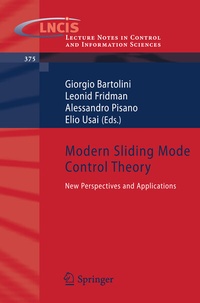
Modern Sliding Mode Control Theory
New Perspectives and Applications
Published on 24. April 2008
Book
Paperback/Softback
XX, 468 pages
978-3-540-79015-0 (ISBN)
Description
This book is a collection of invited chapters covering several areas of modern sliding mode control theory. Preparing this book we tried to identify key c- tributions de?ning the theoretical and applicative state of the art of the sliding mode control theory and the most promising trends of the ongoing research activities. The contributions is divided in four main parts: Part I: Basic Theory. Part II: Design Methods Part III: Observers and Fault Detection Part IV: Applications The ?rst part of the book (Part I: Basic Theory) is devoted to a collection of sixmostlytheoreticalchaptersaddressingbasictheoreticalissuesofsliding-mode based control systems. The ?rst Chapter, by Giorgio Bartolini, Elisabetta Punta, and Tullio Zolezzi, presents new de?nitions of approximability for nonlinear second order sliding mode control systems including the comparison with the related known pr- erties for ?rst order sliding mode control methods. Su?cient conditions are - tainedfor second-orderregularization,a sliding motionerrorestimate is derived, and some relevant examples are discussed.
Chapter 2, by Igor Boiko, Leonid Fridman, Alessandro Pisano, and Elio Usai, developsasystematicapproachtothechatteringanalysisinsystemswithsecond order sliding modes. Su?cient conditions for the existence of orbitally stable periodic motions are found in terms of the properties of corresponding Poincar' e maps. For linear systems driven by the second-order SMC "Generalized Sub- Optimal" algorithm, analysis tools based on the frequency-domain methods are developed. Examples of analysis, worked examples, and simulation results are given throughout the Chapter.
Chapter 2, by Igor Boiko, Leonid Fridman, Alessandro Pisano, and Elio Usai, developsasystematicapproachtothechatteringanalysisinsystemswithsecond order sliding modes. Su?cient conditions for the existence of orbitally stable periodic motions are found in terms of the properties of corresponding Poincar' e maps. For linear systems driven by the second-order SMC "Generalized Sub- Optimal" algorithm, analysis tools based on the frequency-domain methods are developed. Examples of analysis, worked examples, and simulation results are given throughout the Chapter.
More details
Series
Edition
2008 ed.
Language
English
Place of publication
Berlin
Germany
Publishing group
Springer Berlin
Target group
Professional and scholarly
Research
Illustrations
132 s/w Abbildungen
XX, 468 p. 132 illus.
Dimensions
Height: 235 mm
Width: 155 mm
Thickness: 27 mm
Weight
733 gr
ISBN-13
978-3-540-79015-0 (9783540790150)
DOI
10.1007/978-3-540-79016-7
Schweitzer Classification
Other editions
Additional editions
Giorgio Bartolini | Leonid Fridman | Alessandro Pisano
Modern Sliding Mode Control Theory
New Perspectives and Applications
E-Book
04/2008
Springer
€149.79
Available for download
Content
Basic Theory.- Regularization of Second Order Sliding Mode Control Systems.- A Comprehensive Analysis of Chattering in Second Order Sliding Mode Control Systems.- Analysis of Closed-Loop Performance and Frequency-Domain Design of Compensating Filters for Sliding Mode Control Systems.- Discontinuous Homogeneous Control.- Second-Order Sliding Sector for Variable Structure Control.- On Euler's Discretization of Sliding Mode Control Systems with Relative Degree Restriction.- Design Methods.- Circumventing the Relative Degree Condition in Sliding Mode Design.- HOSM Driven Output Tracking in the Nonminimum-Phase Causal Nonlinear Systems.- High Order Sliding Mode Neurocontrol for Uncertain Nonlinear SISO Systems: Theory and Applications.- A Generalized PI Sliding Mode and PWM Control of Switched Fractional Systems.- Stabilization of Nonholonomic Uncertain Systems Via Adaptive Second Order Sliding Mode Control.- Output Tracking with Discrete-Time Integral Sliding Mode Control.- Flatness, Backstepping and Sliding Mode Controllers for Nonlinear Systems.- Observers and Fault Detection.- Observation and Identification Via High-Order Sliding Modes.- High Order Sliding Mode Observers and Differentiators-Application to Fault Diagnosis Problem.- Vehicle Parameter and States Estimation Via Sliding Mode Observers.- An Alternative to the Measurement of Five-Links Biped Robot Absolute Orientation: Estimation Based on High Order Sliding Mode.- Applications.- Robust Orbital Stabilization of Pendubot: Algorithm Synthesis, Experimental Verification, and Application to Swing up and Balancing Control.- Higher Order SM Block-Control of Nonlinear Systems with Unmodeled Actuators: Application to Electric Power Systems and Electrohydraulic Servo-Drives.- Blood Glucose Regulation Via Double LoopHigher Order Sliding Mode Control and Multiple Sampling Rate.- Contact Force Regulation in Wire-Actuated Pantographs.