

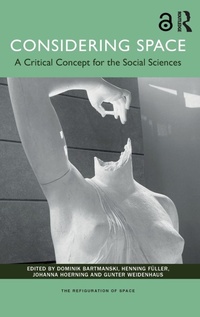
Considering Space
A Critical Concept for the Social Sciences
1st Edition
Published on 15. September 2023
Book
Hardback
284 pages
978-1-032-42088-2 (ISBN)
Description
Considering Space demonstrates what has changed in the perception of space within the social sciences and how useful - indeed indispensable - this category is today.
While the seemingly deterritorializing effects of digitalization might suggest that space is a secondary consideration, this book proves such a presumption wrong, with territories, borders, distances, proximity, geographical ecologies, land use, physical infrastructures - as well as concepts of space - all being shown still to matter, perhaps more than ever before.
Seeking to show how society can and should be perceived as spatial, it will appeal to scholars of sociology, geography, architecture and urban studies.
The Open Access version of this book, available at www.taylorfrancis.com, has been made available under a Creative Commons Attribution-Non Commercial-No Derivatives 4.0 license. Funded by the DeutscheForschungsgemeinschaft (DFG, German Research Foundation) - Projektnummer 290045248 - SFB 1265.
While the seemingly deterritorializing effects of digitalization might suggest that space is a secondary consideration, this book proves such a presumption wrong, with territories, borders, distances, proximity, geographical ecologies, land use, physical infrastructures - as well as concepts of space - all being shown still to matter, perhaps more than ever before.
Seeking to show how society can and should be perceived as spatial, it will appeal to scholars of sociology, geography, architecture and urban studies.
The Open Access version of this book, available at www.taylorfrancis.com, has been made available under a Creative Commons Attribution-Non Commercial-No Derivatives 4.0 license. Funded by the DeutscheForschungsgemeinschaft (DFG, German Research Foundation) - Projektnummer 290045248 - SFB 1265.
Reviews / Votes
'Mixing conceptual exploration and case illustration, this lively volume will make its readers think again and anew about the role of space in social theory and social life.' - Loic Wacquant, Professor of Sociology, University of California Berkeley, USA, author of Bourdieu in the City: Challenging Urban Theory'The idea that space is socially constructed has long been accepted, but it has proved harder to make the case that the social is spatially constructed. This book relishes this challenge, providing new conceptual tools, epistemological advances and empirical evidence. It does so much more than this, though. It provokes us to think about the relationship between socially constructed space and the spatially constructed social. This is a profoundly political task, as this book provides new paths, new opportunities, new affordances for thinking about the current conjuncture, the crisis of crises.' - Steve Pile, Professor of Human Geography, The Open University, UK, author of Bodies, Affects, Politics: The Clash of Bodily Regimes
'There is a thoroughgoing 'spatial turn' taking place in the social sciences right now, one that pervades 'applied' as much as 'theoretical' work... This book excels at bringing to bear the tools of critical reflection onto fundamental spatial concepts and the representational logics on which such concepts are often based. The range of empirical examples is admirable, showing that space ought to be central to theory of social life, not incidental. This collection is of an excellent standard, and its writing first rate.' - Eduardo de la Fuente, Adjunct Senior Lecturer in Sociology, University of South Australia, co-editor of Aesthetic Capitalism and author of Twentieth Century Music and the Question of Modernity
More details
Series
Language
English
Place of publication
London
United Kingdom
Publishing group
Taylor & Francis Ltd
Target group
College/higher education
Postgraduate
Illustrations
10 s/w Abbildungen, 9 s/w Photographien bzw. Rasterbilder, 1 s/w Zeichnung, 1 s/w Tabelle
1 Tables, black and white; 1 Line drawings, black and white; 9 Halftones, black and white; 10 Illustrations, black and white
Dimensions
Height: 240 mm
Width: 161 mm
Thickness: 21 mm
Weight
617 gr
ISBN-13
978-1-032-42088-2 (9781032420882)
Copyright in bibliographic data and cover images is held by Nielsen Book Services Limited or by the publishers or by their respective licensors: all rights reserved.
Schweitzer Classification
Other editions
Additional editions
Dominik Bartmanski | Henning Fueller | Johanna Hoerning
Considering Space
A Critical Concept for the Social Sciences
Book
12/2024
1st Edition
Routledge
€63.70
Shipment within 10-20 days
Dominik Bartmanski | Henning Fueller | Johanna Hoerning
Considering Space
A Critical Concept for the Social Sciences
E-Book
09/2023
1st Edition
Routledge
€0.00
Available for download
Dominik Bartmanski | Henning Fueller | Johanna Hoerning
Considering Space
A Critical Concept for the Social Sciences
E-Book
09/2023
1st Edition
Routledge
€0.00
Available for download
Persons
Dominik Bartmanski is a professor of cultural sociology at Humboldt-Universitaet zu Berlin.
Henning Fueller is a researcher at the Department of Geography, Humboldt-Universitaet zu Berlin.
Johanna Hoerning is a professor of sociology at Technical University Berlin.
Gunter Weidenhaus worked as a guest professor of sociology at the Technical University Berlin.
Henning Fueller is a researcher at the Department of Geography, Humboldt-Universitaet zu Berlin.
Johanna Hoerning is a professor of sociology at Technical University Berlin.
Gunter Weidenhaus worked as a guest professor of sociology at the Technical University Berlin.
Content
1. Introduction: An Invitation to Spatial Theorizing Part I: Considering Space in Social Theory 2. Understanding Social Change: Refigurations; 3. Space in the Theory of Reflexive Modernization: The Location of Subjects from a Cosmopolitan Perspective; 4. Wittgenstein's House: From Philosophy to Architecture to Philosophy; 5. Mapping Assemblages: Analytical Benefits of Thinking with Space; 6. The Invention of the Global: Constitutions of space in theories of globalization Part II: Considering Space in Global Epistemologies 7. Dividing the 'World': Spatial Binaries and the Global Perspective; 8. European Elsewheres: Global Sociologies of Space and Europe; 9. The Refiguration of the Social and the Re-Configuration of the Communal; 10. Caste, Class, and Space: Inequalities in India Part III: Considering Space in Meaning Making 11. A Dangerous Liaison? Space and the Field of Cultural Production; 12. Object Affordances, Space, and Meaning: The Case of Real Estate Staging; 13. Like a Child in a Supermarket: Locational Meanings and Locational Socialization Revisited; 14. Placing Performance into a Distressed Space: The Case of San Berillo; Epilogue