

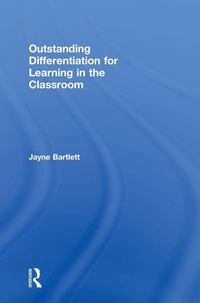
Outstanding Differentiation for Learning in the Classroom
1st Edition
Published on 21. September 2015
Book
Hardback
158 pages
978-1-138-83904-5 (ISBN)
Description
One of the key features of an outstanding lesson is that all learners make progress. All learners are different and teachers must differentiate according to the individual pupil and their individual learning needs to achieve outstanding progress. Outstanding Differentiation for Learning in the Classroom is written with the class teacher in mind and demonstrates how differentiation can be used to enhance and support all aspects of the learning process.
Including chapters on embedding differentiation during each phase of the lesson, assessment and questioning techniques, this book will help you to use differentiation effectively to produce outstanding results. With a strong focus on practical strategies to help you meaningfully apply differentiation in the classroom, this book covers:
what differentiation actually means and why it should be applied in the classroom;
sequencing and planning for learning with an overview of the learning cycle;
practical teaching strategies and effective techniques to use in the classroom;
how to structure and apply differentiation practices in your classroom, department and school.
A vital starting point and effective guide for outstanding differentiation, this timely new book is packed full of practical exercises that are easy to implement in the classroom and it is essential reading for newly qualified and experienced teachers alike.
Including chapters on embedding differentiation during each phase of the lesson, assessment and questioning techniques, this book will help you to use differentiation effectively to produce outstanding results. With a strong focus on practical strategies to help you meaningfully apply differentiation in the classroom, this book covers:
what differentiation actually means and why it should be applied in the classroom;
sequencing and planning for learning with an overview of the learning cycle;
practical teaching strategies and effective techniques to use in the classroom;
how to structure and apply differentiation practices in your classroom, department and school.
A vital starting point and effective guide for outstanding differentiation, this timely new book is packed full of practical exercises that are easy to implement in the classroom and it is essential reading for newly qualified and experienced teachers alike.
More details
Language
English
Place of publication
London
United Kingdom
Publishing group
Taylor & Francis Ltd
Target group
College/higher education
Professional and scholarly
Postgraduate, Professional, Professional Practice & Development, and Undergraduate
Illustrations
3 s/w Photographien bzw. Rasterbilder, 11 s/w Zeichnungen, 8 s/w Tabellen
8 Tables, black and white; 11 Line drawings, black and white; 3 Halftones, black and white
Dimensions
Height: 250 mm
Width: 175 mm
Thickness: 13 mm
Weight
467 gr
ISBN-13
978-1-138-83904-5 (9781138839045)
Copyright in bibliographic data and cover images is held by Nielsen Book Services Limited or by the publishers or by their respective licensors: all rights reserved.
Schweitzer Classification
Other editions
Additional editions
Jayne Bartlett
Outstanding Differentiation for Learning in the Classroom
Book
09/2015
1st Edition
Routledge
€56.60
Shipment within 10-20 days
Jayne Bartlett
Outstanding Differentiation for Learning in the Classroom
E-Book
09/2015
Routledge
€39.49
Available for download
Jayne Bartlett
Outstanding Differentiation for Learning in the Classroom
E-Book
09/2015
Routledge
€39.49
Available for download
Person
Dr Jayne Bartlett has worked in education for over ten years in a range of schools with roles at senior leadership level and is currently working freelance as an independent teaching and learning trainer and consultant.
Content
1. What do we mean by differentiation? 2. Sequencing and planning for learning 3. Differentiation for learning: the start of the lesson 4. Differentiation for learning in the main body of the lesson 5. The final challenge 6. Assessment for learning and differentiation 7. Questioning and differentiation 8. Embedding differentiation Conclusion