

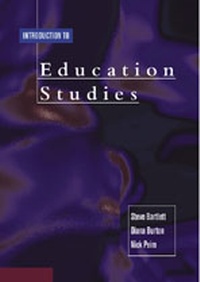
Introduction to Education Studies
1st Edition
Published on 18. July 2001
Book
Hardback
288 pages
978-0-7619-7015-6 (ISBN)
Description
`This fills you in methodically on the background of teaching, including education research on issues such as psychological theory and social aspects' - Ruler
`The authors have provided an important resource for student study in education. Importantly, it reinforces the necessity of a multi-disciplinary approach to the understanding of contested educational process and practices in a contemporary context' - Dave Trotman, Escalate
'It's a paradox of the times that if you take a first degree in education you are unlikely to have much contact with education theory. Today's teacher training is too practical for that. But if your degree is in sports science, drama, philosophy or psychology and the like, it is more than probable that you'll be studying an education module. No bad thing, either: most people go through schooling without questioning what is happening to them.
It's for this second group that An Introduction to Education Studies, edited by Steve Bartlett, Diana Burton and Nick Peim (Paul Chapman Publishing GBP16.99) is written. And very good it is, too. It explains clearly and crisply why education is important and why it will always be contested, what we mean (for example) by "knowledge" and "attainment", and how social issues and perspectives affect educational policies and outcomes. It explains, with a refreshing absence of jargon, why "theory" still matters. It could be useful for students of "education", too - and as a handy work of reference for hard-pressed teachers.
One of its topics is mixed-ability teaching. Current orthodoxy holds that selection and/or ability setting is necessary to maximise pupils' attainment. Orthodoxy, though, is not always firmly founded, and the authors of Ability Grouping in Education (Judith Ireson and Susan Hallam, Paul Chapman Publishing GBP16.99) cite extensive evidence from school and classroom practice to argue that rigid banding or setting may disadvantage weaker pupils' - Michael Duffy, Times Educational Supplement
`Recommended reading for all' - R P Singh, Journal of Educational Planning and Administration
This book is for the undergraduate student of education studies as well as for practitioners embarking on a higher degree.
It provides a grounding for students new to the subject unlike many texts which assume an already high level of knowledge of the area. With extensive experience of teaching and course development at both under-graduate and post-graduate level, the authors use a multidisciplinary approach to the study of education. Drawing on their knowledge of the discipline they synthesize themes in a way which positions education as a study in its own right.
Aspects covered include:
- the nature and purposes of education,
- research in education,
- ideologies and the curriculum,
- social and psychological explanations for pupil/student achievement and
- an analysis of policy developments in compulsory education.
This book will be essential reading for students on educational studies courses.
`The authors have provided an important resource for student study in education. Importantly, it reinforces the necessity of a multi-disciplinary approach to the understanding of contested educational process and practices in a contemporary context' - Dave Trotman, Escalate
'It's a paradox of the times that if you take a first degree in education you are unlikely to have much contact with education theory. Today's teacher training is too practical for that. But if your degree is in sports science, drama, philosophy or psychology and the like, it is more than probable that you'll be studying an education module. No bad thing, either: most people go through schooling without questioning what is happening to them.
It's for this second group that An Introduction to Education Studies, edited by Steve Bartlett, Diana Burton and Nick Peim (Paul Chapman Publishing GBP16.99) is written. And very good it is, too. It explains clearly and crisply why education is important and why it will always be contested, what we mean (for example) by "knowledge" and "attainment", and how social issues and perspectives affect educational policies and outcomes. It explains, with a refreshing absence of jargon, why "theory" still matters. It could be useful for students of "education", too - and as a handy work of reference for hard-pressed teachers.
One of its topics is mixed-ability teaching. Current orthodoxy holds that selection and/or ability setting is necessary to maximise pupils' attainment. Orthodoxy, though, is not always firmly founded, and the authors of Ability Grouping in Education (Judith Ireson and Susan Hallam, Paul Chapman Publishing GBP16.99) cite extensive evidence from school and classroom practice to argue that rigid banding or setting may disadvantage weaker pupils' - Michael Duffy, Times Educational Supplement
`Recommended reading for all' - R P Singh, Journal of Educational Planning and Administration
This book is for the undergraduate student of education studies as well as for practitioners embarking on a higher degree.
It provides a grounding for students new to the subject unlike many texts which assume an already high level of knowledge of the area. With extensive experience of teaching and course development at both under-graduate and post-graduate level, the authors use a multidisciplinary approach to the study of education. Drawing on their knowledge of the discipline they synthesize themes in a way which positions education as a study in its own right.
Aspects covered include:
- the nature and purposes of education,
- research in education,
- ideologies and the curriculum,
- social and psychological explanations for pupil/student achievement and
- an analysis of policy developments in compulsory education.
This book will be essential reading for students on educational studies courses.
More details
Edition
First Edition
Language
English
Place of publication
Thousand Oaks
United States
Target group
College/higher education
Dimensions
Height: 242 mm
Width: 170 mm
Weight
657 gr
ISBN-13
978-0-7619-7015-6 (9780761970156)
Copyright in bibliographic data and cover images is held by Nielsen Book Services Limited or by the publishers or by their respective licensors: all rights reserved.
Schweitzer Classification
Other editions
New editions
Steve Bartlett | Diana Burton
Introduction to Education Studies
Book
06/2007
2nd Edition
SAGE Publications Ltd
€115.32
Article is exhausted; no reprint
Persons
Steve Bartlett is honorary research fellow at Liverpool Hope University. A former Professor of Education Studies and programme leader at the Universities of Wolverhampton and Chester, he led the development of the subject at undergraduate and postgraduate level for many years, chairing the Subject Benchmarking Review Committee for QAA. A founder member and the first Chair of the British Education Studies Association (BESA), he edited the BESA journal for several years. Steve taught Sociology at secondary level for fifteen years from the mid Seventies.
Steve has a Masters and PhD in teacher professionalism and has supervised and examined many doctoral theses as well as externally validating and examining Education Studies at a number of Universities.He has written several education books and articles in the areas of research methods, lifelong learning, teacher development and gender.
Diana Burton is Visiting Professor of Education at the University of Wolverhampton, having formerly led education research at the university. She has held senior leadership and professorial posts at 3 universities, including both Pro Vice-Chancellor for research and Dean of Education posts at Liverpool John Moores University. She was Head of School at Manchester Metropolitan University where she worked for many years leading teacher education programmes having originally been a secondary school teacher of Humanities for over a decade.
Diana has a Masters and PhD in the field of Educational Psychology and continues to examine doctoral theses and advise education departments across the sector. She is the author of several education books and chapters and has written over 70 research articles on pupil learning, teacher development, teacher education policy, educating children with behavioural, emotional and social disadvantage and citizenship education. She is a fellow of the Royal Academy for the Society of the Arts and the Higher Education Academy and is an active member of the British Education Research Association, including as a committee chair.
Steve has a Masters and PhD in teacher professionalism and has supervised and examined many doctoral theses as well as externally validating and examining Education Studies at a number of Universities.He has written several education books and articles in the areas of research methods, lifelong learning, teacher development and gender.
Diana Burton is Visiting Professor of Education at the University of Wolverhampton, having formerly led education research at the university. She has held senior leadership and professorial posts at 3 universities, including both Pro Vice-Chancellor for research and Dean of Education posts at Liverpool John Moores University. She was Head of School at Manchester Metropolitan University where she worked for many years leading teacher education programmes having originally been a secondary school teacher of Humanities for over a decade.
Diana has a Masters and PhD in the field of Educational Psychology and continues to examine doctoral theses and advise education departments across the sector. She is the author of several education books and chapters and has written over 70 research articles on pupil learning, teacher development, teacher education policy, educating children with behavioural, emotional and social disadvantage and citizenship education. She is a fellow of the Royal Academy for the Society of the Arts and the Higher Education Academy and is an active member of the British Education Research Association, including as a committee chair.
Content
The Nature of Education
Researching Education
Knowledge, Beliefs and the Curriculum
Individual Achievement
Major Psychological Theories
Education and Psychological Research
Contemporary Influences
Social Perspectives on Education
The Influence of Social Factors on Achievement
Politics and Policy in Education
Education
A Contested Enterprise
Researching Education
Knowledge, Beliefs and the Curriculum
Individual Achievement
Major Psychological Theories
Education and Psychological Research
Contemporary Influences
Social Perspectives on Education
The Influence of Social Factors on Achievement
Politics and Policy in Education
Education
A Contested Enterprise