

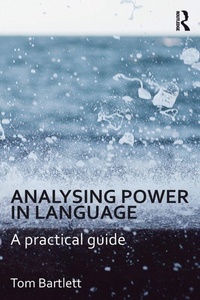
Analysing Power in Language
A practical guide
1st Edition
Published on 14. January 2014
Book
Paperback/Softback
212 pages
978-0-415-66630-5 (ISBN)
Description
Analysing Power in Language introduces students to a range of analytical techniques for the critical study of texts.Each section of the book provides an in-depth presentation of a different method of analysis with worked examples and texts for students to analyse and discuss. Answer keys are also provided for the analyses.
Taking text analysis as the first step in discourse analysis, Analysing Power in Language:
Explores the relationship between the goals of discourse, the social positions of the speakers, the contexts in which they are produced, the audience for which they are intended and the language features chosen
Presents a powerful approach to text analysis that reveals the links between language usage and a community's assumptions, convictions, and understandings
Identifies a range of power types, appropriate to different contexts
Explains and illustrates a social approach to text analysis with important linguistic concepts woven in seamlessly with examples of discourse
Offers concrete guidance in text and discourse analysis with carefully crafted examples and fully illustrated explanations.
Incisive and thought-provoking yet also accessible, Analysing Power in Language will be essential reading for advanced undergraduate, postgraduate and research students studying discourse analysis.
Taking text analysis as the first step in discourse analysis, Analysing Power in Language:
Explores the relationship between the goals of discourse, the social positions of the speakers, the contexts in which they are produced, the audience for which they are intended and the language features chosen
Presents a powerful approach to text analysis that reveals the links between language usage and a community's assumptions, convictions, and understandings
Identifies a range of power types, appropriate to different contexts
Explains and illustrates a social approach to text analysis with important linguistic concepts woven in seamlessly with examples of discourse
Offers concrete guidance in text and discourse analysis with carefully crafted examples and fully illustrated explanations.
Incisive and thought-provoking yet also accessible, Analysing Power in Language will be essential reading for advanced undergraduate, postgraduate and research students studying discourse analysis.
Reviews / Votes
"A rare gem indeed: an accessible introduction to Systemic Functional Linguistics, built on solid theoretical foundations, and yet giving hands-on advice on practical text analysis. Written in a clear and engaging style, the book builds a bridge from text to discourse, and shows readers how to cross it."Gerlinde Mautner, Vienna University of Economics and Business, Austria
""Tom Bartlett's book is a terrific new 'how-to' guide for apprentice discourse analysts. While ambitious in its coverage of linguistic concepts, it remains grounded through diverse and useful exercises for students needing to move from text analysis to the interpretation of the 'magical properties' of language in social context."
Annabelle Lukin, Macquarie University, Australia
"Through an exploration of the contexts and wordings of the speeches of contemporary political, religious and cultural figures, and others, Bartlett presents an accessible framework for text analysis that leads to a critical analysis of discourses of power. His explanations and exercises are engaging and thought-provoking with helpful suggestions for exploring the background of the texts analysed and further reading."
Sheena Gardner, Coventry University, UK
"This book is an engaging, comprehensive and much-needed bridge between the analysis of the specific language used in texts and an understanding of their effects within the historical, cultural and social contexts in which they were produced. Tom Bartlett uses his well-practiced expertise in analysing text as 'gateways' to discourse to breathe life into linguistic analysis, drawing on many examples of real texts and incorporating exercises to scaffold readers into in-depth methods of text and discourse analysis. It is certain to become a treasured textbook for anyone teaching courses in rhetoric, discourse analysis, language studies or communication, and a highly welcome read for those wanting a greater understanding of the relationship between language and power."
Anne McCabe, Saint Louis University, Madrid, Spain
"This book will appeal to both novice and experienced discourse analysts in the academy. Whether learning or teaching discourse analysis, readers will appreciate the pedagogical features of the text. Readers are likely to be inspired by Bartlett's call to provide examples of minority voices making their voices heard by those who have power and control over their lives."
Rebecca Rogers and Kathryn O'Brien, College of Education, University of Missouri-St. Louis, USA in Discourse & Society 26(5)
More details
Language
English
Place of publication
London
United Kingdom
Publishing group
Taylor & Francis Ltd
Target group
College/higher education
Illustrations
14 s/w Tabellen, 10 s/w Abbildungen
14 Tables, black and white; 10 Illustrations, black and white
Dimensions
Height: 234 mm
Width: 156 mm
Thickness: 12 mm
Weight
351 gr
ISBN-13
978-0-415-66630-5 (9780415666305)
Copyright in bibliographic data and cover images is held by Nielsen Book Services Limited or by the publishers or by their respective licensors: all rights reserved.
Schweitzer Classification
Other editions
Additional editions
E-Book
01/2014
1st Edition
Routledge
€65.99
Available for download
E-Book
01/2014
1st Edition
Routledge
€65.99
Available for download
Book
01/2014
1st Edition
Routledge
€207.50
Shipment within 15-20 days
Person
Tom Bartlett is Senior Lecturer in Language and Communication at Cardiff University. His research centres on the relationship between social context and discourse style. This topic is developed in his recent book "Hybrid Voices and Collaborative Change", which examines community participation in local decision making.
Content
Chapter 1: Texts as gateways to discourse analysis; Chapter 2. Ploughing a field (or two); Chapter 3. Construing participation: The speaker as puppeteer; Chapter 4. Interpersonal Meaning: Text as Interaction and Alignment; Chapter 5: Textual meaning: the speaker as weaver; Chapter 6. Space, time and chunks of text; Chapter 7. Voice and hybridity