

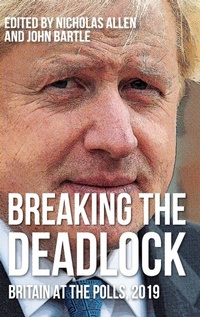
Breaking the Deadlock
Britain at the Polls, 2019
Published on 28. September 2021
Book
Hardback
248 pages
978-1-5261-6278-6 (ISBN)
Description
The 2019 General Election was historic. In one fell swoop it resolved the longstanding stalemate surrounding Brexit and redrew the electoral map of Britain, breaking the deadlock in Parliament and bringing about the fall of Labour's so-called 'Red Wall'.
Since 2016, Members of Parliament had struggled to reconcile a contested exercise in direct democracy with the established institutions of representative government. The 2017 election was meant to bring closure to Brexit. It did not: its indecisive outcome merely exacerbated the challenges. Parliament, the courts and ultimately the Monarch herself became embroiled in the chaos of Brexit. The scale of the Conservatives' definitive victory in December 2020 was therefore a significant departure and a return to the status quo.
This latest edition of a prestigious and venerable series surveys the build up to the tumultuous election and its immediate aftermath, offering reasoned conjecture about the future of British party politics and democracy. -- .
Since 2016, Members of Parliament had struggled to reconcile a contested exercise in direct democracy with the established institutions of representative government. The 2017 election was meant to bring closure to Brexit. It did not: its indecisive outcome merely exacerbated the challenges. Parliament, the courts and ultimately the Monarch herself became embroiled in the chaos of Brexit. The scale of the Conservatives' definitive victory in December 2020 was therefore a significant departure and a return to the status quo.
This latest edition of a prestigious and venerable series surveys the build up to the tumultuous election and its immediate aftermath, offering reasoned conjecture about the future of British party politics and democracy. -- .
Reviews / Votes
'Providing an essential and accessible guide, a stellar group of scholars in this volume...explain the campaign, analyse the results, and consider their meaning.'Pippa Norris, Harvard University
'The volume at hand caps a trio of British elections, ending in the Conservative breaking of the Brexit deadlock. These distinguished electoral scholars take the reader down all sorts of lively paths.'
Michael S. Lewis-Beck, University of Iowa
'Readers outside the UK who want to keep up with British politics will find Breaking the deadlock an ideal one-volume fount of insight into the historic 2019 election.'
Jack Nagel, University of Pennsylvania -- .
More details
Language
English
Place of publication
Manchester
United Kingdom
Target group
College/higher education
Professional and scholarly
Illustrations
44 black & white figures; 16 tables
Dimensions
Height: 240 mm
Width: 161 mm
Thickness: 18 mm
Weight
534 gr
ISBN-13
978-1-5261-6278-6 (9781526162786)
Copyright in bibliographic data and cover images is held by Nielsen Book Services Limited or by the publishers or by their respective licensors: all rights reserved.
Schweitzer Classification
Other editions
Additional editions
E-Book
10/2021
1st Edition
Manchester University Press
€44.99
Available for download
Persons
Nicholas Allen is Professor of Politics at Royal Holloway, University of London
John Bartle is Professor of Government at the University of Essex -- .
John Bartle is Professor of Government at the University of Essex -- .
Content
Preface
1 Deadlock: minority government and Brexit - Nicholas Allen
2 The Conservative Party: the victory of the Eurosceptics - Thomas Quinn
3 The Labour Party: leadership lacking - Paul Whiteley, Patrick Seyd and Harold D. Clarke
4 The two-party system: 'all else is embellishment and detail' - John Bartle
5 A changing electorate: new identities and the British 'culture war' - Maria Sobolewska
6 Why did the Conservatives win? - Robert Johns
7 2019: A critical election? - Jane Green
8 Comparative perspectives - Sarah Birch
Appendix: Results of British general elections, 1945-2019
Index -- .
1 Deadlock: minority government and Brexit - Nicholas Allen
2 The Conservative Party: the victory of the Eurosceptics - Thomas Quinn
3 The Labour Party: leadership lacking - Paul Whiteley, Patrick Seyd and Harold D. Clarke
4 The two-party system: 'all else is embellishment and detail' - John Bartle
5 A changing electorate: new identities and the British 'culture war' - Maria Sobolewska
6 Why did the Conservatives win? - Robert Johns
7 2019: A critical election? - Jane Green
8 Comparative perspectives - Sarah Birch
Appendix: Results of British general elections, 1945-2019
Index -- .